
In the vast and ever-expanding digital landscape, new Top-Level Domains (nTLDs) have introduced an unprecedented level of specificity and choice. Unlike traditional TLDs like .com or .org, many nTLDs are designed with inherent geographic or linguistic characteristics, leading to fascinating patterns in their global adoption. Understanding these patterns is crucial for businesses, domain investors, and anyone interested in the evolving geography of the internet. A key concept in this analysis is ‘skew,’ which helps us quantify the degree to which an nTLD’s registration is concentrated in a particular country.
Every nTLD, by its very nature, carves out its own unique digital geography. This is primarily influenced by language, a powerful determinant of user preference and market relevance. Consider, for example, the Spanish nTLD .VIAJES (meaning “travels”). It finds a natural and viable market throughout Latin America and other Spanish-speaking regions, resonating with a large, culturally unified audience. In stark contrast, .IMMOBILIEN (“real estate”) is predominantly registered within German-speaking Europe, a reflection of its specific linguistic and industry focus. Similarly, .TIENDA (“shop” or “store”) and .FUTBOL (“football”) tend to see higher registration rates in Spanish-speaking nations, where these terms hold direct cultural and commercial relevance. It would indeed be an anomaly if the Arabic nTLD .شبكة (meaning “network”) were not primarily concentrated in the Middle East, given the linguistic demographics of the region.
Demystifying Skew: Quantifying Geographic Concentration
When an nTLD and a specific country show an unusually strong association in registration rates, we refer to this phenomenon as “skew.” We say the TLD skews towards that country, or vice versa, indicating a disproportionate number of registrations originating from that particular location relative to global averages. This metric provides invaluable insight into the geographic distribution and market penetration of nTLDs.
To precisely measure this phenomenon, we use the following definition for Skew:
Skew = (TLD % of Country) / (TLD % of World) = (Country % of TLD) / (Country % of World)
Let’s break down this formula for clarity. The “TLD % of Country” represents the percentage of a specific nTLD’s total registrations that originate from a given country. The “TLD % of World” is the percentage of all global nTLD registrations that belong to that specific nTLD. Alternatively, the formula can be expressed as “Country % of TLD,” which is the percentage of a country’s total domain registrations that are for the specific nTLD, divided by “Country % of World,” representing the percentage of all global domain registrations originating from that country. Both calculations yield the same Skew value, offering a robust measure of relative concentration. A Skew value of 1.0 indicates that the TLD’s registration in that country is perfectly proportional to its global presence. A Skew greater than 1.0 signifies overrepresentation, meaning the TLD is more popular in that country than its global average suggests. Conversely, a Skew less than 1.0 indicates underrepresentation.
For a detailed reference on specific skew data, you can consult this table of Skew data. In our previous article, we extensively analyzed Skew for GEO nTLDs – suffixes explicitly defined by a locality, such as .LONDON, .BRUSSELS, and .WALES. These geographic TLDs inherently exhibit very high skew due to their targeted nature. While language is another significant driver of skew, its effect can vary widely. For instance, Vietnamese is primarily spoken in one country, leading to highly localized TLDs. German is prominent in three countries, offering a slightly broader but still concentrated appeal. Spanish, with its wider global distribution across many nations, will naturally show a more dispersed pattern. English, being a near-ubiquitous global lingua franca, is expected to exhibit even less skew than languages with more regional limitations, a hypothesis we will explore further.
Visualizing Skew: Interpreting the Histograms
To better understand these patterns, we utilize histograms to visualize the distribution of Skew values across various TLD/Country pairs. The first histogram below illustrates the general skew patterns among non-GEO nTLDs.
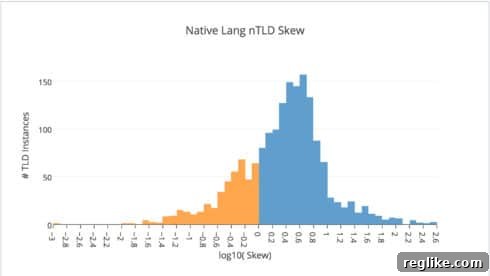
Do not be deterred by the logarithmic axis; it simply allows us to display a wide range of values effectively. To interpret the Skew values, refer to this key:
| Skew | 0.001 | 0.01 | 0.1 | 1.0 | 10 | 100 | 1000 |
| Log10(Skew) | -3 | -2 | -1 | 0 | 1 | 2 | 3 |
The image above straightforwardly counts how many nTLD/Country pairs exhibit a higher-than-usual co-occurrence. When Skew = 100, it means that the TLD is registered in that country at 100 times the global average rate. This appears as Log10(Skew) = 2.0, because 10 raised to the power of 2 equals 100. If the logarithmic scale seems complex, remember these essential facts:
- The blue region of the histogram highlights cases with a positive bias, meaning the TLD is overrepresented in a particular country.
- A tall peak indicates that a significant number of TLD/Country pairs share that specific Skew value, suggesting a common level of geographic concentration.
- The larger the number on the right side of the axis (higher Log10(Skew)), the more intense and pronounced the positive bias and localization effect.
It’s important to note that we generally exclude GEO nTLDs from these general analyses because they inherently possess Skew values as high as 1000 or more, distorting the typical distribution of other nTLDs. Among non-GEOs, it’s quite rare to observe a Skew value reaching 100. When any skew is present, it typically falls below 10 – which explains why most of the blue region in the histogram is concentrated between Log10(Skew) = 0 (Skew = 1, i.e., no bias) and 1.0 (Skew = 10).
The Impact of Native Language nTLDs
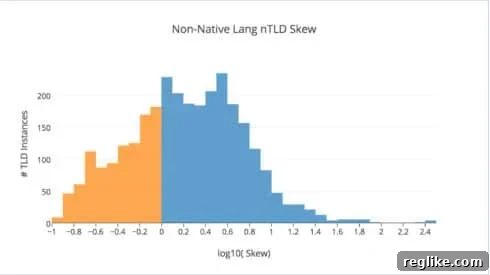
Now, let’s compare the histogram above with the one below, which specifically focuses on nTLDs that are in a country’s native language. The difference is striking: observe how much higher the blue peak is for native language nTLDs. This comes as no surprise; it’s a natural inclination for registrants to gravitate towards domain suffixes in their native language, as it fosters a stronger sense of identity, cultural relevance, and direct communication with their target audience. Conversely, registrants tend to shy away from suffixes in foreign languages unless there’s a specific strategic reason.
English vs. Non-English nTLDs: A Global Divide
The insights become even more profound when we divide nTLDs into English and non-English categories. This separation reveals distinct patterns in how language influences global distribution and local concentration.
English nTLDs: The Lingua Franca Effect
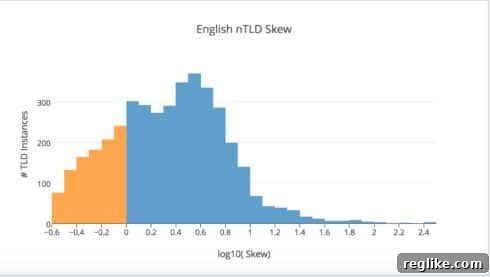
For English nTLDs, the histogram confirms a more dispersed registration pattern globally. Again, most of the blue region falls between Log10(Skew) = 0 (Skew = 1) and 1.0 (Skew = 10). This indicates that English suffixes are rarely registered by any single country at a rate more than 10 times the global average. Typically, when some degree of skew is present, it ranges between Skew = 1.0 (representing proportional distribution) and Skew = 10 (a moderate level of concentration).
While English nTLDs generally show lower skew, there are indeed exceptions where an English nTLD is highly overrepresented in specific countries. For example, the Cayman Islands show a remarkable Skew of 277.1 for .PROPERTY, and Ireland exhibits a Skew of 113.8 for .ORGANIC. These cases often reflect unique economic, industry, or cultural niches within those countries. However, the vast majority of English nTLDs show more moderate skew, similar to India / .EDUCATION (Skew = 2.8) or New Zealand / .FISHING (Skew = 2.8). In these instances, the TLDs are registered at a rate 2.8 times higher than the global norm for those countries, yet this is nowhere near the extreme Skew values (approaching 1000) seen in highly localized GEO nTLDs such as Ireland / .IRISH or South Africa / .CAPETOWN.
This phenomenon underscores English’s role as a global lingua franca. Its universality means that an English nTLD doesn’t necessarily require English to be the native language of a country to achieve a relatively high Skew. For instance, consider Norway / .GOLF (Skew = 96.3), Greece / .VILLAS (Skew = 75.7), or the Czech Republic / .CLOUD (Skew = 72.0). In these examples, English serves as a widely understood language in specific sectors (tourism, technology, sports), allowing these nTLDs to resonate strongly even in non-English speaking nations, demonstrating global appeal and industry relevance.
Non-English nTLDs: A Strong Affinity for Localization
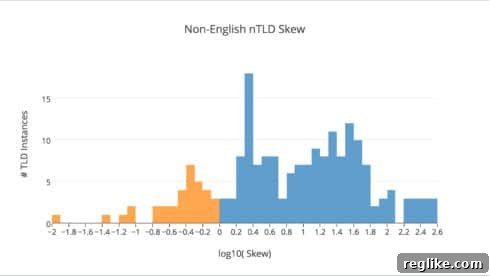
Now, let’s turn our attention to what happens with non-English suffixes. It’s important to acknowledge that other languages are well represented in the nTLD program, with suffixes catering to French, Spanish, German, Chinese, Russian, and many other linguistic communities. It is not an assertion that “foreign” nTLDs are unsuccessful. On the contrary, they serve critical roles in specific markets. However, the data makes it abundantly clear that registrations in non-English suffixes are overwhelmingly more locally skewed. In fact, non-English nTLDs are found to be overrepresented by a factor ranging from 10.0 to 353.6 more than half the time when compared to their global distribution. This indicates a profound and intensified localization effect, where these TLDs are predominantly registered within their respective linguistic and cultural zones.
Conclusion: The Distinct Geographies of English and Non-English nTLDs
The analysis of nTLD skew, particularly through the lens of language, reveals a compelling truth about the global domain market. English nTLDs, benefiting from English’s status as a universal language for business, technology, and international communication, are registered more uniformly across the globe. Their appeal transcends geographical and native linguistic boundaries, leading to a broader, more even distribution of registrations. In essence, they cater to a global audience that often uses English as a common denominator.
Conversely, non-English nTLDs exhibit a significantly higher degree of localization. Their success is often tied to strong cultural identities, specific linguistic communities, and targeted regional markets. While English nTLDs aim for a more horizontal, widespread adoption, non-English nTLDs thrive vertically within their designated linguistic ecosystems. This fundamental distinction highlights how language, whether as a global connector or a cultural identifier, is a paramount factor shaping the unique geographies and adoption patterns of new Top-Level Domains in the digital world. Understanding these skew patterns is not merely an academic exercise; it offers critical strategic insights for brand owners, marketers, and registrars seeking to optimize their domain portfolios and reach their intended audiences effectively in an increasingly diversified online environment.