
GoDaddy’s Innovative Patent: Revolutionizing Domain Name Suggestions from Free Text
In the dynamic world of online presence and digital identity, selecting the perfect domain name is often the first, and arguably one of the most crucial, steps for any individual or business embarking on their online journey. Recognizing the complexities and challenges inherent in this decision-making process, industry giant GoDaddy (NYSE: GDDY) has once again demonstrated its commitment to innovation. The company recently saw the publication of a significant patent application titled “Recommending Domains from Free Text,” a groundbreaking development poised to transform how users discover and secure their ideal web addresses.
A Strategic Evolution in Domain Recommendation Technology
The newly published patent application, filed on December 18, 2020, and made public by the US Patent and Trademark Office, represents a continuation of GoDaddy’s long-standing interest in sophisticated domain suggestion technology. Notably, GoDaddy had previously filed a similar application in 2018, which was subsequently abandoned. This strategic re-filing and expansion underscore the company’s persistent vision and refined approach to leveraging advanced algorithms for a more intuitive user experience. The PDF document detailing the patent application offers an in-depth look at the proposed system.
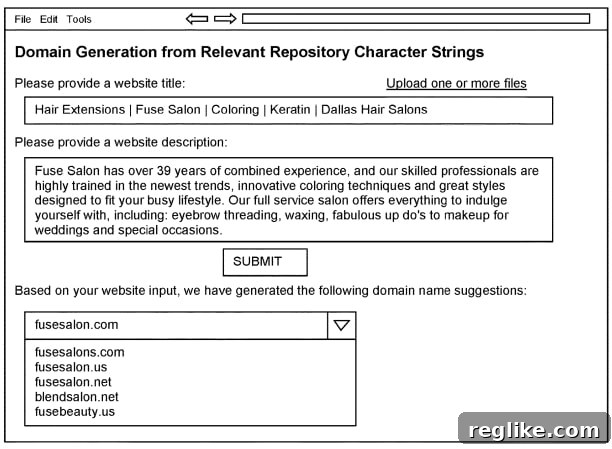
At its core, the patent describes an intelligent system designed to propose highly relevant domain names based on “free form text” supplied by the user. This innovative approach moves beyond simple keyword matching, delving into a deeper understanding of the user’s intent and content. Imagine a scenario where, instead of struggling to brainstorm available domain names, a user simply inputs a description of their business, an “about us” section, or even a detailed project proposal. GoDaddy’s patented system would then analyze this unstructured text, identifying core concepts and filtering out irrelevant noise to present a curated list of suitable domain options.
Understanding the Mechanics: How Free Text Translates to Perfect Domains
The fundamental premise of GoDaddy’s patent lies in its ability to extract meaning from natural language. This is a significant leap from traditional domain suggestion tools that often rely on basic keyword combinations or dictionary lookups. The detailed methodology outlined in the patent application highlights a multi-step process:
- User Input Analysis: The system begins by receiving user-supplied free text. This could range from a paragraph describing a small business, content intended for a website’s landing page, or even specific sections like an “about us” page, as suggested in the application.
- Keyword Identification and Extraction: Utilizing advanced natural language processing (NLP) techniques, the system scans the provided text to identify a broad collection of keywords and phrases. These are the building blocks from which potential domain names will be derived.
- Concept Mainstay Identification: Crucially, the system doesn’t just list keywords; it intelligently sifts through them to identify the “main concept” or overarching theme of the text. This involves a sophisticated understanding of context and semantic relationships.
- Irrelevant Concept Elimination: To ensure the generated domain names are concise, memorable, and highly relevant, the system is designed to prune out extraneous information. This includes, but is not limited to, common “stop words” (e.g., “a,” “the,” “is”), grammatically incorrect phrases that don’t contribute to core meaning, and terms or phrases that are universally common to almost all websites (e.g., “contact us,” “privacy policy,” “terms and conditions”). By filtering these out, the focus remains on unique and differentiating aspects of the user’s input.
- Meaningful Domain Generation: Once the relevant core concepts are identified and refined, the system then leverages these insights to generate meaningful domain name recommendations. This could involve various techniques such as combining keywords, suggesting synonyms, adding industry-specific prefixes or suffixes, and checking for availability across various top-level domains (TLDs). The ultimate goal is to offer domain names that are not only available but also shorter, more memorable, and perfectly aligned with the user’s original intent.
This excerpt from the patent application succinctly captures the essence of this intelligent filtration process and its ultimate objective:
Once the user hosting account is established, the user may upload the files to the repository, or otherwise transfer the files through the network for storage. The disclosed system may then use the provided user input, and/or content within the provided files, to automatically identify the main concept from a collection of identified keyword within the rich amount of text contents, while eliminating other irrelevant concepts. These irrelevant concepts may include, as non-limiting examples, stop words, grammatically incorrect phrases, and terms or phrases common to all websites (e.g., “about us”).
Thus, the disclosed system determines how to generate meaningful domain name recommendations based on relevant concepts, which also remove irrelevant keywords or phrases, thereby providing one or more domain names that are shorter and easier for the user to remember.
Beyond Keywords: The Power of Context and AI in Domain Selection
The innovation described in GoDaddy’s patent goes far beyond mere algorithmic suggestions. It represents a significant step towards integrating artificial intelligence and machine learning into the foundational process of establishing an online presence. By understanding the context and core message of a user’s free text input, the system can:
- Reduce User Frustration: The often tedious and challenging task of finding an available and suitable domain name is simplified dramatically. Users can focus on their business idea or website content, letting the system handle the complexities of domain selection.
- Enhance Brand Identity: By suggesting names that are directly derived from the core concepts of the user’s input, the system helps create domain names that are inherently more relevant and reflective of the brand or personal identity, fostering stronger recall and recognition.
- Promote Shorter, More Memorable Domains: The explicit goal of filtering out irrelevant words and concepts is to produce domain names that are concise. Shorter domains are easier to type, share, and remember, contributing to better user experience and stronger SEO.
- Offer Diverse and Creative Suggestions: Leveraging a deep understanding of the text, the system can potentially unearth creative and unique domain possibilities that a user might not have considered through manual brainstorming or simple keyword searches.
Implications for GoDaddy, Users, and the Domain Industry
This patent application has profound implications across several fronts:
For GoDaddy: Solidifying Industry Leadership
As the world’s largest domain registrar, GoDaddy continually seeks to add value to its extensive suite of services. This patent reinforces its position as an innovator, enhancing its core offering by making domain registration more intelligent and user-friendly. Such advanced tools can attract new customers and retain existing ones by providing a superior experience compared to competitors who might still rely on more rudimentary suggestion methods. It also positions GoDaddy as a leader in applying cutting-edge AI and NLP to practical digital solutions, potentially driving increased domain registrations and associated hosting and website builder service uptake.
For Users: Simplifying the Online Journey
For millions of entrepreneurs, small business owners, and individuals, the process of choosing a domain name can be daunting. This technology has the potential to democratize website creation by removing a significant barrier to entry. Users can articulate their vision in plain language, and the system guides them to an optimal digital identity. This means less time spent brainstorming and more time building their actual online presence, leading to faster launch times and a more seamless initial setup experience.
For the Domain Industry: Raising the Bar
GoDaddy’s patent could set a new benchmark for domain recommendation tools across the entire industry. Competitors may be compelled to develop similar intelligent systems, fostering a new wave of innovation in how domains are discovered and registered. This could lead to a more sophisticated and user-centric approach to domain management overall, benefiting end-users across various platforms and registrars. Furthermore, by making it easier to find relevant and memorable domains, it could slightly shift the dynamics of the secondary domain market by reducing the pressure on highly generic or ultra-short domains if compelling, contextually relevant alternatives become readily available.
The Future of Digital Identity and AI Integration
This patent is a testament to the increasing role of artificial intelligence and machine learning in simplifying complex digital tasks. As the internet continues to grow and evolve, so too does the importance of a strong, recognizable, and relevant online identity. GoDaddy’s commitment to refining its domain recommendation technology through this patent reflects a forward-thinking approach to empowering users in their digital endeavors.
One can envision future iterations of such a system becoming even more sophisticated, perhaps integrating with social media profiles, business registration data, or even user behavior patterns to provide hyper-personalized recommendations. The ability to automatically discern the essence of a user’s project from unstructured text is a powerful capability that extends beyond just domain names, potentially influencing content suggestions, SEO optimization, and overall digital marketing strategies.
In conclusion, GoDaddy’s published patent application for “Recommending Domains from Free Text” signifies a pivotal moment in the evolution of domain name registration. By leveraging advanced NLP and intelligent filtering mechanisms, the company aims to transform a traditionally challenging process into an intuitive and efficient experience. This innovation not only strengthens GoDaddy’s position as a market leader but also promises to empower countless individuals and businesses to establish their online presence with greater ease, relevance, and impact, ultimately shaping the future of digital identity creation for years to come.