
Revolutionizing Domain Discovery: A Deep Dive into GoDaddy’s New Refinement Tool
Finding the perfect domain name in today’s crowded digital landscape can feel like searching for a needle in a haystack. With millions of domains already registered and countless new ones appearing daily, the quest for a memorable, brand-aligned, and available web address is a significant challenge for individuals and businesses alike. Traditionally, domain registrars have relied on basic keyword searches, leaving much to interpretation and often resulting in frustration when a desired name is unavailable.
GoDaddy, a leading player in the domain registration industry, is tackling this pervasive problem head-on with an innovative new feature designed to extract more specific user intent. This tool aims to move beyond simple keyword matching, delving into a user’s unique needs to provide more tailored and relevant domain name suggestions. By gathering additional, contextual information, GoDaddy seeks to significantly enhance the domain discovery experience, making the process less daunting and more fruitful for its customers.
The Challenge of Understanding User Intent in Domain Search
The core difficulty for any domain registrar lies in bridging the gap between a user’s vague initial keyword and their precise vision for an online presence. A search for “marketing,” for instance, could mean anything from a digital marketing agency to a personal branding blog, or even a local marketing consultant. Without further context, the suggestions provided by standard search algorithms are often generic, broad, or irrelevant. This often leads to users performing multiple searches, tweaking keywords endlessly, and ultimately settling for a less-than-ideal domain or giving up altogether.
The scarcity of prime, short, and easily recallable .com domains further exacerbates this issue. As the internet matured, many intuitive names were quickly snapped up. This forces users to get creative, adding prefixes, suffixes, or trying less common TLDs. A smarter suggestion engine, one that understands the *purpose* behind the search, becomes an invaluable asset in navigating this complex environment. GoDaddy’s new “refine” feature is a promising step towards achieving this deeper understanding, aiming to unlock a broader spectrum of relevant, available, and potentially premium domain options that a user might not have considered otherwise.
Introducing GoDaddy’s Intelligent “Refine” Feature
GoDaddy’s new domain refinement tool is intuitively integrated into the existing search flow, activating precisely when a user encounters the common roadblock of an unavailable domain. Instead of merely displaying a “domain taken” message and offering generic alternatives, the system now presents a prominent “refine” button. This subtle addition signals a shift towards a more proactive and personalized domain search experience.
Upon clicking the “refine” button, users are directed to a structured form designed to gather more specific details about their domain needs. This form systematically prompts for several key pieces of information:
- Keywords: Beyond the initial search, users can add more descriptive terms related to their project or business.
- Business Category: A fixed, yet extensive list of business categories allows users to classify their venture, providing crucial context.
- Location: Users can input a city name or a zip code, indicating a desire for geo-specific domains or services.
- Your Name: While seemingly minor, this could potentially assist in personal branding domain suggestions.
This multi-faceted input allows GoDaddy’s algorithm to construct a far more comprehensive profile of the user’s intent. Instead of just “hockey,” the system can now process “hockey, sports gear, retail, Chicago, John Doe,” enabling it to generate suggestions that are not only relevant to hockey but also to sports retail, local businesses in Chicago, or even personal branding. The goal is clear: to leverage this enriched data to generate highly customized domain name choices, thereby increasing the likelihood of a successful and satisfying domain registration.
Here’s an illustration of the “refine” button appearing when a domain is unavailable:

Putting the Refinement Tool to the Test: Case Studies
To truly evaluate the efficacy of this promising new feature, it’s essential to examine its performance through practical examples. The initial tests reveal both the immense potential and areas requiring further development. The goal is to see if the tool can indeed translate richer input into smarter suggestions.
Case Study 1: The Hockey.com Experiment
My initial search began with the highly sought-after domain, “Hockey.com.” Unsurprisingly, it was unavailable. This led me to click the “refine” button, where I provided additional information to guide the suggestion engine. For this test, I specified “hockey” as a keyword and selected “Hockey” as the business category. The intent was clear: I was looking for domains related to the sport of hockey.
The input I provided looked something like this:
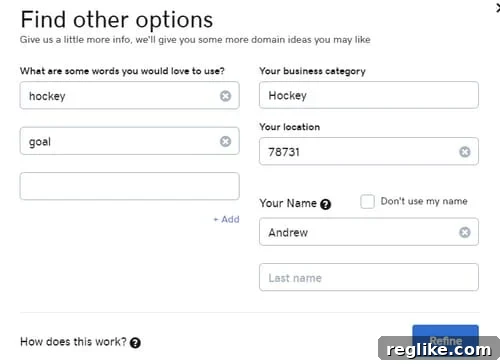
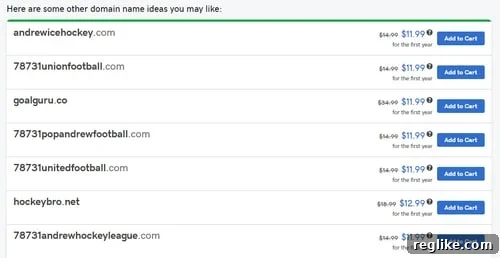
The results generated by the tool were interesting but also highlighted areas needing refinement. While many suggestions were indeed hockey-related, a noticeable number of suggestions were for “football.” This discrepancy is puzzling, especially given the clear and specific inputs. It suggests a potential over-reliance on broad sports categories or a semantic linking that erroneously connects two distinct sports. An ideal algorithm should prioritize the most specific category provided by the user, ensuring that “hockey” doesn’t inadvertently lead to “football” unless explicitly intended or contextually relevant (e.g., a “multi-sport” business).
Furthermore, while I entered location data (a zip code in this instance), the output did not visibly incorporate corresponding city names into the suggestions, or prioritize local domains. Leveraging location data effectively could unlock hyper-local domain suggestions (e.g., “ChicagoHockeyShop.com” or “AustinHockeyLeague.net”), which would be immensely valuable for small businesses and community organizations. This aspect represents a missed opportunity for enhanced personalization and relevance.
Here are the results from the Hockey.com refinement:
Case Study 2: The Juice.land Enigma
For a second test, I searched for “juice.land,” a more niche domain. After it was unavailable, I proceeded to the refinement form. My inputs were carefully chosen: I selected “juice bar” as the business category and included “bar” as one of the keywords, alongside “juice.” The intention was to find domains relevant to a juice bar business.
The refinement data submitted for the “juice.land” search was as follows:
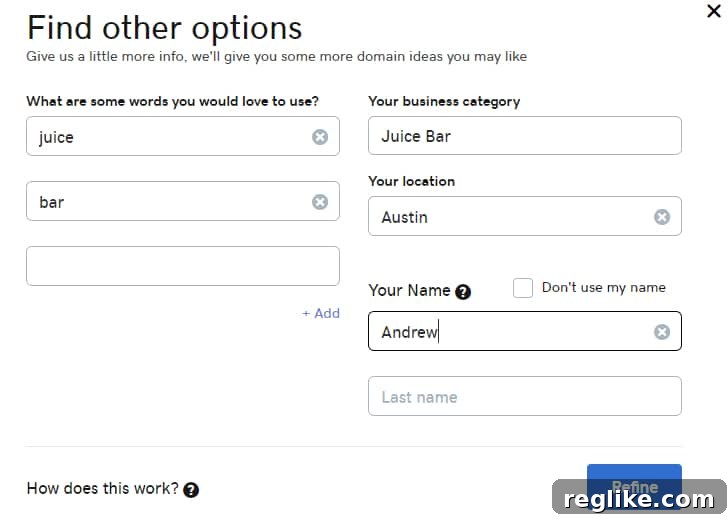
Surprisingly, this specific combination of inputs yielded no results. This “no results” outcome for a clearly defined business type (juice bar) and relevant keywords is perplexing. It suggests a potential conflict or over-filtering within the algorithm when multiple keywords, especially one like “bar” which can have negative connotations in some contexts, are combined with a specific category. It’s possible the system interpreted “bar” too broadly or flagged it, leading to the null output.
To investigate further, I went back and removed “bar” from the keywords, keeping “juice bar” as the category. This small adjustment immediately produced a list of domain suggestions. This indicates that the keyword “bar” was likely interfering with the search logic, despite being directly relevant to the chosen business category. This highlights a critical area for improvement: the algorithm needs to be more intelligent in how it interprets and prioritizes keywords in conjunction with explicit category selections. An intuitive system should understand that “bar” within the context of “juice bar” is entirely appropriate.
A positive observation from this test was the inclusion of many domains ending in “.land” among the suggestions after removing “bar.” This confirms that the refinement tool does effectively integrate data from the original search query (“juice.land”) into its expanded suggestions, ensuring continuity and relevance based on the user’s initial interest in specific TLDs.
Strengths and Promising Aspects of the GoDaddy Refinement Tool
Despite the areas needing improvement, the underlying concept of GoDaddy’s refinement tool is genuinely innovative and addresses a critical pain point in domain registration. Several aspects demonstrate its potential to revolutionize domain discovery:
1. Innovative Approach to User Intent
The most significant strength is the commitment to understanding deeper user intent. By moving beyond a single keyword, GoDaddy is attempting to build a more contextual and user-centric search experience. This proactive approach sets it apart from traditional domain search tools and is a necessary evolution in the crowded domain market.
2. Integration of Original Search Data
The tool’s ability to seamlessly incorporate elements from the original, unavailable domain search (such as the “.land” TLD in the second case study) is a smart design choice. This ensures that the refinement process doesn’t completely disregard the user’s initial preferences but rather builds upon them, leading to more consistent and relevant suggestions.
3. Broad Domain Name Inclusion, Including Premium Options
The refinement tool doesn’t limit its suggestions to standard available domains. It also thoughtfully integrates premium domain names, often sourced from platforms like AfternicDLS. This is a considerable advantage, as premium domains, while pricier, often offer superior branding potential, shorter names, and higher memorability. Providing these options within the same search flow saves users time and exposes them to a wider spectrum of high-quality choices they might not otherwise discover.
4. Potential for Hyper-Personalization
Once fully optimized, the ability to combine keywords, business categories, and location data offers unprecedented opportunities for hyper-personalized domain suggestions. This could lead to highly targeted recommendations for local businesses, niche communities, or specific industry ventures, greatly simplifying the search for a truly relevant and brandable online identity.
Areas for Improvement and Future Development
While the concept is strong, the initial tests highlight several key areas where the refinement tool could benefit from further development to reach its full potential:
1. Enhancing Algorithmic Logic and Keyword Interpretation
The most critical area for improvement lies in the algorithm’s interpretation of keywords and their interaction with specified business categories. The “hockey leading to football” and “juice bar with ‘bar’ keyword yielding no results” issues indicate a need for more nuanced semantic understanding. The algorithm should prioritize exact category matches and understand context within compound terms or categories. This could involve more sophisticated natural language processing (NLP) to ensure keywords are interpreted as intended within their given context.
2. Maximizing Location Data Utility
The current implementation of location data (zip code/city) appears underutilized. The tool should intelligently convert zip codes to city names and prioritize domains that are geographically relevant. This could mean suggesting domains with local city names, state abbreviations, or even country-code TLDs (ccTLDs) if the user’s location makes it relevant. For example, a search for a “bakery” in “London” should yield suggestions like “LondonBakery.co.uk” or “BestBunsLondon.com.”
3. Providing Transparency and Feedback Mechanisms
A small enhancement could be providing a brief explanation for certain suggestions, or for when no results are found. For instance, if “football” appears for a “hockey” search, a tooltip explaining “related sports category” might alleviate confusion. Furthermore, integrating a “thumbs up/down” or “report irrelevant suggestion” feedback mechanism could allow the tool to learn and improve directly from user interaction.
4. Streamlining User Experience and Input Validation
While the form is straightforward, continuous improvement in UX can always be made. Perhaps dynamic suggestions for categories based on initial keywords, or real-time validation for complex keyword combinations, could prevent scenarios like the “no results” from the “juice bar” test. Ensuring a seamless and intuitive input process is crucial for user adoption.
5. Expanding and Dynamizing Categories
While the business category list is “big,” relying on a fixed list can sometimes limit scope. Exploring dynamic category suggestions or even allowing users to propose new categories for review could further enhance the tool’s adaptability and relevance across a wider range of niche industries.
The Future of Domain Name Search: A Personalized Journey
GoDaddy’s refinement tool represents a significant leap forward in the domain discovery process. It acknowledges that finding a domain name is no longer a simple transaction but a journey of branding and identity formation. As artificial intelligence and machine learning technologies continue to advance, we can expect such tools to become even more sophisticated, capable of understanding complex queries, learning from user preferences over time, and offering highly curated suggestions that perfectly align with a user’s vision.
The evolution of domain search will undoubtedly move towards hyper-personalization, where registrars act as intelligent guides rather than mere database query engines. GoDaddy’s initiative, despite its current need for refinement, paves the way for a future where finding the ideal domain name is less about luck and more about intelligent, contextual assistance.
Conclusion
In conclusion, GoDaddy’s new domain name refinement tool is an excellent concept with tremendous potential. It bravely tackles a long-standing challenge in the domain industry: understanding the nuanced intent behind a user’s search. The ability to collect additional contextual information, such as business categories and location, marks a significant step towards a more intelligent and user-friendly domain discovery experience.
While the initial implementation reveals areas that require further development, particularly concerning algorithmic logic, keyword interpretation, and comprehensive utilization of location data, the core idea is undeniably sound. The issues encountered are typical of early-stage AI-driven features and can be addressed through iterative improvements and continuous learning. As GoDaddy continues to refine this tool, it holds the promise of transforming how individuals and businesses find their digital homes, making the daunting task of domain registration a far more intuitive and rewarding experience. This innovative approach is a clear indicator of GoDaddy’s commitment to enhancing user satisfaction and maintaining its position at the forefront of the domain industry.