
Google Solidifies Digital Footprint with Strategic G.me Domain Acquisition
In a significant move underscoring its relentless pursuit of digital dominance and brand consolidation, tech giant Google has officially confirmed the acquisition of the highly coveted one-letter domain name, G.me. This strategic purchase adds another valuable asset to Google’s impressive portfolio of concise, memorable web addresses, reinforcing its commitment to streamlined user experience and robust online presence.
From Speculation to Confirmation: The G.me Journey
The journey to Google’s ownership of G.me began with speculation, a familiar scenario in the fast-paced world of premium domain acquisitions. Back in May, industry insiders and domain enthusiasts keenly observed subtle shifts that pointed towards a potential Google involvement. The domain G.me had been registered through MarkMonitor’s DNStinations, a reputable corporate domain management service frequently employed by major corporations, including Google, to handle their confidential domain acquisitions and portfolio management. MarkMonitor’s role often signals a significant corporate interest, as it provides a layer of privacy and professional handling for high-value transactions.
What was once an educated guess has now become official. The digital breadcrumbs left by the acquisition process have coalesced into clear evidence. The nameservers for G.me have been updated and now definitively point to Google.com, a conclusive indicator of ownership transfer. Furthermore, a simple browser test provides immediate confirmation: typing g.me into any web browser currently redirects users straight to plus.google.com. This redirect clearly signifies Google’s active use of the domain, aligning it with one of its prominent social communication platforms.
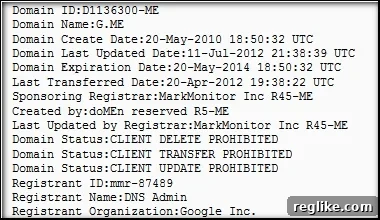
Unpacking the .me TLD and Registry-Reserved Domains
The acquisition of G.me is particularly noteworthy due to the nature of the domain itself. G.me was not a domain available on the open market or through standard registration channels. Instead, it was categorized as a “registry-reserved” domain name. This classification means that the .me registry, which governs all domains ending in .me, had specifically held this domain back from general public registration. Such domains are often considered premium assets due to their brevity, strong branding potential, and desirability, and are typically only released through special agreements or direct negotiations with the registry.
This implies that Google likely engaged in direct negotiations and a private sale with the .me registry to secure G.me. This approach is common for exceptionally valuable domains, where registries leverage their reserved inventory for strategic partnerships or significant financial transactions with reputable entities. The .me top-level domain (TLD), originally assigned to Montenegro, has gained immense popularity globally for its inherent personal branding appeal. Businesses and individuals alike use .me domains to create unique, memorable, and often personalized web addresses, making “G.me” a particularly fitting and powerful choice for Google’s diverse ecosystem of services, especially those centered around user profiles and personalization.
The Strategic Value of Short, Memorable Domains for Google
Google’s acquisition of G.me is not an isolated incident but rather a continuation of a well-established and highly strategic pattern. The company has a demonstrated history of investing in and leveraging short, impactful domain names to enhance its brand visibility, simplify access to its services, and strengthen its overall digital infrastructure. These “dot” domains serve as essential entry points into Google’s vast universe of products and platforms, providing users with easy-to-remember shortcuts.
Perhaps the most prominent example of this strategy is Google’s earlier acquisition of G.co. This domain has been widely utilized by Google as its official URL shortener, providing a concise and trusted way to share links across various platforms. The advantage of a branded URL shortener like G.co is manifold: it instills user confidence, improves brand recall, and offers a consistent, professional image for all links shared by Google or its associated services. These short URLs are not merely convenient; they are powerful branding tools that reinforce Google’s identity with every shared piece of content.
Beyond G.co, Google also owns other strategically important short domains like Goo.gl (its now-retired URL shortener), and has a history of acquiring valuable, generic keyword domains. The focus on single-letter domains, in particular, highlights an ambition to own the absolute pinnacle of digital real estate. Such domains are exceedingly rare, incredibly valuable, and instantly recognizable. They convey a sense of authority, simplicity, and technological leadership, qualities that are synonymous with the Google brand.
Potential Future Applications and Google’s Digital Ecosystem
While G.me currently redirects to plus.google.com, its long-term potential extends far beyond a single platform. At the time of this acquisition, Google+ was a significant part of Google’s strategy to integrate social elements across its services. The choice to direct G.me to Google+ suggested an effort to personalize and simplify access to user profiles, social interactions, and other “me-centric” features within Google’s ecosystem.
However, the beauty of owning such a versatile domain is its adaptability. Google could, at any point, repurpose G.me to serve a different function. It could become a central hub for all personalized Google services, offering users direct access to their dashboards, settings, privacy controls, or even a personalized news feed. It could be used for specific campaigns, product launches, or even as a unique identifier for individual users within Google’s vast network. The domain’s brevity and the “me” TLD lend themselves perfectly to any application that emphasizes personalization, individuality, or user-specific content. This flexibility is a key reason why companies like Google invest heavily in premium, generic domains – they are future-proof assets that can evolve with the company’s strategic directions.
The Broader Impact: Premium Domain Valuation and Brand Strategy
Google’s continued investment in premium domain names like G.me sends a clear message about the enduring value of concise, memorable, and brand-aligned web addresses. In an increasingly crowded digital landscape, simplicity and instant recognition are paramount. Short domains minimize typing errors, enhance word-of-mouth marketing, and make it easier for users to recall and access services. For a company of Google’s scale, every millisecond saved and every point of friction removed from the user experience translates into billions of interactions and significant competitive advantage.
The acquisition also underscores the fierce competition for top-tier digital assets. As the internet continues to expand, the scarcity of truly exceptional domain names, particularly those with single letters or common keywords, only increases their value. Companies worldwide are recognizing that a premium domain is not just a URL; it is a foundational component of digital branding, a strategic investment in intellectual property, and a powerful tool for market differentiation. Google, with its foresight and financial might, consistently positions itself at the forefront of this trend, ensuring that its digital footprint is as robust, memorable, and accessible as possible. The acquisition of G.me is another testament to this enduring philosophy, cementing Google’s place as a leader not just in technology, but also in strategic digital asset management.