
The Evolving Landscape of Domain Privacy: Google’s Limited Whois Data and the Impact of GDPR
The digital world is constantly evolving, and with it, the rules governing how personal data is handled online. A significant shift is underway in the realm of domain name management, largely driven by the European Union’s General Data Protection Regulation (GDPR). This transformative regulation has prompted domain name registrars and registries worldwide to re-evaluate how they display personal information within Whois records. Among the major players, Google has already taken a proactive step, significantly limiting the data accessible through its domain name registry for certain top-level domains.
Just weeks before many domain service providers are expected to implement their interpretations of GDPR compliance, Google’s registry has notably altered the information it presents for thick Whois records. This move, which began sometime last month, signals a new era for domain privacy, fundamentally changing how individuals and organizations can access details about domain ownership.
Understanding Whois: A Historical Perspective
For decades, Whois records have served as the publicly accessible directory for domain name ownership. Before the advent of stricter data protection regulations, a standard Whois lookup typically revealed a wealth of information about a domain’s registrant. This often included the registrant’s full name, postal address, email address, phone number, administrative contact, technical contact, and sometimes even the organization they belonged to. This transparency was initially envisioned to foster accountability and facilitate communication within the internet ecosystem.
The original intent of Whois was multifaceted. It allowed potential buyers to identify and contact domain owners, facilitated legal processes such as trademark disputes and intellectual property infringement claims, and provided a means for security researchers and law enforcement to report and address malicious online activities like spam, phishing, and malware. In essence, Whois was the internet’s public ledger, crucial for maintaining order and trust in the rapidly expanding digital frontier.
GDPR’s Mandate: A Catalyst for Change
The General Data Protection Regulation (GDPR), enacted by the European Union, is a comprehensive data privacy and security law that imposes obligations on organizations globally, so long as they target or collect data related to people in the EU. Its core principles revolve around protecting individuals’ personal data, granting them more control over how their information is collected, processed, and stored. Under GDPR, “personal data” is broadly defined, encompassing any information that can be used to directly or indirectly identify a natural person. This includes names, email addresses, IP addresses, and even location data.
The direct conflict between GDPR’s stringent privacy requirements and the historical transparency of Whois records became immediately apparent. Many domain registrars and registries interpreted GDPR as requiring the redaction or obscuration of personal data from public Whois lookups to comply with the regulation’s principles of data minimization and purpose limitation. This interpretation has set in motion a profound transformation of the Whois system, pushing it towards greater privacy for individual registrants.
Google’s Proactive Approach: Setting a Precedent
Google, as a prominent ICANN-regulated registry operator for several generic top-level domains (gTLDs) such as .app, .dev, and .page, has emerged as an early mover in adapting to the GDPR landscape. The company’s decision to limit Whois data within its registry operations demonstrates a proactive stance on data privacy, potentially setting a precedent for other registries and registrars to follow. This early adoption highlights Google’s commitment to compliance and its recognition of the increasing demand for enhanced privacy safeguards online.
The data Google’s registry now displays for domains under its management is significantly truncated, focusing primarily on information that is unlikely to be classified as personal data. For instance, a Whois record for a .app domain registered through Google’s registry now typically only reveals the State, Country, and Organization Name. Crucially, any information that could directly identify an individual registrant, such as a personal name, email address, or phone number, is no longer publicly available.
Here’s an illustrative example from a .app domain I recently registered, showcasing the limited nature of the displayed record:
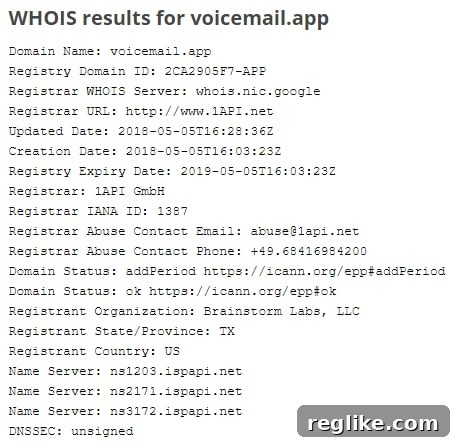
This image clearly demonstrates the stark reduction in publicly available information. If this domain were registered under my personal name, the only pieces of data related to me that would remain visible are the state and country. Conspicuously absent are crucial contact details like an email address, leaving no direct means for others to contact the domain owner regarding the domain name.
It is important to note the distinction: while Google’s *registry* has implemented these changes, its *registrar* operations (where users register domains) have not yet uniformly truncated Whois records. This suggests a phased approach or different compliance mechanisms depending on the specific role Google plays in the domain ecosystem.
The Implications of Limited Whois Data: A Dual-Edged Sword
The shift towards limited Whois data presents both significant advantages and considerable challenges, reshaping various aspects of the internet landscape.
Enhanced Privacy for Domain Owners: The Upside
The most immediate and apparent benefit of truncated Whois records is the increased privacy for individual domain registrants. In an era where personal data is highly valued and often exploited, reducing the public exposure of names, addresses, and contact information is a welcome development for many. This change helps mitigate risks such as spam, unsolicited marketing, identity theft, and targeted harassment, which were previously facilitated by easily accessible Whois data.
For individuals running personal websites, blogs, or small businesses, this newfound privacy offers a greater sense of security and control over their digital footprint. It aligns perfectly with the spirit of GDPR, empowering individuals with more rights over their personal information.
Challenges and Concerns: The Downside
While privacy is paramount, the obscuring of Whois data also introduces a host of complexities and concerns for various stakeholders who previously relied on the system’s transparency:
1. For Law Enforcement and Intellectual Property Holders:
Investigators, law enforcement agencies, and intellectual property (IP) rights holders often use Whois data to identify individuals or entities responsible for illegal activities, trademark infringement, or copyright violations. With essential contact information redacted, their ability to conduct investigations, issue cease and desist orders, or serve legal notices becomes significantly hampered. This could potentially make it harder to combat online crime and protect brand integrity.
2. For Cybersecurity and Abuse Reporting:
Security researchers, anti-spam organizations, and webmasters frequently rely on Whois data to report and mitigate malicious activities originating from domain names, such as phishing scams, malware distribution, or Denial of Service (DoS) attacks. Without direct contact information, reporting abuse becomes a labyrinthine process, potentially slowing down incident response and allowing malicious actors to operate with greater impunity.
3. For Domain Investors and Buyers:
The domain aftermarket thrives on the ability of potential buyers to identify and contact domain owners for acquisition purposes. When Whois records are sparse, it becomes exceedingly difficult for domain investors, brokers, or businesses looking to acquire a specific domain to initiate contact. This could reduce liquidity in the domain market and complicate legitimate business transactions.
4. The Absence of a Standardized Contact Mechanism:
Perhaps the most pressing concern is the current lack of a universally adopted, standardized contact mechanism to replace the direct communication previously afforded by Whois email addresses. While some registrars offer proxy services or anonymized contact forms, these solutions are inconsistent and not universally available. Without a clear, reliable pathway to contact domain registrants for legitimate reasons, the internet risks becoming less accountable and more fragmented.
ICANN’s Role and the Search for a Solution
The Internet Corporation for Assigned Names and Numbers (ICANN), the non-profit organization responsible for coordinating the maintenance and procedures of several databases related to the namespaces and numerical spaces of the Internet, is at the forefront of this debate. ICANN has issued a Temporary Specification for gTLD Whois data, which allows for the redaction of personal data in Whois to comply with GDPR. However, this is a temporary measure, and ICANN is actively working on developing a permanent, globally compliant Whois policy that balances privacy with legitimate access needs.
The challenge for ICANN and the wider internet community is to devise a system that respects individual privacy rights while simultaneously ensuring that critical functions, such as law enforcement investigations, abuse reporting, and domain transactions, can still be carried out effectively. This involves intricate discussions among diverse stakeholders, including registrars, registries, privacy advocates, legal experts, and government representatives.
Industry Reactions and Future Outlook
The industry’s reaction to limited Whois data has been mixed, reflecting the complex interplay of interests. Many registrars have responded by offering privacy protection services, often free of charge, which essentially act as a proxy, displaying the registrar’s contact information instead of the registrant’s. Some are exploring encrypted contact forms on their websites that allow third parties to send messages to domain owners without revealing their identity directly.
Looking ahead, the future of domain ownership transparency will likely involve a multi-layered approach. It’s improbable that Whois will ever return to its pre-GDPR level of transparency for individual registrants. Instead, we might see the development of an “Accredited Access System” where legitimate parties (e.g., law enforcement, IP holders) can gain conditional access to redacted Whois data under strict guidelines and oversight. This would allow for necessary investigations while upholding privacy principles.
The move by Google’s registry is a significant harbinger of this new era. It underscores the profound impact of global data protection regulations like GDPR on fundamental internet infrastructure. As the digital landscape continues to evolve, the balance between transparency and privacy will remain a critical point of contention and innovation within the domain name industry.
Conclusion
Google’s decision to limit Whois data within its registry operations marks a pivotal moment in the ongoing saga of domain privacy and compliance with GDPR. While it undoubtedly enhances the privacy of individual domain registrants, it simultaneously introduces substantial hurdles for those who traditionally relied on Whois for legitimate purposes. The internet community, led by organizations like ICANN, is now tasked with the complex challenge of forging a new path – one that safeguards personal data without compromising the internet’s security, accountability, and commercial vitality. The journey towards a globally coherent and privacy-respecting Whois system is far from over, and Google’s initial steps are merely the beginning of this transformative process.