
Navigating the Nuance: Google’s Stance on New TLDs and Search Engine Rankings
The digital landscape is constantly evolving, and with it, the strategies businesses employ to enhance their online visibility. A recurring topic of debate in the search engine optimization (SEO) community revolves around the impact of new top-level domains (TLDs) on search engine rankings. These modern domain extensions, such as .attorney, .tech, or .shop, were introduced to offer more specific and memorable web addresses. However, their actual SEO value has often been a point of contention.
Recently, the discussion was reignited by claims from Rightside, a prominent company in the new TLD space, promoting the supposed SEO advantages of these contemporary domain names. Rightside championed a case study, commissioned with GlobeRunner, which highlighted an attorney’s website migration from ErickBlockLaw.com to Jacksonville.Attorney, purportedly leading to a significant increase in traffic. This promotion, particularly a sponsored post on Search Engine Land, quickly drew the attention of Google’s John Mueller, who, much like his predecessor Matt Cutts, frequently steps in to clarify Google’s official stance on various SEO claims and myths.
The Great Debate: Do New TLDs Directly Boost SEO?
The core of Rightside’s marketing centers on the idea that a new, descriptive TLD can inherently improve a website’s search engine performance. The argument often suggests that a domain like “Jacksonville.Attorney” carries more weight or relevance for search engines when users are looking for legal services in Jacksonville, compared to a generic .com address. While this logic might seem intuitively appealing from a human perspective, Google’s algorithms operate on a far more complex and nuanced set of principles.
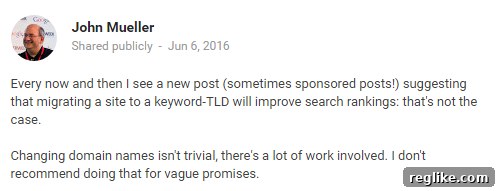
John Mueller’s intervention was a critical reminder of Google’s consistent message: new TLDs, by themselves, do not provide a direct ranking boost. Google has repeatedly stated that its ranking algorithms are sophisticated enough to evaluate content, relevance, and user experience regardless of the specific domain extension used. A .com, .org, .net, or any of the hundreds of new TLDs are treated equally in terms of inherent ranking potential. The focus remains steadfastly on the quality and relevance of the website’s content, its technical health, and the overall user experience it delivers.
Deconstructing the Jacksonville.Attorney Case Study
To fully understand the situation, it’s essential to scrutinize the case study promoted by Rightside. The transition from ErickBlockLaw.com to Jacksonville.Attorney, followed by an reported uptick in traffic, appears compelling on the surface. However, a deeper dive into the full report from GlobeRunner reveals a more intricate picture. The domain name change was merely one component of a much broader overhaul of the attorney’s online presence.
Crucially, the lawyer didn’t just switch domain names; they embarked on a comprehensive digital transformation. This included an entirely new website design, presumably with improved navigation, modern aesthetics, and better mobile responsiveness. More importantly, the site began incorporating high-quality, relevant content, which is a cornerstone of any effective SEO strategy. New content, especially content designed to answer user queries and provide valuable information, is a well-established driver of organic traffic and improved search rankings.
With so many significant variables at play – a completely new website, fresh and valuable content, and potentially updated backlink strategies or local SEO efforts – attributing the traffic increase solely or even primarily to the change in the top-level domain becomes highly speculative. It’s a classic case of correlation versus causation. The success observed in the case study is almost certainly a result of a holistic SEO approach and a substantial investment in improving the website across multiple dimensions, rather than a magical boost from the .attorney extension itself. Google’s algorithms are designed to reward websites that provide genuine value and a superior user experience, not those that simply adopt a trendier domain extension.
The Nuance: CTR, Branding, and Perceived Relevance
While new TLDs may not offer a direct ranking advantage, it’s important to consider their potential indirect benefits, particularly in terms of branding and click-through rate (CTR). A descriptive domain like Jacksonville.Attorney could, theoretically, stand out in search results. When a searcher sees a domain that perfectly matches their query (e.g., “Jacksonville attorney”), they might perceive it as more relevant or authoritative than a generic .com address, leading to an increased likelihood of clicking on that result. This potential for higher CTR is a real consideration.
An improved CTR, where more users click on your listing when it appears in search results, can act as a positive signal to Google. While not a direct ranking factor in the same way content quality is, sustained higher CTR can indirectly influence rankings over time. Google’s algorithms strive to present the most relevant and useful results to users, and if users consistently choose one result over others for a specific query, it can indicate that the chosen result is highly satisfying. However, it’s crucial to understand that this is an *indirect* effect, and it relies heavily on the domain’s ability to genuinely differentiate itself and be perceived as more relevant by users, not just by virtue of its TLD.
Furthermore, new TLDs can contribute to a stronger brand identity. A domain like “Jacksonville.Attorney” is memorable, clear, and immediately communicates the website’s purpose and location. For businesses, especially those in niche markets or specific geographic areas, a highly relevant TLD can enhance brand recall and make the website appear more specialized and trustworthy to potential clients. This improved branding, while not a direct SEO ranking factor, can certainly contribute to overall business success and, in turn, support SEO efforts through increased direct traffic and brand searches.
The Challenges of Domain Migration: More Than Just a Name Change
Another crucial point raised by John Mueller, and often overlooked in the excitement surrounding new TLDs, is the inherent difficulty and complexity of changing a website’s domain name. Migrating a website from one domain to another is a significant undertaking that, if not executed flawlessly, can lead to substantial and long-lasting negative impacts on search rankings and organic traffic. As discussed in detail in resources like DNW Podcast #70, the work involved is far from trivial.
A successful domain migration requires meticulous planning and execution, including:
- 301 Redirects: Implementing permanent 301 redirects from every old URL to its corresponding new URL is paramount. This ensures that search engines understand the change and pass on existing link equity to the new domain.
- Google Search Console Updates: Informing Google of the domain change via the “Change of Address” tool in Google Search Console is a critical step.
- Internal Link Updates: Every internal link on the new website must be updated to point to the new domain, preventing broken links and ensuring proper crawlability.
- Backlink Outreach: While challenging, attempting to update important backlinks from external websites to point to the new domain can help preserve link equity.
- Canonical Tags: Ensuring correct canonical tags are implemented on the new site is vital to prevent duplicate content issues.
- Monitoring: Closely monitoring traffic, rankings, and crawl errors post-migration is essential to quickly identify and address any issues.
Even with perfect execution, a temporary dip in organic traffic and rankings is often an unavoidable consequence of a domain migration. Google needs time to process the changes, recrawl and reindex the new URLs, and consolidate signals. Businesses considering a domain change solely for the perceived SEO benefits of a new TLD must weigh these potential risks against the highly uncertain rewards. The costs in terms of time, resources, and potential short-term traffic loss are considerable.
There’s an ongoing hope within the SEO community that Google might make the domain migration process more seamless in the future. Simplifying this complex task could indeed be a significant boon for new domain name choices, making it less risky for businesses to experiment with or adopt TLDs that better reflect their brand or purpose. However, for now, the process remains technically demanding and requires expert attention.
Beyond TLDs: What Truly Drives SEO Success
Given Google’s consistent messaging and the complexities of domain migration, it’s clear that businesses should not view new TLDs as a shortcut to search engine success. Instead, focus should remain on the fundamental elements that genuinely drive organic visibility and sustained growth. These include:
- High-Quality, Relevant Content: Creating valuable, comprehensive, and engaging content that genuinely answers user queries and solves their problems is the single most important factor.
- Exceptional User Experience (UX): A fast-loading website, mobile-friendliness, intuitive navigation, and an overall enjoyable experience for visitors are crucial. Google prioritizes websites that users love.
- Strong Backlink Profile: Earning high-quality backlinks from authoritative and relevant websites signals trust and authority to search engines. This is typically achieved through outstanding content and strategic outreach.
- Robust Technical SEO: Ensuring your site is easily crawlable and indexable by search engines, free of broken links, and uses appropriate schema markup helps Google understand your content.
- Targeted Keyword Research: Understanding what your target audience is searching for and naturally integrating those keywords into your content and metadata is vital.
- Local SEO Optimization: For local businesses, optimizing Google My Business profiles, acquiring local citations, and generating local reviews are paramount.
These are the enduring principles that have consistently delivered SEO results, far outweighing any hypothetical benefit from a specific domain extension. A new TLD might complement a strong SEO strategy, but it can never replace the foundational work of building a valuable, user-centric website.
Conclusion
The debate surrounding new top-level domains and their impact on search engine rankings will likely continue as the digital landscape evolves. However, Google’s message, as consistently articulated by John Mueller, remains clear: new TLDs do not serve as a direct ranking factor. The success stories, like the Jacksonville.Attorney case study, are almost invariably the result of comprehensive website overhauls and robust SEO strategies that extend far beyond a mere domain name change.
While new TLDs can offer branding advantages and potentially influence click-through rates through perceived relevance, these are indirect benefits that complement, rather than substitute, core SEO best practices. Businesses considering a switch to a new TLD must be fully aware of the significant technical challenges and potential risks associated with domain migration. True, sustainable SEO success is built on providing exceptional content, ensuring an outstanding user experience, and adhering to Google’s guidelines, regardless of the characters that follow the final dot in a web address.