
Unlock Passive Income: How Google AdSense Auto Ads Revolutionize Website Monetization
For many online publishers, the phrase “Google AdSense” evokes memories of a bygone era, a time when website monetization seemed simpler and significantly more lucrative. Indeed, more than a decade ago, the digital landscape offered incredible opportunities, where some creators, myself included, saw daily earnings from AdSense soar into the thousands of dollars, and consistent triple-digit daily revenues were a tangible reality for an even longer period.
The internet has undergone a seismic shift since those golden days. The “made-for-AdSense” sites that once thrived, meticulously designed to capture traffic and display ads, now struggle to attract even a trickle of visitors. Many of these digital relics have since been left to expire, fading into the vast archives of the web. Yet, even amidst this evolution, Google AdSense remains a formidable and accessible income stream, particularly for websites that, due to their scale or niche, aren’t yet able to secure direct advertising deals. It’s a testament to its enduring power that even today, I maintain a couple of websites, untouched for over a decade, which quietly generate a passive income of more than $100 each month. This kind of effortless revenue, requiring no ongoing effort, truly underscores the platform’s potential.
Introducing AdSense Auto Ads: The Next Frontier in Automated Revenue
In a significant stride forward for website monetization, Google recently unveiled AdSense Auto Ads. This innovative solution marks a true paradigm shift, embodying the ultimate “set-it-and-forget-it” approach to advertising. I believe this feature is poised to become the ideal ad monetization solution for a vast array of creators, especially those managing smaller websites, hobby blogs, niche content platforms, and even domainers who leverage mini-sites on their acquired domains.
Simplifying Ad Placement with Smart Automation
The traditional method of integrating AdSense involved a somewhat cumbersome process: meticulously selecting ad locations, determining optimal sizes, and then manually inserting specific AdSense code snippets into each designated spot on your website. This often required a blend of intuition, A/B testing, and a fair bit of technical know-how to achieve even moderately optimized results. AdSense Auto Ads entirely bypasses this complexity.
With Auto Ads, website owners are required to perform just one simple action: insert a single, universal code snippet into the section of their web pages. Once this is done, the heavy lifting is handled entirely by Google’s sophisticated machine learning algorithms. These algorithms intelligently analyze your site’s content, layout, and user behavior to dynamically determine the most effective locations and sizes for ads to be displayed. This means no more guesswork, no more manual adjustments, and significantly less time spent on ad management.
The Power of Google’s Optimization Engine
While many webmasters pride themselves on their ability to identify prime ad real estate and maximize revenue through manual placement, I personally place a much higher degree of confidence in the capabilities of Google’s engineers and their advanced AI systems. For smaller to medium-sized sites, especially, leveraging Google’s robust optimization engine can lead to superior AdSense income. The sheer volume of data, the continuous learning from billions of impressions across countless websites, and the relentless pursuit of optimizing for both publisher revenue and user experience are resources no single website owner can replicate.
A particularly welcome benefit of Auto Ads is the elimination of the need for separate optimization strategies for different devices. In today’s multi-device world, ensuring a seamless and effective ad experience across desktops, tablets, and mobile phones is crucial. Manually optimizing for each breakpoint can be an arduous and time-consuming task. Auto Ads inherently handles this responsiveness, automatically adjusting ad placements and formats to perfectly suit the user’s viewing device, ensuring optimal performance and aesthetics without any additional effort from the publisher.
Retaining Control: Your Preferences Still Matter
Despite the high degree of automation, website owners are not entirely surrendering control. A key aspect of AdSense Auto Ads is that publishers still retain the ability to select the types of ads that will display on their site. Whether you prefer text & display ads, in-feed ads, in-article ads, matched content, or a combination, you can configure these preferences within your AdSense account. This ensures that while Google manages the placement, the fundamental nature and relevance of the ads shown align with your site’s content and audience, maintaining a level of brand consistency and user experience.
Beyond selecting ad types, publishers also have the flexibility to block sensitive ad categories, review specific ad content, and even exclude certain pages from displaying Auto Ads. This suite of controls ensures that despite the ‘set-it-and-forget-it’ nature, you maintain oversight and can fine-tune the ad experience to meet your specific requirements and maintain a positive environment for your users.
A Real-World Experiment: Putting Auto Ads to the Test
To truly understand the practical implications of this new feature, I decided to conduct a personal experiment. A couple of years ago, I launched a financial content site, UpMoney.com, on which I publish content very sporadically. As it had no ads whatsoever, it presented the perfect canvas to test AdSense Auto Ads in a live environment. The setup process was remarkably straightforward – just a few clicks in the AdSense dashboard and the single code snippet placed in the site’s header.
My initial observations revealed an interesting learning phase for the Auto Ads system. At first, the ad behavior wasn’t entirely optimal, likely attributable to the relatively low traffic volumes the site receives. I noticed instances where Google’s algorithms appeared to be reserving space for ads but weren’t always delivering actual ad creatives. The screenshot below vividly illustrates this, showing two prominent blank spaces where ads were expected, alongside one spot where an ad was correctly inserted.
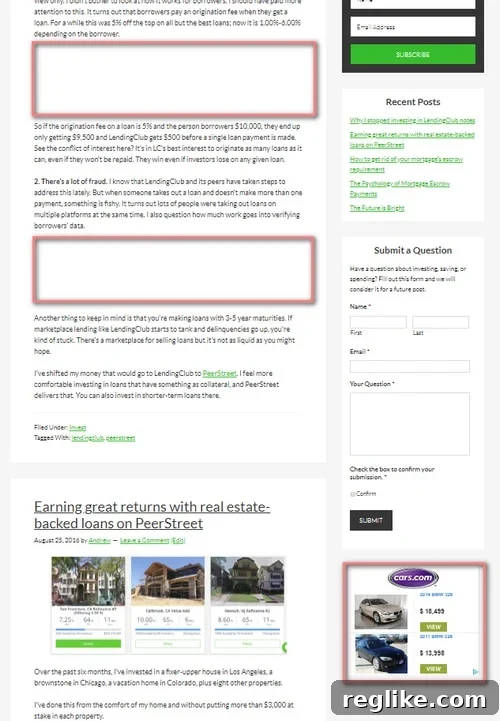
However, this initial phase was transient. Approximately half an hour after capturing that screenshot, I revisited the site to find that ads had started appearing in some of the previously blank white spaces. Intriguingly, other white spaces had been newly introduced elsewhere on the page, indicating that the system was continuously experimenting and refining its placement strategy in real-time. This dynamic adaptation highlights the machine learning at play; it constantly evaluates performance, user engagement, and revenue potential, adjusting placements to optimize over time.
Despite the initial blank spaces, my overall assessment of Google’s location selection for the ads was quite positive. The system intelligently identified areas that didn’t disrupt content flow excessively. The primary concern, therefore, wasn’t the chosen locations, but rather the intermittent delivery, which resulted in blank spaces instead of active ads. This is a common phenomenon in the early stages of implementing dynamic ad systems on sites with fluctuating or lower traffic, as the demand-side platform (DSP) and real-time bidding (RTB) processes require sufficient impressions and data to consistently fill all available ad slots. Over time, as traffic grows and the system gathers more data, ad fill rates are expected to improve significantly.
Who Benefits Most from AdSense Auto Ads?
AdSense Auto Ads are truly designed for a specific segment of online publishers who prioritize simplicity and automation over granular manual control:
- Small Website Owners and Bloggers: For individuals and small teams focused on content creation rather than ad optimization, Auto Ads free up valuable time and resources.
- Hobbyists and Niche Content Creators: Those who run websites for passion projects, without the bandwidth for complex ad management, can easily generate passive income.
- Domainers with Mini-Sites: Individuals who own numerous domains and set up basic content sites can quickly monetize their portfolio without extensive configuration for each site.
- Publishers Seeking Cross-Device Optimization: Any site aiming for consistent performance across mobile, tablet, and desktop without manual intervention will find Auto Ads invaluable.
- Those New to AdSense: The simplified setup lowers the barrier to entry for new publishers looking to monetize their content.
Maximizing Your AdSense Auto Ads Performance: Best Practices
While Auto Ads handle much of the heavy lifting, publishers can still take proactive steps to ensure optimal performance and revenue generation:
- Focus on High-Quality Content: Engaging, valuable, and relevant content is the ultimate driver of traffic and user engagement, which in turn attracts higher-paying advertisers.
- Ensure Excellent User Experience: Beyond ads, focus on site speed, mobile-friendliness, and intuitive navigation. Google’s algorithms favor sites that offer a positive user experience.
- Monitor Your AdSense Reports: Regularly check your AdSense performance reports. While you don’t control placement, understanding what’s performing well can inform your content strategy.
- Experiment with Ad Types: Within your AdSense dashboard, test different combinations of allowed ad formats to see which yields the best results for your audience.
- Maintain Site Health: Regularly update your CMS (e.g., WordPress), themes, and plugins to ensure security and optimal performance.
Potential Considerations and the Future of Automated Monetization
While Auto Ads offer significant advantages, it’s also important to acknowledge potential considerations. For very large publishers with dedicated ad operations teams, the lack of granular, pixel-perfect control over every ad slot might be a perceived drawback. However, for the vast majority of websites, the benefits of automated, intelligent optimization far outweigh this minor limitation.
The occasional blank spaces, as observed in my experiment, underscore that Auto Ads, like any AI-driven system, has a learning curve. As traffic increases and the system gathers more data about your specific audience and content, these instances are likely to diminish, leading to more consistent ad delivery and higher fill rates. This continuous learning process is a hallmark of Google’s approach to ad technology, constantly striving for a balance between maximizing publisher revenue and maintaining a positive experience for site visitors.
In conclusion, AdSense Auto Ads represent a pivotal evolution in website monetization. By simplifying the ad integration process, leveraging powerful machine learning for optimal placement, and adapting to various devices, Google has provided an incredibly accessible and efficient tool for publishers to generate income. For anyone looking for a truly “set-it-and-forget-it” solution to effortlessly optimize their website’s advertising revenue, AdSense Auto Ads are not just a convenient option—they are a game-changer.