
Google Domains: A Closer Look at Google’s Approach to Simple Web Presence
Establishing an online identity is a crucial step for any business in today’s digital landscape. For many, the journey begins with securing a domain name. When Google, a titan of the internet, announced its foray into domain name registration, it signaled a new era of simplified web presence. This comprehensive review delves into the initial beta experience of Google Domains, examining its core offerings, user experience, strategic partnerships, and early challenges, ultimately highlighting its clear focus on making online presence accessible for small businesses.
It’s been a little over a month since Google first unveiled its domain name registration service, and early access to the beta program has provided valuable insights into what the search giant envisions for this space. As anticipated by many industry observers, Google Domains emerges as a refreshingly straightforward and uncluttered platform. Its primary objective appears to be precisely what its name suggests: providing a no-frills, highly intuitive pathway for individuals and businesses to get their websites up and running with minimal complexity.
The essence of Google Domains is its commitment to simplicity. From the very first interaction, the platform is designed to demystify the often-intimidating process of domain acquisition and management. This approach is particularly beneficial for those who are new to the online world, offering a streamlined experience that removes common technical hurdles and allows users to focus on building their brand rather than wrestling with complex configurations.
Navigating the Domain Search Experience
The initial step in establishing an online presence is, of course, finding the perfect domain name. Google Domains’ search interface is commendably clean and efficient. To test its capabilities, I experimented with a somewhat niche concept, inspired by a recent article about innovative beverage dispensing: “cocktails on tap.” This phrase allowed me to observe how Google’s search algorithms handle creative and slightly unconventional queries, beyond standard business names.
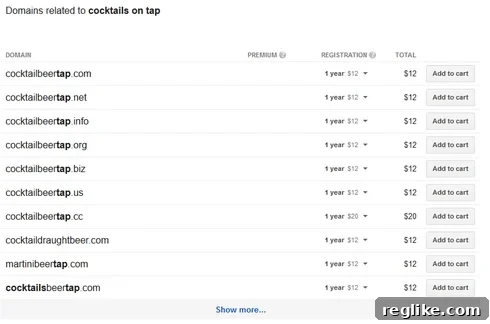
Upon submitting the search query, the results page provided several interesting observations about Google’s domain suggestion engine and its market integration:
- Rudimentary Name Spinner: Google appears to employ a basic, yet functional, name spinner or suggestion algorithm. For instance, my search for “cocktails on tap” intelligently picked up on synonyms and related concepts like “draft,” leading to suggestions that included “beer.” While not overly sophisticated, this feature can be helpful in sparking ideas when an exact match is unavailable, guiding users towards related and available domain names. This hints at Google’s potential to leverage its vast understanding of language and search queries to enhance the domain discovery process in the future.
- Integration with Premium Domain Marketplaces: Significantly, Google Domains is not solely focused on standard new registrations. It seamlessly integrates offerings from third-party premium domain name marketplaces, such as Afternic and Sedo. This means that if a highly desirable, short, or memorable domain is already registered, Google Domains can present it as an option for purchase, broadening the user’s choices beyond newly available names. This strategic partnership allows users access to a wider inventory, including valuable previously registered domains that can offer an immediate competitive edge.
During my search, I specifically encountered one premium domain listed. Interestingly, this domain, owned by HugeDomains, was advertised for sale on both Afternic and Sedo. However, a notable discrepancy was observed in the pricing displayed on Google Domains compared to what was shown directly on the respective marketplaces. While minor in this instance, such inconsistencies could potentially impact user trust or negotiation strategies, suggesting an area for refinement in the integration process.
Once a suitable domain name is identified, the checkout process is remarkably straightforward, leveraging the familiarity and security of Google Wallet. This integration simplifies the payment experience, removing friction and aligning with Google’s overall strategy of providing a cohesive and user-friendly ecosystem.
Beyond Registration: Empowering Businesses to Get Online
Google’s venture into domain registration is more than just a standalone service; it’s a strategic move that aligns perfectly with its overarching goal of getting more businesses online. By simplifying the initial hurdle of domain acquisition, Google aims to encourage greater adoption of its other powerful services and tools, such as Google Workspace for professional email and collaboration, Google Analytics for website insights, and Google Ads for marketing. The welcome email received by new domain registrants succinctly confirms this broader ambition:
We think domain management should be simple, secure and reliable – everything should just work, with no unwelcome surprises. We also want you to succeed online, so we’ll work tirelessly to bring you features, tools and products that can help you do just that.
This mission statement underscores Google’s commitment not only to providing a domain but also to fostering online success. With this philosophy at its core, Google Domains significantly streamlines the process of setting up a website once a domain is secured. The platform offers direct integrations with a variety of popular website building services, including industry leaders like Wix and Shopify. This collaboration is a game-changer for individuals and small business owners who often find the technical aspects of website deployment daunting.
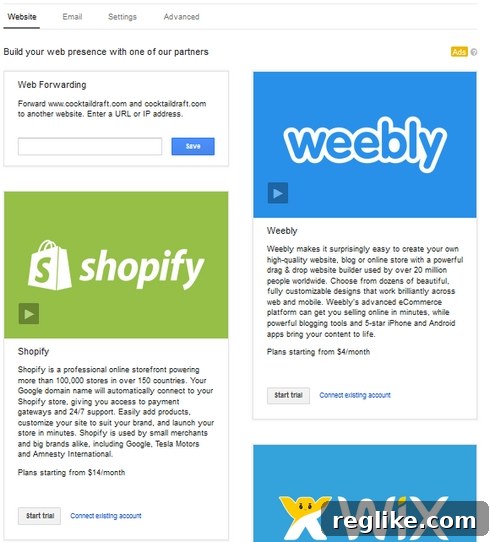
A key benefit of these integrations is the elimination of the need for users to understand complex concepts like “nameservers.” Traditionally, configuring a domain to point to a website involves manually updating nameserver records – a task that can be intimidating for novices. With Google Domains, if you opt to start a trial with a partnered website builder, these services can automatically access and modify your domain records on your behalf. This hands-off approach drastically reduces the technical expertise required, making website creation accessible to a much broader audience and significantly lowering the barrier to entry for establishing an online presence.
Beyond website setup, Google Domains also makes it incredibly easy to configure essential services like email forwarding. Users can effortlessly direct emails sent to their new domain name (e.g., [email protected]) to an existing personal or business email address. This functionality is vital for projecting a professional image and ensuring seamless communication from day one, without requiring a full email hosting solution immediately.
Strategic Alliances: The Role of Key-Systems and WhoisProxy
The operational backbone of a domain registrar often involves various partnerships, and Google Domains is no exception. Early investigations by publications like Domain Name News raised questions about a potential collaboration with Key-Systems’ RRP Proxy. Evidence suggests that these companies are indeed intertwined on multiple levels, forming a critical operational alliance for Google Domains.
Upon registering a domain through Google Domains, the Whois server information revealed that the domain data was being pulled from a server operated by RRP Proxy. This indicates that Key-Systems, through its RRP Proxy service, is playing a significant role in the underlying infrastructure for domain management at Google. RRP Proxy is a well-established wholesale domain registrar service that allows other companies to offer domain registration without building their own registrar infrastructure from scratch. This partnership enables Google to quickly scale its domain services while relying on Key-Systems’ expertise and existing systems.
Furthermore, it has been observed that Key-Systems serves as the registrar of record for all domain names registered at Google Domains, with the exception of the most common generic top-level domains (gTLDs) such as .com, .net, .org, .us, .biz, and .info. This division of labor suggests a strategic delegation where Google handles the direct registration of the most popular TLDs, while Key-Systems manages the broader portfolio of other extensions. This arrangement leverages Key-Systems’ extensive experience and accreditation with various registries worldwide.
It’s worth noting that Key-Systems also owns Moniker, another domain registrar. However, users can rest assured that the sleek, user-friendly interface of Google Domains bears no resemblance to the often-criticized and complex user experience found on Moniker’s platform. This distinction highlights Google’s commitment to its own design principles and user experience standards, regardless of underlying partnerships.
Another crucial partnership that enhances the value proposition of Google Domains is with WhoisProxy.com Ltd. This collaboration provides free domain name privacy with every registration. Domain privacy is a highly valued feature, as it allows registrants to shield their personal contact information (address, email, phone number) from public Whois databases. In an age where online privacy and protection against spam and unwanted solicitations are paramount, offering this service for free significantly elevates Google Domains’ appeal and demonstrates a commitment to user security.
Transparent Terms of Service and Renewal Policies
One of the most refreshing aspects of the Google Domains beta is its remarkably simple and straightforward Terms of Service. In an industry often plagued by dense legal jargon and obscure clauses, Google Domains stands out by offering a highly digestible set of terms. This transparency builds trust and empowers users to understand their rights and obligations without needing a legal degree. While it is reasonable to expect these terms to evolve and potentially expand over time as the service matures and new features are introduced, the current iteration is commendably free of any hidden “gotchas” or complex caveats that might disadvantage users.
The language surrounding domain name renewals is also commendably clear and user-friendly, setting predictable expectations for registrants. Google Domains allows users a generous window to renew their domains after expiration, categorized into distinct phases:
- Standard Renewal Period: For up to 30 days following expiration, a domain can be renewed at the standard registration price (which, at the time of this beta review, was $12 for a .com domain). This grace period provides ample time for users to address accidental expirations without incurring penalties.
- Extended Renewal Period: Should a domain remain expired beyond the initial 30 days, a further window of 31 to 60 days is provided for renewal. During this period, a higher fee, typically $40, is charged. This premium accounts for the additional administrative effort involved in retrieving a domain from its post-expiration status.
- Non-Renewal: After 60 days post-expiration, the domain officially enters the deletion process and can no longer be renewed by the original registrant through Google Domains. At this point, it typically becomes available for public re-registration or enters various redemption phases through different registrars, often at significantly higher costs.
This structured renewal policy is standard across the domain industry but is articulated with exceptional clarity by Google. Crucially, given Google’s core business model and ethos, it is highly unlikely that the company will seek to profit from the sale of expired domain names. Unlike some registrars or domain aftermarket players who actively monetize expired domains, Google’s focus remains on user acquisition and promoting its ecosystem of services, aligning with its commitment to a fair and transparent domain registration experience.
Early Beta Bugs and User Experience Insights
As with any product in its beta phase, Google Domains presented a few minor bugs and usability quirks that are typical for early software releases. These issues, while small, offer valuable insights into the development process and Google’s targeted user base.
One encountered issue involved an attempt to set up a trial with the popular web builder Weebly through the Google Domains interface. This action unfortunately resulted in a generic 500 server error, indicating an internal system problem rather than a user-specific one. Such errors are common during beta testing and are typically ironed out as development progresses and integration points are refined. They serve as important feedback for the engineering team to ensure robust and seamless connectivity with third-party services.
More amusingly, and perhaps more tellingly, was the unexpected difficulty in registering a second domain after successfully securing the first. Upon completion of the initial registration, the dashboard provided no immediate or obvious link to return to a domain search box or the Google Domains home page. Navigating back to `domains.google.com` simply redirected to the existing dashboard, showing the newly registered domain.
The only viable solution to initiate a new domain search was to manually type `Google.com/domains` into the browser, which then forwarded to `domains.google.com/about` and subsequently presented the search interface. While a minor inconvenience, this design oversight is a fascinating clue into Google’s primary audience for this service. It suggests that Google Domains, at least in its initial iteration, is not primarily designed for “bulk domainers” – individuals or businesses that register hundreds or thousands of domains. Instead, the interface seems optimized for small businesses or individuals who might register one or two domains to establish their core web presence and then primarily focus on managing those domains and building their websites.
This subtle usability issue reinforces the idea that Google Domains is meticulously crafted to serve the needs of typical small business owners who are looking for a simple, secure, and integrated platform to kickstart their online journey, rather than catering to the highly specialized workflows of professional domain investors or portfolio managers. As the service evolves, it will be interesting to see if Google introduces features that cater to a broader spectrum of domain management needs, or if it continues to sharpen its focus on empowering the small business community.
Conclusion: Google Domains as a Gateway to Online Success
In its beta phase, Google Domains presented itself as a strong contender in the domain registration market, particularly for its intended audience. Its emphasis on simplicity, intuitive user experience, and seamless integration with website builders and other essential online tools positioned it as an ideal gateway for small businesses and individuals looking to establish a robust web presence without the usual complexities. From the clear search results, including premium options, to transparent terms of service and valuable partnerships for privacy, Google laid a solid foundation.
While early bugs and usability quirks were present, as expected in a beta product, they merely highlighted Google’s focused approach: to streamline the journey from domain registration to a fully functional online identity. By removing technical barriers and offering an accessible platform, Google Domains clearly aimed to empower a new generation of online ventures, reinforcing Google’s broader mission to organize the world’s information and make it universally accessible and useful.