
Brand Integrity at Stake: Google Battles Cybersquatters and Deceptive Survey Sites
In the vast and ever-expanding digital landscape, securing one’s brand identity is a continuous and often challenging endeavor. For technology giants like Google, protecting their valuable trademarks and ensuring user trust is paramount. This vigilance frequently leads them into direct conflict with opportunistic entities engaged in cybersquatting and other forms of online deception. A classic example of Google’s proactive approach recently came to light as the company initiated a complaint with the National Arbitration Forum, aiming to reclaim the deceptively similar domain names: Goggle.com, Goggle.net, and Goggle.org.
While superficially these domain names might appear “generic” due to their phonetic similarity to “Google,” it is their deliberate and misleading use that has propelled Google into action. This particular case highlights a prevalent issue in the online world: the exploitation of minor misspellings or phonetic resemblances to lure unsuspecting users into various schemes, most notably the pervasive and often harmful “survey scams.”
The Anatomy of a Deception: The Goggle.com Controversy
The Deceptive Domain Names: A Typosquatter’s Tale
The choice of “Goggle” instead of “Google” is a classic example of typosquatting, a form of cybersquatting where domain names are registered that are variations of popular brand names, often incorporating common typographical errors. Users, accustomed to rapid typing, might inadvertently land on these sites. The use of .com, .net, and .org extensions for “Goggle” further compounds the potential for confusion, as these are widely recognized top-level domains, lending an air of legitimacy to illegitimate operations.
These domains were not merely idle registrations; they were actively used to mislead. Similar to another recent complaint involving YouTube.ph, which also targeted a fraudulent survey site, Goggle.com, Goggle.net, and Goggle.org were found to be redirecting users to a deceptive survey page. This page, designed to entice users, then pushes them to complete numerous offers, often involving the submission of personal information, sign-ups for unwanted services, or even credit card details.
The Modus Operandi: Survey Scams and Unwanted Offers
The typical lifecycle of a survey scam initiated by cybersquatted domains is insidious. A user, perhaps mistyping “Google” or clicking on a malicious link, lands on one of the “Goggle” domains. They are then immediately redirected to a page promising tempting rewards – anything from cash prizes to free high-value products – in exchange for completing a “quick survey.” The initial survey might seem harmless, gathering basic demographic information. However, this is merely a gateway to a series of more intrusive requests.
Users are then often funneled into a labyrinth of “offers” from third-party advertisers. These offers frequently require signing up for trial subscriptions that automatically convert to paid services, providing credit card information for “shipping and handling” of a “free” item that never arrives, or submitting vast amounts of personal data that can later be used for spamming, phishing, or even identity theft. The promise of the initial reward rarely materializes, leaving users frustrated, potentially out of pocket, and vulnerable to future online threats.
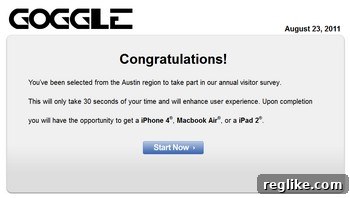
The current iteration of the survey page linked from the “Goggle” domains might not overtly mimic Google’s official logo, as depicted below, but the underlying intent to capitalize on Google’s brand recognition remains clear:
A History of Brand Imitation and Confusion
While the present iteration might be subtle, there’s historical evidence suggesting a more direct attempt at brand confusion. DomainTools’ historical thumbnails reveal that at one point, the site did feature a logo strikingly similar in font and style to Google’s official branding. This earlier design served as undeniable proof of intent to deceive, creating an almost identical visual impression that could easily mislead users into believing they were interacting with a legitimate Google-affiliated service.

Even without the direct logo imitation, the mere phonetic similarity of “Goggle” to “Google” is sufficient to cause widespread confusion. This deliberate linguistic closeness is a cornerstone of cybersquatting tactics, banking on human error and the brand’s immense recognition to divert traffic.
Google’s Unwavering Commitment to Brand Protection
Why This Matters: Protecting Users and Reputation
For a company like Google, these battles are not just about domain names; they are about safeguarding user trust and protecting a global brand built on innovation and reliability. When users encounter fraudulent sites masquerading as Google, it erodes confidence, potentially leading to a diminished perception of the legitimate brand. Beyond reputational damage, there’s a significant risk of users falling victim to phishing attacks, malware installations, or financial fraud, all of which reflect negatively on the brand they believed they were interacting with.
Google invests heavily in security measures, but these efforts can be undermined if malicious actors successfully trick users at the very first point of contact – the domain name. Therefore, proactively combating cybersquatting is a critical component of Google’s broader strategy for online safety and brand integrity.
The Legal Framework: UDRP and the National Arbitration Forum
To address such infringements efficiently, companies frequently turn to the Uniform Domain-Name Dispute-Resolution Policy (UDRP), a streamlined administrative procedure developed by the Internet Corporation for Assigned Names and Numbers (ICANN). UDRP provides a faster and more cost-effective alternative to traditional court litigation for resolving domain name disputes.
The National Arbitration Forum (NAF) is one of the leading providers of UDRP services. For a complainant like Google to succeed in a UDRP case, they must demonstrate three key elements:
- The domain name is identical or confusingly similar to a trademark or service mark in which the complainant has rights. (e.g., “Goggle” vs. “Google”).
- The registrant of the domain name has no rights or legitimate interests in respect of the domain name. (e.g., they aren’t commonly known by that name, or using it for a legitimate non-commercial purpose).
- The domain name has been registered and is being used in bad faith. (e.g., to disrupt the business of a competitor, to attract users for commercial gain by creating confusion with the complainant’s mark, or to sell the domain name to the complainant).
Given the historical use of a Google-like logo and the current use for deceptive survey scams, Google has a strong case for proving both confusing similarity and bad faith registration and use. This legal avenue is a crucial tool for trademark holders globally.
A History of Vigilance: Google’s Past Battles
Google’s current action against the “Goggle” domains is by no means an isolated incident. The company has a long and well-documented history of aggressively pursuing cybersquatters and trademark infringers. From battling against variations like “Googel.com” to “Gogle.net,” Google consistently monitors and acts upon unauthorized use of its brand. This dedication extends to its subsidiaries, as seen with the YouTube.ph case, where a deceptively similar domain was used to host scam content. This proactive stance serves not only to protect Google’s immediate interests but also to send a clear message to potential infringers that such activities will not be tolerated.
The Broader Impact of Cybersquatting and Survey Scams
Threats to Consumers: Beyond the Click
The consequences of falling victim to survey scams extend far beyond a wasted click. Consumers face a multitude of risks:
- Data Privacy Concerns: Surveys often demand sensitive personal information, which can be harvested and sold to third parties, leading to unwanted marketing, spam, or even identity theft.
- Financial Loss: Hidden subscriptions, charges for “free” trials, or outright credit card fraud can result in significant monetary losses.
- Malware and Phishing Risks: Deceptive sites can be gateways for downloading malicious software or can be used to phish for login credentials to legitimate accounts.
- Time and Frustration: Users lured into endless loops of offers and surveys waste valuable time and can experience considerable frustration and stress.
Challenges for Brand Owners: A Constant Struggle
For legitimate brand owners, the battle against cybersquatting is a constant drain on resources:
- Reputational Damage: Even if not directly affiliated, negative user experiences with scam sites linked to a brand’s name can damage its reputation.
- Financial Costs: Legal fees, monitoring services, and the cost of pursuing UDRP complaints add up.
- Dilution of Brand Equity: The proliferation of confusingly similar domains can dilute the uniqueness and strength of a brand’s trademark.
- Loss of Traffic: Legitimate traffic can be diverted to fraudulent sites, impacting business and marketing efforts.
Industry-wide efforts, involving organizations like ICANN, domain registrars, and various cybersecurity bodies, are continuously evolving to create a safer internet. However, the sheer volume of new domain registrations and the ingenuity of malicious actors make this an ongoing challenge.
Staying Safe Online: What Users Can Do
Navigating the digital landscape safely requires constant vigilance. Users can protect themselves from cybersquatting and survey scams by following a few key practices:
- Verify URLs Carefully: Always double-check the spelling of domain names, especially for well-known brands. Even a single letter difference can indicate a fraudulent site.
- Look for HTTPS: Ensure the website uses a secure connection (HTTPS, indicated by a padlock icon in the browser address bar), especially when entering personal or financial information. However, note that some scam sites also use HTTPS, so it’s not a sole indicator of legitimacy.
- Be Wary of Unsolicited Offers: Approach promises of exorbitant rewards or free high-value items with skepticism. If an offer seems too good to be true, it likely is.
- Read Reviews and Research: Before engaging with an unfamiliar survey or offer site, perform a quick online search for reviews or reports of scams.
- Use Reliable Security Software: Keep antivirus and anti-malware software updated to detect and block malicious websites.
- Report Suspicious Activity: If you encounter a suspicious website or scam, report it to relevant authorities or browser security features to help protect others.
Conclusion: The Enduring Fight for Digital Trust
Google’s legal action against Goggle.com, Goggle.net, and Goggle.org serves as a powerful reminder of the relentless efforts required to maintain brand integrity and user safety in the digital age. This case underscores the sophisticated tactics employed by cybersquatters and the pervasive nature of online survey scams.
By leveraging mechanisms like the UDRP and the National Arbitration Forum, Google not only protects its own intellectual property but also champions the broader cause of online consumer protection. As the internet continues to evolve, the battle against deception remains an ongoing challenge. Google’s vigilance, coupled with increased user awareness and industry-wide collaboration, forms the bedrock of a safer, more trustworthy online experience for everyone.