Hypocrisy.com: How America’s Big Firms are the Biggest Cybersquatters
A look at how big firms have joined forces to cybersquat and how they justify it.
In May 2007, I noticed something curious on a fresh Gateway desktop computer I purchased. When I mistyped a web address, my browser showed a page full of ads.
That’s nothing fresh. But who profited from the page was. It wasn’t some modest fry cybersquatter. It was Gateway.
I later found out that Dell did the same thing. Both computer manufacturers had teamed up with search firms to show a page of links when someone typed in a non-existent domain name.
Shortly thereafter, internet service providers such as Verizon, Time Warner, and later Comcast jumped on the bandwagon and started similar schemes.
There’s only one reason these firms do this: money. They earn money every time someone clicks on a paid link on one of these error pages. But almost all of the firms masquerade error redirect pages as a “service” for their clients.
What’s perplexing is that many of the firms that use error services, counting Verizon and Dell, are members of Coalition Against Domain Name Abuse (CADNA). CADNA seeks to stamp out cybersquatting. Yet Verizon and Dell essentially typosquat on fellow members.
To understand how particularly egregious these firm’s activities are, consider that almost all of the typos they serve ads on are of existing sites — essentially, trademarks. They aren’t of generic domains, which is a sizable part of traditional domain name parking. Following all, when was the last time you typed in a generic domain name and it wasn’t by now registered? Since all of the generic web addresses are registered, it’s clear that the typos these firms are serving up are mostly trademarks.
Earlier this year I interviewed Verizon Vice President and Associate General Counsel Sarah Deutsch regarding fresh top level domain names. Although I didn’t include it in my original story, I asked Deutsch regarding these error pages. She explained that they were very different from domain parking. Among her reasons:
1. If you typo a domain, the first thing you see on the page is a link “did you mean to go to realdomain.com…â€
2. You can opt-out, which you can’t do of domain parking
3. The pages show organic listings in addition to ads
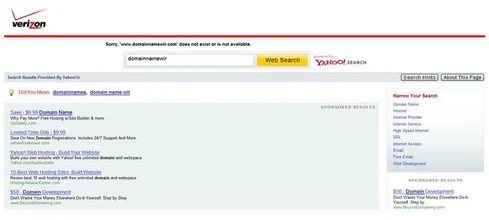
Although not won over by her arguments, I let it rest. But recently I received some screenshots of just how Verizon’s error pages look. Here’s one for DomainNameWir.com (notice the missing ‘e’):
Notice that most of the page is just ads. Where are the organic listings? They’re there, but they’re below the fold. It’s clear that the intent of this page is to get you to click on an ad. If it were to help you find the site you mistyped, the organic listings would be at the top of the page.
As for a suggestion of which web site you really meant to visit, apparently your web site needs to be bigger than just the 29,989th most trafficked site on the web to qualify.
To be fair, I’m sure Deutsch would rather her firm not offer this service. Someone within these firms sees a money making opportunity, agrees to terms, and then forces it on the IT department to implement and deal with clients’ furor. I doubt the intellectual property attorney is consulted in the process; they just have to defend it when their firm’s hypocrisy is called out.
Just how much revenue do firms earn from error redirects? It’s hard to tell. Google advertisers get a break out of how much traffic they get from error pages. In my experience, it’s dwarfed by the amount of parking traffic my campaigns get. And although Google notes the specific parked pages that served ads, it doesn’t show which error pages served up ads.
But the revenue is meaningful. Otherwise Google, Yahoo, and these firms wouldn’t put up with the kicking and screaming from their clients.
Note: hypocrisy.com is a real web site, unrelated to this article.