
Revolutionizing Domain Name Dispute Resolution: Unveiling UDRP.tools for Advanced Analysis
In the complex world of domain name disputes, having access to comprehensive and actionable data can be the difference between winning and losing. Recognizing this critical need, a powerful new search and analysis platform, UDRP.tools, has officially launched. Developed by a team of respected domain name industry veterans, this innovative tool is poised to transform how legal professionals, brand owners, and domain investors approach cases under the Uniform Domain Name Dispute Resolution Policy (UDRP).
While other UDRP search tools exist, UDRP.tools distinguishes itself by offering unparalleled depth and breadth of data, making it an indispensable resource for anyone involved in cybersquatting cases. Its unique features, such as detailed case citations and intricate panelist statistics, provide insights that were previously difficult, if not impossible, to obtain efficiently. This granular level of analysis empowers users to build stronger cases, understand historical precedents, and strategically navigate the UDRP process with newfound confidence.
Understanding the Uniform Domain Name Dispute Resolution Policy (UDRP)
Before diving deeper into the capabilities of UDRP.tools, it’s essential to understand the framework it supports. The Uniform Domain Name Dispute Resolution Policy (UDRP) is a streamlined administrative procedure established by the Internet Corporation for Assigned Names and Numbers (ICANN). It provides an efficient and cost-effective mechanism for resolving disputes between trademark holders and domain name registrants, particularly concerning alleged cybersquatting – the bad-faith registration of a domain name identical or confusingly similar to a trademark.
The UDRP process aims to offer an alternative to traditional litigation, which can be time-consuming and expensive. Under the UDRP, a complainant must prove three key elements to succeed: (1) the domain name is identical or confusingly similar to a trademark in which the complainant has rights; (2) the registrant has no rights or legitimate interests in respect of the domain name; and (3) the domain name has been registered and is being used in bad faith. Decisions are rendered by independent panelists appointed by approved dispute resolution providers, such as the World Intellectual Property Organization (WIPO) and the National Arbitration Forum (NAF).
Given the nuanced nature of UDRP cases, involving complex legal arguments, varying panelist interpretations, and a vast body of prior decisions, effective research and strategic planning are paramount. This is precisely where UDRP.tools steps in, simplifying and enhancing the strategic decision-making process for all stakeholders.
The Visionaries Behind UDRP.tools
The creation of UDRP.tools is a testament to the collaborative spirit and deep expertise within the domain name industry. The platform was developed by a formidable trio of industry veterans, each bringing a unique set of skills and insights to the project. Kevin Ohashi, known for his work with the web host comparison site ReviewSignal, contributed his technical prowess and understanding of data management. Michael Sumner, the architect behind the renowned domain sales data site NameBio, provided invaluable expertise in structuring and presenting vast datasets in an accessible manner. Their combined efforts were further augmented by the strategic assistance of Nat Cohen, a well-known figure and respected commentator within the domain name space.
This collaboration of technical acumen, data analysis proficiency, and industry insight has culminated in a tool that is not only robust and comprehensive but also intuitively designed to meet the specific needs of UDRP practitioners. Their shared goal was to demystify the UDRP process, making critical information more transparent and actionable for everyone involved.
Unprecedented Analytical Power: Key Features for Strategic Advantage
UDRP.tools is more than just a search engine; it’s a sophisticated analytical platform designed to provide a competitive edge. Its standout features offer distinct advantages for preparing, prosecuting, and defending UDRP cases:
Deep Dive into Case Citations: Unlocking Winning Strategies
One of the most revolutionary features of UDRP.tools is its comprehensive Case Citations Report. For the first time, users can easily identify which previous UDRP decisions are most frequently cited by successful complainants or respondents in cases similar to their own. This capability is invaluable for legal professionals seeking to bolster their arguments with strong precedents.
Imagine you are defending a client against a cybersquatting claim involving a generic domain name. With UDRP.tools, you can filter for cases with analogous facts and outcomes, and then instantly see which foundational cases were referenced by the winning parties. This essentially provides you with a “playbook” of proven legal arguments and cited authorities. By understanding the judicial reasoning and specific precedents that have swayed panelists in the past, attorneys can refine their legal strategies, anticipate opposing arguments, and present their case with greater precision and authority. This feature significantly reduces the time spent on manual research, allowing for a more focused and effective legal approach.
Panelist Statistics and Outcome Reports: Strategic Panel Selection
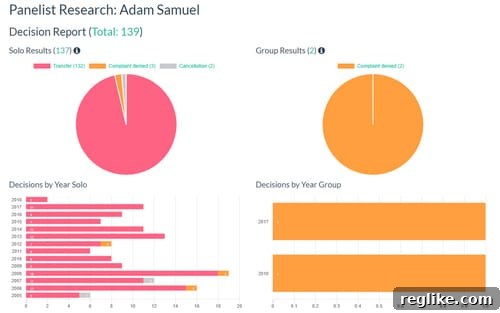
Another game-changing feature is the Panelist Outcomes Report. The choice of a panelist, particularly in a three-member panel, can significantly influence the outcome of a UDRP dispute. Until now, gaining a detailed understanding of individual panelists’ decision-making patterns was a labor-intensive process, often relying on anecdotal evidence or fragmented searches. UDRP.tools changes this entirely.
The platform provides statistical breakdowns of how specific panelists have ruled in various types of cases. For instance, if you are defending a three-letter .com domain, you can not only pull up all similar LLL.com cases but also filter them to identify instances where Reverse Domain Name Hijacking (RDNH) was found – a critical defense strategy. More importantly, the Panelist Outcomes Report allows you to see which panelists have historically ruled in favor of registrants in LLL.com cases, or those where RDNH was considered. This empirical data is incredibly powerful when nominating a panelist or evaluating the potential biases or inclinations of the opposing party’s nominee.
As Michael Sumner aptly illustrates:
Let’s say you are defending a three-letter dot-com domain. You can not only pull up all LLL.com cases, you can also filter for ones where RDNH was found to mount the strongest possible defense. With the Citations Report you can see which cases those winners cited most frequently, basically giving you the playbook for how they won. But now you need to nominate one of hundreds of panelists to your three-member panel, with the Outcomes Report you can easily see who is most likely to find in your favor based on their past decisions in LLL.com cases.
This level of insight moves panelist selection from an educated guess to a data-driven strategic decision, significantly enhancing the chances of a favorable outcome.
Comprehensive Database and Advanced Filtering Capabilities
UDRP.tools aggregates data from all major UDRP dispute resolution providers. This includes the vast archives of the World Intellectual Property Organization (WIPO), the National Arbitration Forum (NAF), and the Czech Arbitration Court (CAC). This comprehensive coverage ensures that users have access to a complete picture of UDRP jurisprudence, regardless of the forum.
Beyond its breadth, the platform excels in its filtering capabilities. Users can refine their searches by various parameters, including specific domain types (e.g., LLL.com, brand.tld), case outcomes (e.g., transfer, denial, RDNH finding), dates, panelists involved, and even keywords within the decisions themselves. This advanced filtering allows users to quickly hone in on the most relevant cases, making research exceptionally efficient and targeted.
Who Benefits from UDRP.tools?
UDRP.tools is designed to be an invaluable resource for a diverse range of professionals:
- Legal Professionals and Attorneys: For lawyers specializing in intellectual property and domain law, the tool offers unparalleled strategic insights into case precedents, panelist tendencies, and common arguments, saving countless hours of research and strengthening case preparation.
- Brand Owners and In-House Counsel: Companies looking to protect their trademarks online can proactively research potential disputes, understand their chances of success, and identify recurring patterns in cybersquatting attempts.
- Domain Investors and Registrants: Those who register and develop domain names can use the tool to understand the risks associated with certain domain types, assess potential UDRP challenges, and prepare robust defenses if a dispute arises.
- Academics and Researchers: The comprehensive, searchable database provides a rich resource for studying trends in domain name disputes, legal outcomes, and the evolution of UDRP jurisprudence.
Accessibility and Pricing Structure
UDRP.tools is committed to making its powerful analytics accessible. The platform offers a free tier for initial exploration: users can perform up to five searches per day without registration. For those who require more extensive research, registration is free and includes 50 non-expiring search credits, allowing deeper engagement with the tool’s features.
Additional search credits are available for purchase, offering a flexible payment model that caters to varying usage needs. This tiered approach ensures that casual users can benefit from basic searches, while professionals requiring in-depth, ongoing analysis have access to cost-effective options for comprehensive data retrieval and strategic planning.
Conclusion: An Essential Tool for Modern Domain Dispute Resolution
The launch of UDRP.tools marks a significant leap forward in the field of domain name dispute resolution. By integrating advanced search capabilities with detailed analytical reports on case citations and panelist statistics, the platform addresses long-standing challenges in UDRP research and strategy. It empowers users with actionable intelligence, transforming what was once a time-consuming and often opaque process into a transparent and data-driven endeavor.
Whether you are prosecuting a trademark infringement, defending a domain name registration, or simply seeking to understand the intricacies of UDRP jurisprudence, UDRP.tools provides the comprehensive data and strategic insights necessary to navigate these complex cases with greater efficiency and a higher probability of success. It is an indispensable resource for anyone seeking to gain a competitive edge in the evolving landscape of domain name disputes.