
Crafting a High-Converting Landing Page and Sign-Up Form: A Rapid Deployment Guide
In today’s fast-paced digital landscape, the ability to quickly launch effective marketing assets is paramount for businesses, entrepreneurs, and content creators alike. Whether you’re promoting a new product, collecting leads, or growing your newsletter audience, a dedicated landing page is often the most efficient tool for driving conversions. This past weekend, I faced precisely such a challenge: I needed to create a sign-up page for my wife’s new newsletter – and I needed it fast. The traditional route of setting up a new hosting account, installing WordPress, and configuring a MailChimp integration plugin felt like an unnecessary time sink.
The quest for speed and simplicity led me to explore modern alternatives: landing page generators. These platforms promise to streamline the entire process, handling everything from design and hosting to seamless form integration with email marketing services. The idea of bypassing the technical complexities and focusing solely on the message and design was incredibly appealing, especially under a tight deadline.
The Power of Dedicated Landing Page Builders: Why They Outperform Traditional Methods
Before diving into my specific experience, it’s worth understanding why dedicated landing page builders have become indispensable tools for digital marketers. Unlike general-purpose website builders or content management systems like WordPress, landing page platforms are hyper-focused on one goal: conversion. They offer intuitive drag-and-drop interfaces, a vast library of professionally designed templates optimized for various industries and campaign types, and built-in features for A/B testing, analytics, and CRM integrations. This specialization allows users, even those with no coding or design experience, to create visually appealing and highly functional pages in a fraction of the time it would take using traditional methods.
The common pain points addressed by these platforms include:
- Time-Consuming Setup: Eliminating the need for server setup, CMS installation, and plugin configurations.
- Design Constraints: Providing access to conversion-optimized templates and easy customization without graphic design skills.
- Technical Expertise: Simplifying complex integrations (like MailChimp, HubSpot, Salesforce) with a few clicks.
- Hosting Management: Offering integrated hosting solutions, removing the hassle of external web hosting.
- Conversion Optimization: Including features like A/B testing, heatmaps, and analytics to continuously improve performance.
For someone like me, who needed a quick, clean, and effective solution without getting bogged down in technical minutiae, a landing page builder was the clear path forward.
Choosing the Right Tool: Instapage vs. LeadPages
With a clear understanding of the benefits, my next step was to identify the best platform. A quick search revealed several popular solutions, but two names consistently emerged as industry leaders: Instapage and LeadPages. Both are renowned for their robust feature sets and user-friendly interfaces, making the choice a critical one for my project’s success.
After a brief initial review, I decided to give Instapage a try. My decision was primarily influenced by two key factors:
- Risk-Free Trial: Instapage offered a free 30-day trial that didn’t require me to enter any credit card information. This “try before you buy” approach was incredibly appealing, allowing me to fully test the platform’s capabilities without any financial commitment. LeadPages, on the other hand, primarily offered a money-back guarantee, which still requires an upfront payment.
- Ethical Business Practices: I became aware of some public controversies surrounding LeadPages, particularly an incident involving allegations of “reverse domain name hijacking.” While this might not deter everyone, for me, it raised a red flag regarding their business ethics, making Instapage a more reassuring choice.
These considerations, especially the no-risk trial, made Instapage the obvious starting point for my rapid landing page deployment.
My Instapage Journey: From Initial Hurdles to Rapid Success
My first few minutes with Instapage were a mixed bag. The platform’s overall simplicity and powerful features were evident, but I almost stumbled at the very beginning due to a common user onboarding challenge. Instead of presenting a straightforward template selection page, Instapage guided me through a tutorial designed to help me create my “first” template.
Navigating the Onboarding Experience
While the intention behind a guided tutorial is often good – to educate new users – in this instance, it felt more like a roadblock. It wasn’t immediately clear that it was a tutorial, and I found myself wishing for a simple “skip” button to just dive in and pick a template. The process felt more prescriptive than empowering, adding an unnecessary layer of complexity when all I wanted was speed. I couldn’t find an obvious way to exit the tutorial, so I had to follow the steps, which included creating a dummy page. This initial friction, though minor, highlights the importance of intuitive user onboarding, especially for users like me who prefer to explore independently after a quick overview.
Unleashing Creative Freedom: Template Selection and Customization
Once I navigated past that initial hurdle, the true power of Instapage became apparent. The platform offers a vast array of beautiful, conversion-optimized templates catering to diverse needs, from lead generation to product launches and event registrations. The drag-and-drop editor is exceptionally intuitive, allowing for precise control over every element on the page. I quickly selected a template that closely matched my needs for a simple sign-up form. The beauty of these templates lies not just in their aesthetic appeal but also in their modularity.
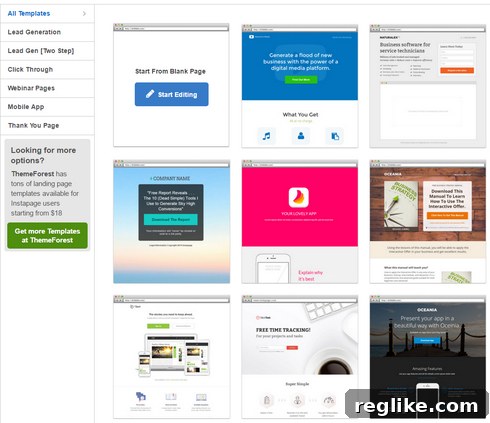
For my wife’s newsletter, I needed a clean, focused page with a clear call to action. The chosen template, while excellent, included several sections that were not necessary for my specific goal, such as testimonials, detailed feature lists, and multiple call-to-action buttons. With Instapage’s editor, deleting these superfluous sections was as simple as a click, instantly streamlining the page and enhancing its core message. This level of flexibility meant I wasn’t constrained by the template but rather empowered by it, using it as a starting point to quickly achieve my desired minimalist design. The ability to easily add, remove, and rearrange content blocks truly sets these platforms apart, allowing for rapid iteration and customization.
The 15-Minute Milestone: A Testament to Efficiency
With the onboarding complete and the editor at my fingertips, the process became incredibly efficient. I added my content, customized the form fields, adjusted the colors to match the newsletter’s branding, and made a few minor layout tweaks. The entire process, from selecting a template to publishing a fully functional and aesthetically pleasing landing page, took approximately 15 minutes. This incredible speed is precisely why dedicated landing page builders are so valuable. Within a quarter of an hour, I had transformed a vague requirement into a live, conversion-ready asset. You can see the result of this rapid deployment here: my created landing page.
The speed was not just about getting a page live, but about freeing up valuable time that would otherwise be spent on technical configurations. This efficiency allows marketers and business owners to focus on what truly matters: crafting compelling copy, designing engaging visuals, and analyzing campaign performance.
Exceptional Support and Seamless Hosting
Even with highly intuitive platforms, minor issues can sometimes arise. I encountered a small challenge while trying to precisely resize a background image to fit a specific aesthetic. Rather than spending time troubleshooting myself, I reached out to Instapage’s support team.
Responsive and Educational Customer Support
My experience with Instapage’s customer support was outstanding. Not only did the support person quickly resolve the background resizing issue for me, but they went above and beyond by sending a screen capture video demonstrating exactly how they made the change. This proactive approach was incredibly valuable, transforming a simple support query into a learning opportunity. It highlighted their commitment not just to fixing problems, but to empowering users to become more proficient with their platform. Such high-quality, educational support significantly enhances the user experience and builds trust.
Effortless Custom Domain Integration
Once the page was designed and ready, the next step was to make it accessible via a custom domain. Instapage simplifies this process tremendously. Instead of complex server configurations, all I had to do was create a CNAME record at my domain registrar, GoDaddy, pointing to the Instapage server. This simple, one-step process ensured that the landing page was hosted under my desired domain, maintaining brand consistency and improving professionalism. The ease of custom domain setup is another critical advantage of using a dedicated landing page builder, removing yet another technical barrier for users.
The Value Proposition: Pricing and Future Considerations
Instapage’s comprehensive features and ease of use come at a cost, reflecting the significant value it provides. Their packages start at $29 per month when paid annually. This pricing structure places Instapage in the premium segment of the market, which is generally justifiable for businesses and individuals who frequently create multiple landing pages and lead forms, or those managing extensive digital marketing campaigns.
Is the Price Right for Everyone?
For agencies or larger businesses running numerous A/B tests and needing advanced analytics and CRM integrations, the cost-benefit analysis often favors such a robust platform. The efficiency gains, conversion uplift, and advanced features can easily justify the annual expenditure of $348. However, for someone with limited needs—perhaps just a single, simple sign-up page linking to MailChimp, like my scenario—the value proposition becomes a bit more nuanced. In such cases, the annual cost might seem disproportionately high, especially if the page isn’t constantly being optimized or if the lead volume is low.
When considering alternatives for a very basic, single-page requirement, paying someone to set up a simple WordPress site on a domain and integrate MailChimp directly might appear more cost-effective in the long run. While it sacrifices the speed and drag-and-drop simplicity of Instapage, the one-time setup cost for a simple site could be less than a year’s subscription to a premium landing page builder.
A Call for More Flexible Pricing
This leads to a recurring thought: it would be incredibly beneficial if Instapage, and similar high-end platforms, offered a more accessible “starter” or “light” package. Imagine a tier priced around $5 to $10 per month, designed for users with very limited needs – perhaps for a single landing page, basic analytics, and one integration. Such a package would significantly broaden their market reach, catering to solo entrepreneurs, small personal projects, or those just dipping their toes into digital marketing without the need for extensive features. It would allow more users to experience the power of these platforms before committing to a higher-tier plan, ultimately fostering a larger community and potentially converting more users to full-price plans as their needs grow.
Final Thoughts: Embracing Efficiency in Digital Marketing
My experience with Instapage unequivocally demonstrated the immense value of dedicated landing page builders for rapid deployment and efficient lead generation. From overcoming initial user experience quirks to leveraging intuitive design tools and experiencing stellar customer support, the journey reinforced the idea that modern marketing demands tools that prioritize speed, ease of use, and conversion optimization. The ability to create a professional, high-converting sign-up page in just 15 minutes is a testament to the power of these platforms.
While the pricing structure encourages a strategic consideration of needs versus investment, the overall benefits for businesses focused on scaling their online presence are undeniable. For anyone looking to launch effective campaigns quickly and without technical headaches, exploring a dedicated landing page builder like Instapage is a highly recommended step. The digital landscape continues to evolve, and tools that simplify complex tasks will always be at the forefront of successful online strategies.