
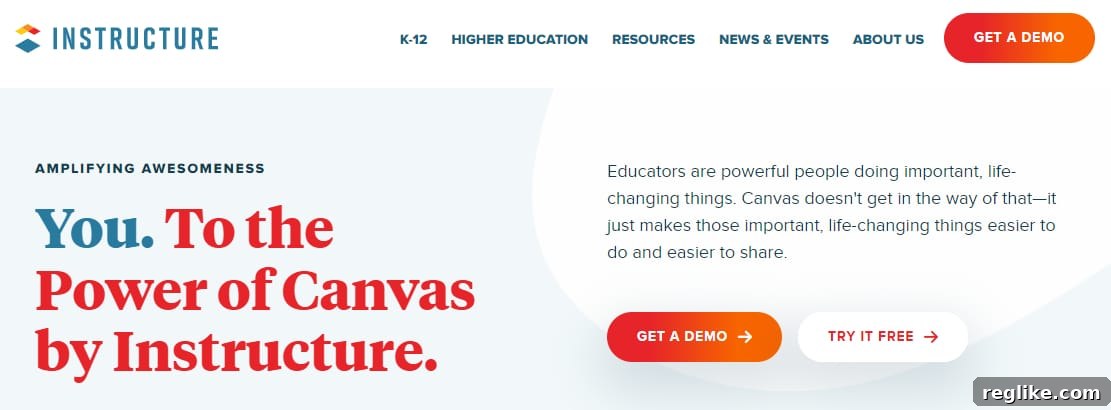
The highly coveted domain, canvas.com, now officially points to Instructure’s Canvas brand page, marking a pivotal moment in the competitive education technology (EdTech) sector.

After an extended and often contentious legal battle centered around the “Canvas” brand, the premium domain name canvas.com has definitively transitioned, now directing visitors to Instructure.com. This development confirms long-standing speculation and concludes a significant saga in the digital brand landscape.
The domain’s journey has been closely watched by industry insiders. In recent weeks, observations showed the domain name migrating from GoDaddy to Namecheap, a registrar Instructure frequently utilizes. Further evidence emerged with Instructure actively monitoring traffic to the domain via a specific tracking URL, strongly indicating direct ownership and strategic intent. These movements coalesce into a clear picture: Instructure, the prominent EdTech company behind the Canvas Learning Management System (LMS), has successfully acquired the highly valuable digital asset, canvas.com.
The Genesis of a High-Stakes Legal Confrontation
The roots of this dispute trace back to November 2021, when Instructure (NYSE: INST) initiated legal action against a startup, also named Canvas. Instructure’s lawsuit asserted that the startup’s rebranding from “Jumpstart” to “Canvas” constituted a clear infringement upon its established trademarks. This wasn’t merely a naming conflict; it was a fundamental clash over brand identity and market positioning in a rapidly evolving industry.
For Instructure, a recognized leader with a well-entrenched product used by millions globally, protecting its brand “Canvas” was paramount. Trademark law exists precisely to prevent consumer confusion and safeguard the goodwill associated with a brand. The startup’s choice of “Canvas” posed an immediate threat, potentially diluting Instructure’s brand and creating ambiguity in the marketplace, particularly for potential customers navigating the EdTech ecosystem.
A Swift and Decisive Judicial Intervention
The legal proceedings moved with remarkable speed. In January 2022, the presiding judge issued a preliminary injunction, a powerful legal tool that demands immediate action to prevent further harm. This injunction decisively favored Instructure, ordering the startup to cease using the “Canvas” brand within 15 days. Crucially, this mandate extended to changing its domain name, explicitly prohibiting the continued use of Canvas.com.
A preliminary injunction is a serious matter, often indicating that the court believes the plaintiff has a high likelihood of succeeding on the merits of the case. For the startup, this was a devastating blow, effectively crippling its brand identity just as it was trying to establish itself. Despite appealing the decision, the startup was unable to convince the appeals court to reverse the preliminary injunction. The judicial system stood firm on the initial ruling, reinforcing the gravity of trademark protection.
Contempt of Court and the Inevitable Rebrand
Facing insurmountable legal pressure and having missed the court-imposed deadline, the startup found itself in an even more precarious position. In February 2022, the judge found the startup in contempt of court, imposing a daily fine of $2,500 for its non-compliance. This ruling underscored the judiciary’s resolve and served as a stark reminder of the consequences of disregarding court orders. The fines rapidly accumulated, placing immense financial strain on the young company.
With its legal avenues dwindling and the financial penalties mounting, the startup had little choice but to concede. It officially rebranded to “Untapped” and migrated its operations to the new domain, untapped.io. This rebranding was a direct consequence of the legal defeat, forcing a complete overhaul of its market presence and identity. Alongside this rebrand, the startup entered into a settlement agreement with Instructure, bringing an end to the protracted legal dispute.
The Elusive Details: What Happened to Canvas.com?
While the settlement brought an end to the direct legal confrontation, one significant question remained shrouded in mystery: what would be the ultimate fate of the canvas.com domain name? The situation was particularly complex because the startup, “Canvas” (now Untapped), did not actually own the domain outright. Instead, it had entered into a lease-to-own agreement with the domain’s legal owner, Branded Holding Group, LLC.
Adding another layer to this intricate narrative, Instructure itself had attempted to acquire canvas.com prior to the startup’s lease agreement. However, Instructure reportedly balked at the asking price at that time, highlighting the significant premium attached to such a highly desirable domain. This earlier attempt demonstrates Instructure’s long-standing interest in securing this digital asset.
The settlement terms between Canvas/Untapped and Instructure were, as is common in such agreements, not publicly disclosed. This secrecy fueled speculation regarding the domain’s transfer. Was there a clause in the original lease agreement between Branded Holding Group and the startup that compelled the startup to defend the domain in legal challenges? Or, did the settlement agreement explicitly stipulate that the startup would acquire the domain from Branded Holding Group and then immediately transfer it to Instructure? The precise mechanism by which Instructure ultimately secured ownership remains unclear at this point.
Instructure’s Strategic Vision: Securing a Digital Cornerstone
Instructure’s relentless pursuit of canvas.com underscores the immense strategic value it places on digital assets and brand coherence. In the digital age, a domain name like canvas.com is more than just an address; it’s a critical piece of intellectual property, a powerful branding tool, and a direct conduit to potential users. Owning the exact match domain for a flagship product like “Canvas” offers numerous advantages:
- Brand Authority: It solidifies Instructure’s position as the definitive “Canvas” in the EdTech space, leaving no room for ambiguity.
- Enhanced SEO: A direct-match domain can significantly boost search engine optimization, making it easier for users to find Instructure’s products organically.
- User Experience: It simplifies navigation for users, removing any potential confusion or misdirection.
- Competitive Advantage: It prevents competitors or other entities from capitalizing on the brand’s name, protecting market share and brand equity.
- Future-Proofing: Securing such a premium domain is a long-term investment that safeguards the brand against future challenges and strengthens its digital footprint.
This acquisition is a clear indicator of Instructure’s commitment to protecting its intellectual property and reinforcing its market leadership in the EdTech landscape, a sector that relies heavily on digital presence and brand recognition.
Ongoing Inquiry and Unanswered Questions
Despite the apparent conclusion of the domain’s transfer, the specifics of the acquisition remain elusive. Our attempts to gain clarity directly from Instructure last week regarding the acquisition have not yet yielded a response. Furthermore, an email address previously used for Branded Holding Group bounced, suggesting potential changes in their contact information. (We have since reached out to its founder via LinkedIn and will provide updates if and when new information becomes available.)
A review of Instructure’s latest SEC filings also did not reveal any explicit mention of the domain name acquisition, which could imply the transaction was below a material disclosure threshold or structured in a way that doesn’t require immediate public reporting in filings. While it is highly probable that Instructure now holds the complete ownership of canvas.com, the precise financial and contractual details surrounding this significant domain acquisition are yet to be fully transparent.
Implications for the Broader EdTech and Domain Markets
The saga of canvas.com serves as a powerful case study with significant implications for both the EdTech industry and the broader domain market. For startups, it underscores the critical importance of conducting thorough trademark research and securing distinctive brand names and corresponding domains from the outset. Rushing into a name without proper due diligence can lead to costly legal battles, forced rebrands, and potentially existential threats, as demonstrated by the journey of Untapped.
For established companies like Instructure, it highlights the unwavering commitment required to defend intellectual property. In a digital-first world, a company’s brand is often its most valuable asset, and robust protection strategies, including securing key domain names, are indispensable. The willingness to pursue extensive legal action and invest significantly in a premium domain like canvas.com illustrates the high stakes involved in maintaining brand integrity and market dominance.
This acquisition also reaffirms the intrinsic value of premium, exact-match domains. Such domains are finite assets that command substantial prices and can act as powerful competitive differentiators. Their scarcity, combined with their ability to enhance brand recognition and simplify user access, makes them highly sought after by companies aiming for long-term digital leadership.
Conclusion: A New Chapter for Canvas.com
The official redirection of canvas.com to Instructure’s brand page marks the end of a complex legal and digital tussle. This acquisition is a strategic triumph for Instructure, consolidating its brand identity and significantly strengthening its digital footprint in the competitive EdTech space. While the precise terms of the acquisition may remain private, its implications are clear: Instructure has firmly asserted its claim over the “Canvas” brand, ensuring clarity for its users and cementing its position as a leading innovator in education technology.
The journey of canvas.com, from a contested asset to a definitive brand gateway for Instructure, exemplifies the critical importance of digital brand protection and the enduring value of premium domain names in today’s interconnected world. It’s a compelling narrative that underscores how legal strategy, market foresight, and a robust understanding of digital assets converge to shape corporate success.