
Domain Name Expiration Incident: A Podcast Recording Interrupted
In the world of digital content creation, maintaining a consistent online presence is crucial. For podcasters and other online content creators, this means ensuring that their domain names are always active and accessible. Recently, I experienced a rather ironic situation: a domain expiration occurred while I was in the middle of recording a podcast interview. This incident highlighted the importance of proactive domain name management and the potential consequences of overlooking renewal deadlines.
The Internet Corporation for Assigned Names and Numbers (ICANN) plays a vital role in overseeing the domain name system. ICANN has implemented several policies designed to protect domain name owners from accidentally losing their domains. These policies mandate that registrars take specific steps to alert domain owners when their domain is approaching expiration. One key measure is the “interruption” of the website by changing the domain’s nameservers. This action ensures that website visitors are redirected to a parking page or an expiration notice, effectively notifying the domain owner that their domain is no longer active. This interruption serves as a critical warning, giving the owner an opportunity to renew the domain if they have missed previous renewal notifications.
While ICANN’s policies primarily apply to generic top-level domains (gTLDs) like .com, .org, and .net, the principles of domain expiration management extend to country code top-level domains (ccTLDs) as well. Although ccTLD operators are not directly bound by ICANN’s policies, many of them implement similar practices to protect their domain name holders. These practices often include sending expiration notices and interrupting website functionality to prompt renewal.
The Unfortunate Interruption During a Podcast Recording
The irony of the situation wasn’t lost on me. I was in the midst of recording an interview for the Domain Name Wire Podcast when I experienced a DNS interruption firsthand. This incident underscored the importance of understanding the domain name system and the potential vulnerabilities that can arise if domain names are not properly managed.
For my podcast recordings, I rely on a platform called Squadcast. Squadcast is a valuable tool for capturing high-quality audio from both sides of a conversation, ensuring a superior audio output compared to using standard video conferencing platforms like Zoom. The platform records audio locally, ensuring no data loss due to unstable internet connections.
Squadcast operates under the domain name squadcast.fm. This domain is essential for accessing the platform and managing podcast recordings.
After completing my interview, I encountered an unexpected error message stating that the full audio file could not be uploaded. Initially, I attempted to resolve the issue by refreshing the browser, hoping it was a temporary glitch. However, instead of the Squadcast platform, I received a security warning indicating that the site’s connection was not private. This raised immediate concerns, suggesting a potential problem with the domain’s SSL certificate or the domain itself.
Bypassing the security warning, I was redirected to a generic parking page. This confirmed my suspicion: the squadcast.fm domain was no longer resolving to the Squadcast platform. The parking page indicated that the domain was either expired or temporarily unavailable.
Investigating the Domain Expiration
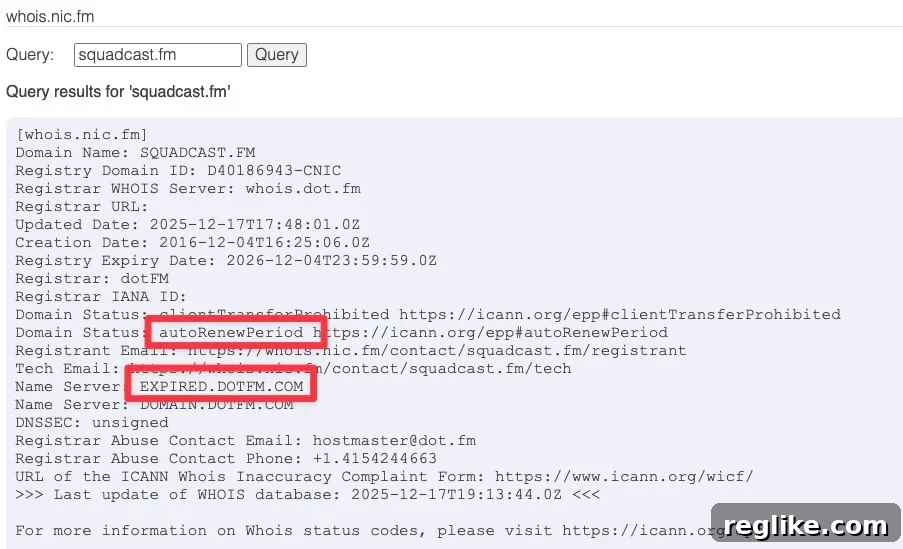
As a domain enthusiast, my immediate reaction was to investigate the .fm Whois server to determine the cause of the issue. The Whois database provides publicly accessible information about domain name registrations, including the registration date, expiration date, and nameserver information.
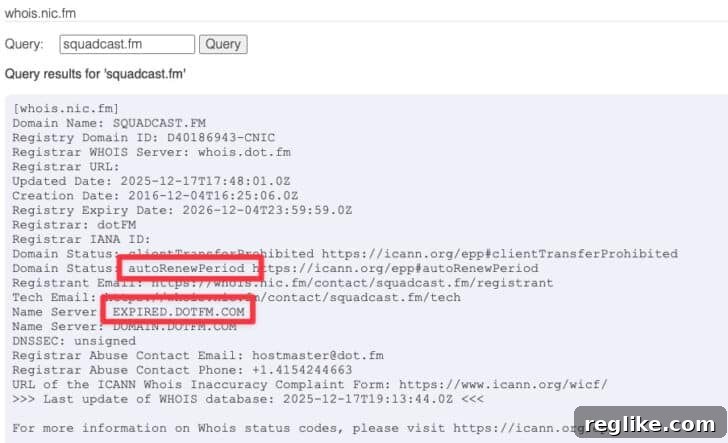
The Whois record, as illustrated above, revealed that the squadcast.fm domain had indeed expired on December 4th. Furthermore, the nameserver information showed that the domain’s nameservers had been changed to expired.dotfm.com. This indicated that the .fm registry had taken action to interrupt the website’s functionality due to the domain’s expiration.
According to my understanding, the .fm registry typically changes nameservers approximately two weeks after a domain expires. Unfortunately, this particular incident occurred precisely while I was recording my podcast interview, disrupting my workflow and potentially jeopardizing the recording.
Swift Action and Resolution
Recognizing the urgency of the situation, I immediately contacted Squadcast’s support team to inform them about the domain expiration. I also reached out to the .fm registry to bring the issue to their attention. Given the popularity of the .fm domain extension within the podcasting industry, it was imperative that the domain be restored as quickly as possible.
Fortunately, the .fm registry responded promptly and collaborated with Squadcast to renew the domain. By the evening, the domain was resolving correctly, and the Squadcast platform was once again accessible. This swift action prevented further disruption and ensured that the podcast recording could be recovered.
Lessons Learned and the Importance of Domain Management
While it was undoubtedly unfortunate that the domain expiration occurred during a live podcast recording, I was fortunate to have a local backup of the interview. This precautionary measure prevented the loss of valuable content. However, the incident served as a valuable reminder of the importance of diligent domain name management.
The potential consequences of domain expiration could have been far more severe. Had the registry not interrupted the nameservers, the domain could have entered a full deletion process without Squadcast’s awareness. This could have resulted in the permanent loss of the domain name and significant disruption to their business operations.
This experience highlights the critical role that ICANN policies and ccTLD operators play in safeguarding domain name holders. By implementing expiration notification systems and interrupting website functionality, they provide a crucial safety net against accidental domain loss.
For businesses and individuals who rely on their domain names for their online presence, it is essential to implement robust domain name management practices. These practices should include:
- Setting up automatic renewal for domain names
- Monitoring domain expiration dates
- Ensuring that contact information is up-to-date
- Implementing redundancy measures, such as using multiple domain registrars
By taking these proactive steps, domain owners can minimize the risk of domain expiration and ensure the continuity of their online presence. In the digital age, a well-managed domain name is an invaluable asset that should be protected with diligence and care. This incident served as a real-world example of why domain name management is critical for any business or individual with an online presence, and it should not be overlooked. Losing a domain, even for a short period, can have serious repercussions.
Ultimately, this experience underscored the importance of understanding the infrastructure that supports our digital world. From ICANN policies to ccTLD operator practices, numerous mechanisms are in place to ensure the smooth functioning of the internet. However, it is equally important for individuals and organizations to take responsibility for managing their own digital assets and protecting their online identities. The next time you receive a domain renewal notice, don’t ignore it. Take a moment to ensure that your domain is properly managed and that your online presence remains secure.