
PayPal’s Stance on Epik: The Masterbucks Tax Controversy Unpacked
The digital landscape often sees major players parting ways, but few instances ignite as much debate as a prominent payment processor severing ties with a well-known service provider. Such was the case recently when PayPal made the decision to cease providing its services to Epik, a significant domain name registrar and web hosting company. While initial speculation centered on Epik’s controversial client base, a deeper investigation reveals that the core issue appears to be rooted in Epik’s proprietary “Masterbucks” system, an alternative currency pitched with potentially misleading tax advantages.
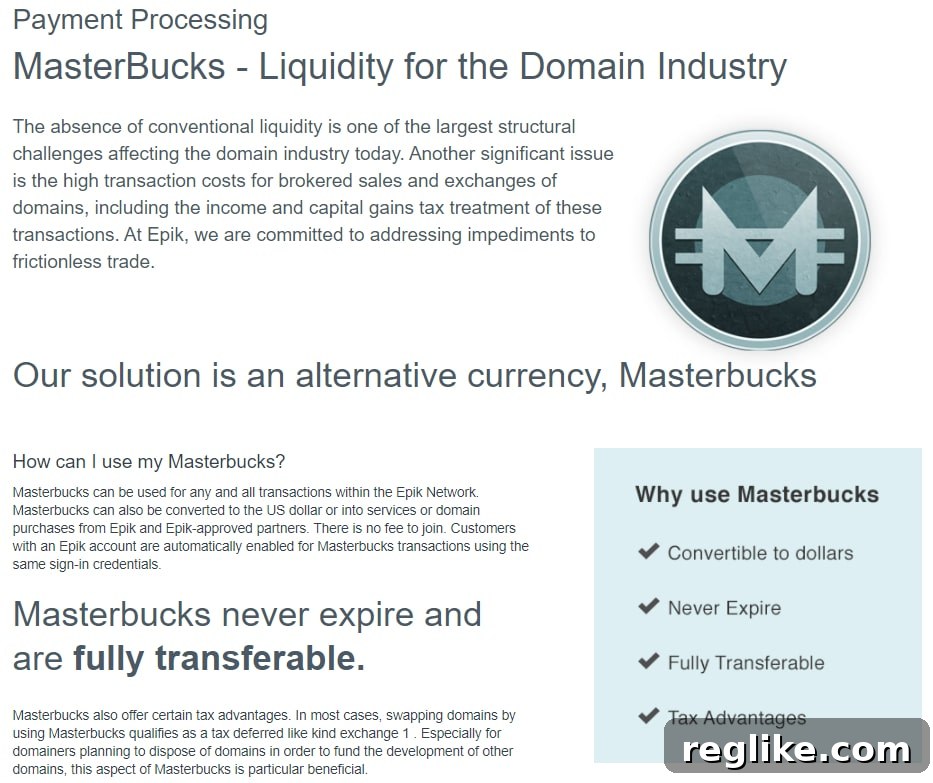
The news first broke when Domain Name Wire reported on PayPal’s decision to drop Epik. This immediately sparked widespread discussion across the internet, with many observers initially attributing the move to Epik’s reputation for hosting politically fringe and far-right websites. However, subsequent reporting by Mashable writer Matt Binder confirmed directly with PayPal that the decision was unrelated to Epik’s clientele. Instead, a confidential source revealed that the dispute stemmed from Epik’s Masterbucks system, shining a spotlight on the intricacies of financial compliance in the digital domain industry.
The Unraveling: Epik’s Response and the Vanishing Information
In the wake of this controversy, Epik swiftly reacted by taking down a blog post that contained several letters it had issued in response to the situation. More significantly, the main informational page about Masterbucks on its official website was also removed. Google’s cache data indicates that this crucial Masterbucks page disappeared between recent days, suggesting a rapid response to the public scrutiny. While the primary service page was removed, a knowledge base article detailing the use of Masterbucks remained accessible online for a period. Interestingly, an update noted that the PayPal letters on Epik’s blog became accessible again, and the original Masterbucks page URL (epik.com/services/masterbucks), which previously returned a 404 error, now redirects to a separate website at Masterbucks.com. This series of actions—removing, then partially restoring or redirecting content—raises questions about Epik’s strategy in managing information surrounding this contentious issue and potentially attempting to reframe the Masterbucks narrative or distance it from the main Epik brand.
Demystifying Masterbucks: More Than Just Store Credit?
Given the intense controversy and PayPal’s firm stance, a closer examination of the Masterbucks concept is essential. Epik positioned Masterbucks as a novel “alternative currency” designed specifically for the domain name ecosystem. However, upon closer inspection, it functions primarily as a form of store credit within the Epik platform. The operational mechanics are straightforward: when Epik customers successfully sell domain names through the platform, they have the option to receive their proceeds in Masterbucks. This internal credit can then be utilized for a variety of Epik services, including registering new domain names, acquiring existing domains on the aftermarket, and facilitating other platform-specific transactions. Furthermore, users were able to deposit “real” money into their Masterbucks accounts to increase their balance and, conversely, withdraw Masterbucks back into traditional currency. The appeal for domain investors and traders was clear: a seamless internal economy designed to facilitate frequent transactions.
However, the true contentious element lay in Epik’s ambitious promotion of Masterbucks as a tax-efficient mechanism for buying and selling domain names. Rob Monster, the CEO of Epik, was a vocal proponent of this aspect. In a notable post on the industry forum NamePros, dating back to the previous year, Monster explicitly articulated the purported tax benefits:
Proceeds can be held in the form of in-store-credit until redeemed. Redemption to cash is a taxable event, however trading domains for domains is a like-for-like exchange for which there should be no taxable event. Depending on your jurisdiction, you should consult with your tax advisor, but we have yet to see a challenge.
Monster’s assertion that “trading domains for domains is a like-for-like exchange for which there should be no taxable event” was central to Masterbucks’ marketing. This statement implicitly, and often explicitly, linked Masterbucks transactions to the concept of a 1031 exchange, a specific provision within U.S. tax law designed to defer capital gains taxes.
The Core Contention: Masterbucks and the 1031 Exchange Claim
To fully grasp the gravity of the situation, it’s crucial to understand what a 1031 exchange (also known as a like-kind exchange) entails. This is a common and legitimate tax strategy frequently employed by real estate investors in the United States. The principle is simple yet powerful: when a real estate investor sells an investment property and realizes a capital gain, they can essentially roll that gain into the purchase of another “like-kind” investment property, thereby deferring the payment of capital gains taxes until a later date, often indefinitely if they continue to perform 1031 exchanges. This deferral can be a significant financial advantage, allowing investors to reinvest their full proceeds without immediate tax burden.
Historically, the 1031 exchange provision was indeed applied to various types of property beyond just real estate. However, a pivotal change occurred with the passage of the Tax Cuts and Jobs Act (TCJA) in 2017. This landmark legislation fundamentally altered the scope of 1031 exchanges, explicitly stating that, effective January 1, 2018, these exchanges could only be applied to “real property.” This change was a monumental shift, removing personal property, which would typically include assets like domain names, from eligibility for 1031 tax deferral. The intent of the law was clear: limit the benefits of like-kind exchanges to tangible real estate assets.
Despite this significant legislative change, Epik CEO Rob Monster continued to promote the 1031 exchange value proposition for domain names through Masterbucks, even after the TCJA came into effect. This continued advocacy for applying 1031 exchange principles to domain names, post-2017, forms the crux of the controversy and likely became a major concern for PayPal regarding financial compliance and potential legal exposure. The potential for such an interpretation, if valid, would indeed represent a substantial tax advantage for U.S. domain investors, allowing them to defer taxes on gains from domain sales, similar to how real estate investors operate.
The seriousness of Epik’s claims is underscored by Monster’s own statements. In October 2018, nearly a year after the TCJA had limited 1031 exchanges to real property, Monster publicly wrote on Domain Name Wire, stating unequivocally: “We have folks buying and selling daily, tax-free as 1031 transactions.” Such a direct claim, made after the legal change, directly contradicts the updated U.S. tax code, raising alarm bells for any financial institution involved in processing payments for such transactions.
Potential Repercussions and the Broader Implications
The implications of this situation are far-reaching. For Epik customers in the U.S. who relied on Masterbucks and its associated claims to avoid paying taxes on domain name transactions, there could be significant trouble ahead. If the IRS were to challenge these transactions, individuals could face back taxes, penalties, and interest. While Epik’s initial advice included consulting a tax advisor, the specific and repeated claims of “tax-free 1031 transactions” could have misled users into believing they were operating within legal bounds, even when the law had clearly changed.
PayPal’s decision to drop Epik, therefore, appears to be a proactive measure to mitigate its own risk exposure. As a major financial services provider, PayPal is under strict regulatory obligations to ensure that its platform is not used to facilitate activities that could be construed as tax evasion or money laundering. Even if Epik’s intentions were to offer an innovative, legitimate service, the perceived discrepancy between their Masterbucks tax claims and current U.S. tax law likely created an unacceptable level of risk for PayPal. This incident serves as a stark reminder of the increasing scrutiny placed on payment processors to ensure compliance across all services they support, especially when those services involve complex financial instruments or claims of tax advantages.
This case also highlights a broader trend: the convergence of digital asset trading, alternative payment systems, and increasingly stringent financial regulations. As the digital economy evolves, platforms offering unique financial services or claiming novel tax interpretations must operate with utmost transparency and legal rigor. The Epik-PayPal saga underscores the critical importance for all participants in the domain industry – registrars, investors, and platform providers alike – to fully understand and comply with evolving tax laws and financial regulations. Failure to do so can lead to severe operational disruptions, reputational damage, and significant financial liabilities for all parties involved.
In conclusion, while the initial rumors surrounding PayPal’s decision focused on Epik’s controversial client base, the actual catalyst seems to be the Masterbucks system and its alleged tax advantages, particularly its problematic alignment with 1031 exchange laws post-2017. This incident serves as a powerful cautionary tale about the complexities of financial innovation within the digital realm and the uncompromising stance that major financial institutions like PayPal take on compliance and legal integrity.