
The Mastodon Migration: How New Top-Level Domains, Especially .social, Are Redefining Digital Identity
Mastodon’s Rise and the Decentralized Web
In the wake of significant changes at Twitter following Elon Musk’s acquisition, a noteworthy exodus of users has propelled the open-source social network, Mastodon, into the global spotlight. Mastodon has emerged as a compelling Twitter alternative, offering a fresh perspective on social media built on principles of decentralization, transparency, and community-driven governance. Unlike traditional centralized platforms such as Twitter, Facebook, or TikTok, where users subscribe to a single monolithic service, Mastodon operates as a network of independent, interconnected servers, collectively known as the Fediverse.
This fundamental architectural difference means that instead of joining one massive platform, users choose to join a specific “instance” or server running the Mastodon software. These individual servers are independently operated by a diverse range of entities—from dedicated individuals and hobbyists to non-profit organizations and specialized communities. This unique structure grants server administrators greater autonomy over content moderation policies, community guidelines, and the overall user experience, fostering a more tailored and often more intimate online environment. Crucially, for the world of domain names, each of these independent Mastodon servers typically identifies itself with its own distinct second-level domain name, forming the bedrock of its digital identity and accessibility within the Fediverse.
The Critical Role of Domain Names in a Decentralized Ecosystem
In the decentralized landscape of Mastodon, domain names transcend mere website addresses; they serve as the foundational identity for each community and, by extension, for its users. A domain name for a Mastodon instance is not just a URL; it’s a brand, a statement of purpose, and the digital address that users will associate with their online home. For example, the original server maintained by the Mastodon gGmbH non-profit operates under mastodon.social, instantly conveying its nature. Another exemplary instance is learningdisability.social, an inclusive community explicitly designed for individuals with an interest in learning disabilities. The clarity and relevance of such domain names are paramount in attracting and building specific communities.
The choice of a domain name plays a pivotal role in an instance’s discoverability and perceived trustworthiness. A well-selected, memorable, and relevant domain enhances the instance’s appeal, making it easier for potential users to find and identify with its mission. This is especially vital in a vast network like the Fediverse, where thousands of instances coexist, each catering to potentially different interests, languages, or geographical locations. As of recent statistics, the Mastodon network boasts approximately 6.1 thousand active servers and serves an impressive 1.8 million monthly active users, highlighting the immense scale and diversity of this federated ecosystem.
The Rise of New Top-Level Domains (nTLDs) and .social’s Unprecedented Surge
The increasing popularity of Mastodon has brought with it a fascinating trend in domain name selection, particularly the widespread adoption of new Top-Level Domains (nTLDs). These nTLDs, introduced over the past decade, offer a wider array of descriptive and niche-specific extensions beyond the traditional .com, .org, or .net. For Mastodon server owners seeking to clearly articulate their instance’s purpose and foster a distinct brand identity, nTLDs provide an invaluable opportunity.
A review of active Mastodon servers, notably those highlighted on trusted platforms like instances.social and the official joinmastodon.org/servers list, reveals a clear preference for these modern domain extensions. Among the 57 servers specifically listed on Mastodon’s official website that adhere to the Mastodon Server Covenant, the breakdown of Top-Level Domains is particularly telling:
- .social: 19 instances
- .io: 3 instances
- .org: 3 instances
- .community: 2 instances
- .net: 2 instances
- One each: .ai, .app, .au, .be, .ca, .chat, .club, .co, .exchange, .games, .gr, .ie, .lgbt, .lol, .nu, .nz, .party, .press, .scott, .sh, .to, .uk, .us, .wales, .world, .xyz, .zone
The overwhelming dominance of .social is undeniable, capturing nearly a third of all TLDs among these prominent instances. This isn’t merely a coincidence; the .social TLD perfectly encapsulates the very essence of Mastodon’s purpose – building and facilitating online social interactions and communities. Its intuitive nature allows server owners to immediately communicate the function of their instance, making it an ideal choice for a platform fundamentally about social connection.
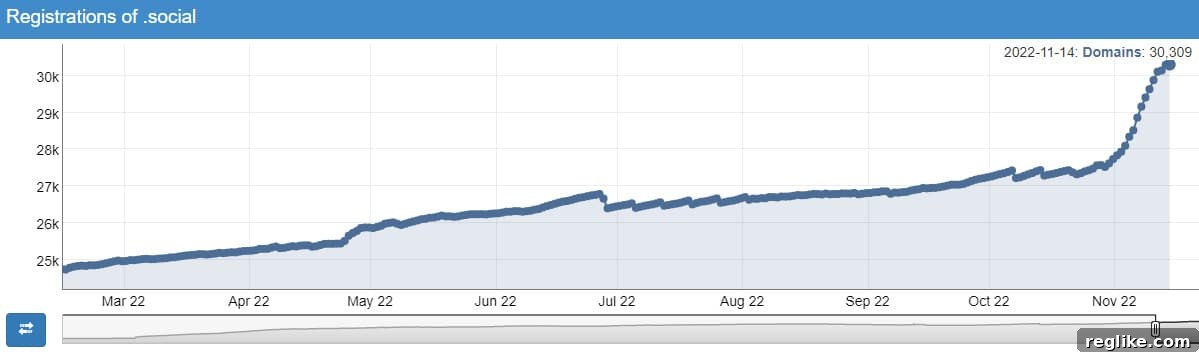
Further supporting this trend, data from nTLDStats indicates a significant jump in .social domain registration volume this month, directly correlating with Mastodon’s heightened visibility. While the raw number of registrations for a single nTLD might not always seem astronomical when compared to the vast domain market, what makes this surge particularly meaningful is the context: these domains are not merely registered; they are actively put into use, forming the backbone of live, thriving Mastodon communities. Every time a user interacts with a Mastodon instance, they are exposed to its TLD, inherently validating and promoting the widespread adoption of these new extensions.
Beyond .social: A Diverse TLD Landscape Reflecting Community Niches
While .social clearly leads the pack, the diverse array of other TLDs chosen by Mastodon instances speaks volumes about the platform’s ability to cater to an incredibly wide spectrum of interests and identities. TLDs like .io, popular in the tech community due to its association with “input/output,” are frequently chosen by instances focused on technology or developer communities. The enduring appeal of .org persists for non-profit organizations and community-focused initiatives, aligning perfectly with Mastodon’s open-source and community-driven ethos.
More specialized nTLDs further illustrate this point: .community and .chat directly state their purpose, drawing in users seeking connection and conversation. Domains like .lgbt, .games, .art, .party, and .zone allow for hyper-specific branding, enabling niche communities to immediately convey their focus. This granularity in domain selection is a powerful tool for community building within the Fediverse, allowing instance owners to signal their content and target audience from the very first impression. It helps in creating a tapestry of diverse online spaces, each with its unique flavor and purpose, accessible through a relevant and intuitive domain name.
It’s also worth noting that a handful of these highlighted instances are subdomains built on existing websites. While effective, the trend clearly leans towards dedicated second-level domains with descriptive TLDs, reinforcing the idea that a distinct domain fosters a stronger, more independent identity for a Mastodon instance.
Implications for the Domain Industry and the Future of Social Media
The Mastodon phenomenon and its embrace of new TLDs carry significant implications for the domain name industry. It demonstrates a tangible and practical application for nTLDs, showing that they are not just alternatives but can be strategic choices for new digital ventures, especially those requiring strong identity and niche targeting. Each of the approximately 6,000 active Mastodon servers represents a live, “in use” domain, providing invaluable exposure for these newer extensions. This widespread usage acts as a powerful endorsement, signaling to other internet users and businesses that nTLDs are viable, reputable, and often more descriptive choices than traditional options.
For users, this trend translates into more intuitive and memorable online addresses. Instead of generic subdomains or hard-to-remember URLs, they encounter domains that clearly articulate the nature of the community they are joining. This enhances discoverability and trust, making the decentralized web feel more organized and accessible.
The Mastodon gGmbH, the non-profit behind the main Mastodon project, appropriately uses joinmastodon.org for its primary informational website, leveraging the well-established trust associated with the .org TLD for its foundational presence. The question of brand protection and traffic surge, however, is a complex one in this decentralized model. While the author reached out to the owner of mastodon.com a couple of weeks ago to inquire about any increased traffic, a response is still pending. This highlights the challenges and opportunities for legacy brand owners in an rapidly evolving digital landscape where community-driven initiatives can quickly gain traction under similar or related names.
Conclusion: A New Era for Digital Identity in the Fediverse
The resurgence of Mastodon as a viable and vibrant alternative to centralized social media platforms marks a pivotal moment for how we perceive and utilize domain names. The strategic adoption of new Top-Level Domains, particularly the overwhelming popularity of .social, underscores a clear shift towards more descriptive, community-focused, and identity-driven online presences. In the decentralized world of the Fediverse, a carefully chosen domain name is more than just an address; it is a declaration of purpose, a beacon for like-minded individuals, and a critical component in building resilient and meaningful online communities. As Mastodon continues its growth trajectory, it will undoubtedly continue to showcase the power and versatility of nTLDs, shaping the future of digital identity across the internet.