
MMX Rocked by Financial Scandal: CEO and CFO Out Following Revenue Recognition Investigation

A significant corporate shake-up has hit MMX (London AIM: MMX), a prominent player in the top-level domain name industry. The company’s Board of Directors recently concluded an extensive investigation into its financial practices, particularly focusing on revenue recognition. This deep dive into the books has led to the immediate departure of two key executives – the Chief Executive Officer (CEO) and Chief Financial Officer (CFO) – and has necessitated a restatement of the company’s financial results, specifically impacting its income statement. The news sends ripples through the market, highlighting the critical importance of robust financial controls and transparent reporting within public companies.
The Genesis of the Investigation: Premature Revenue Recognition
The saga began earlier this month when the MMX board first announced it was scrutinizing a specific contract. Concerns arose regarding the possibility that revenue from this contract might have been recognized prematurely, potentially inflating the company’s reported earnings. Revenue recognition is a cornerstone of financial accounting, dictating precisely when and how income should be recorded. Misinterpreting or misapplying these rules can lead to a misleading picture of a company’s financial health, impacting investor decisions and market valuations.
Following a thorough review, the board confirmed its initial suspicions, revealing irregularities that necessitated immediate corrective action. The official statement from the board today provided critical insights into their findings:
The Board believes that revenue attached to the specific contract has been incorrectly recognised. As previously announced, cash of $1.125m was received in connection with the specific contract and revenue of $938,000 was recognised in FY-2019. Following its investigation the Board believes that any cash sums initially received pursuant to this contract should have been classified as a deposit against future sales and then recognised as revenue as the Company’s partner made sales to end-users. To date, the Company’s partner has made $201,900 of end-user sales under the contract.
This revelation points to a fundamental misunderstanding or misapplication of accounting principles, where an upfront cash receipt was treated as earned revenue rather than a liability (a deposit) that would only convert to revenue as underlying services or sales were delivered to end-users. This distinction is vital for accurate financial reporting, as it affects the timing of earnings and the overall profitability picture presented to shareholders.
Uncovering Additional Financial Irregularities
The initial investigation, while focused on a specific contract, unearthed further discrepancies within MMX’s financial records. The board’s expanded review identified two additional contracts from Fiscal Year 2019 (FY-2019) where revenue recognition was also deemed incorrect. These additional issues compound the initial problem, suggesting a potentially broader systemic issue within the company’s financial operations.
In addition to the above, the investigation has identified two additional contracts entered into in FY-2019 totaling $790,000 where receipts were incorrectly categorised as revenue. These contracts were offset with payment contracts that have been recorded as deferred charges or capital expenditures, thereby impacting earnings. The reversal of these amounts will not impact the cash position of the Company.
The discovery of these extra contracts, totaling an additional $790,000 in miscategorized receipts, raises further questions about the internal controls and oversight mechanisms in place at MMX. While the board clarifies that the reversal of these amounts will not impact the company’s cash position – implying the cash itself was received – the incorrect categorization significantly distorted the company’s reported earnings and potentially its balance sheet. This distinction is crucial: liquidity (cash) remains stable, but profitability (earnings) and assets/liabilities are affected, presenting a false picture of operational performance.
The Tangible Impact: Financial Restatements and Executive Accountability
The repercussions of these accounting irregularities are substantial and immediate. MMX is now compelled to restate its financial reports for FY-2019, an action that invariably erodes investor confidence and often leads to increased scrutiny from regulators and the market. The Board released a summary of the restated financials, illustrating the direct impact on the company’s reported figures:
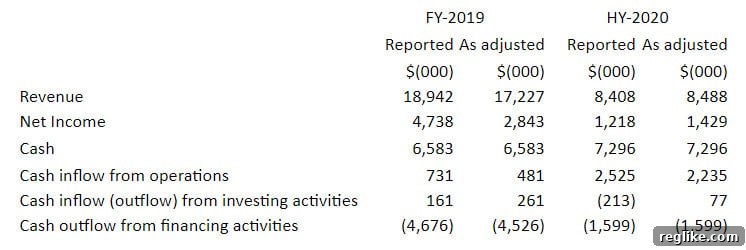
This image vividly demonstrates the scale of the adjustments, impacting the perception of MMX’s financial performance during the period in question. While the specific counterparties involved in these transactions remain undisclosed, the focus quickly shifts to executive accountability, a cornerstone of corporate governance.
Executive Departures: A Consequence of Oversight Failure
In the wake of the comprehensive investigation and the damning findings, Toby Hall, the Chief Executive Officer, and Michael Salazar, the Chief Financial Officer, have both tendered their resignations from the MMX board and have reportedly left the company entirely. The departure of both the CEO and CFO in such circumstances is a clear signal of serious governance failures and accountability at the highest levels. The CEO is ultimately responsible for the overall operations and financial health of the company, while the CFO is directly responsible for the accuracy of financial reporting and the integrity of accounting practices.
To ensure continuity and guide the company through this challenging period, MMX has moved swiftly to appoint interim leadership. Tony Farrow has been named interim Chief Executive Officer, stepping into the formidable role of steering the company forward. Simultaneously, Bryan Disher has taken on the responsibilities of interim CFO, tasked with stabilizing the financial reporting functions and rebuilding trust in the company’s accounts. These interim appointments are crucial steps in demonstrating to investors and the market that the company is taking decisive action to address the crisis and restore stability.
Wider Ramifications: Investor Confidence and Market Response
The news of accounting irregularities and executive departures inevitably sends shockwaves through the investment community. MMX, being listed on the London AIM market, relies heavily on investor confidence and transparent financial disclosures. Such events typically lead to a significant decline in share price, reflecting market skepticism and concerns about the company’s future prospects.
Further evidence of the immediate impact can be seen in MMX’s decision to postpone a planned £3.0 million tender offer, which had been scheduled for November. Tender offers, often used by companies to buy back their own shares from investors, can signal confidence and potentially boost shareholder value. The postponement, however, underscores the precarious financial and reputational position the company now finds itself in. Proceeding with a tender offer amidst such uncertainty and impending financial restatements would be ill-advised, as it could be perceived as disingenuous or poorly timed, further damaging investor relations.
The delay indicates that MMX’s board is prioritizing the resolution of its internal financial issues and the restoration of transparency before engaging in significant capital market activities. This is a prudent, albeit damaging, step that highlights the profound effect of these accounting errors on the company’s strategic and financial planning.
Understanding the Core Issue: The Nuances of Revenue Recognition
For a company like MMX, operating in the dynamic domain name industry, proper revenue recognition is particularly complex. Revenue recognition standards, such as IFRS 15 or ASC 606, aim to provide a consistent framework for recognizing revenue when it is earned, not merely when cash is received. Key principles include identifying the contract, identifying performance obligations, determining the transaction price, allocating the price to performance obligations, and recognizing revenue when (or as) performance obligations are satisfied.
In MMX’s case, the classification of cash receipts as immediate revenue rather than deposits against future sales indicates a misjudgment of when its performance obligations were fulfilled. A deposit implies a future obligation that has not yet been met, while earned revenue means the service has been delivered or the product provided. The distinction is not just semantic; it dictates when a company can legitimately claim to have “earned” money, directly affecting its reported profitability and financial health. Incorrect application of these rules can artificially inflate earnings in one period, only to necessitate painful restatements later, as seen here.
Strengthening Corporate Governance and Internal Controls
This incident serves as a stark reminder of the critical importance of robust corporate governance and stringent internal financial controls. The Board of Directors plays a crucial oversight role, ensuring management acts in the best interests of shareholders and that financial reporting is accurate and compliant. When issues like premature revenue recognition occur, it often points to deficiencies in one or more of these areas:
- **Board Oversight:** Was the board sufficiently diligent in challenging management’s financial reporting?
- **Internal Audit:** Were there adequate internal audit functions to detect such errors?
- **Management Controls:** Were the processes for recording and reporting revenue properly designed and enforced?
- **Ethical Culture:** Was there a culture that prioritized accurate reporting over short-term financial targets?
Moving forward, MMX will likely face significant pressure to review and strengthen its entire financial reporting ecosystem. This includes revisiting its accounting policies, enhancing internal control frameworks, and ensuring that all personnel involved in financial transactions receive appropriate training on revenue recognition standards. The appointment of an interim CFO will be instrumental in leading this critical overhaul, working closely with the Board and external auditors to restore integrity to MMX’s financial statements.
The Path Ahead for MMX: Rebuilding Trust and Stability
The road to recovery for MMX will undoubtedly be challenging. The company must not only rectify its financial statements but also actively work to regain the trust of its investors, partners, and employees. This will require:
- **Transparency:** Continuing to communicate openly and clearly about the findings of the investigation and the steps being taken to address them.
- **Accountability:** Demonstrating that those responsible for the errors are held accountable, which has already begun with the CEO and CFO departures.
- **Strengthened Controls:** Implementing robust internal controls and financial processes to prevent future recurrences.
- **Strategic Focus:** Re-establishing a clear strategic direction for the core domain name business, demonstrating that operational fundamentals remain strong despite the financial turmoil.
- **Regulatory Compliance:** Addressing any potential inquiries or actions from financial regulators, which often follow such significant restatements.
While the immediate focus is on financial cleanup, the long-term health of MMX will depend on its ability to emerge from this crisis with renewed commitment to corporate integrity and sound financial management. The interim leadership faces the daunting task of navigating the company through this storm, laying the groundwork for a more stable and trustworthy future.
In conclusion, the MMX saga underscores the profound impact of financial misconduct and accounting irregularities on publicly traded companies. The departure of its CEO and CFO, coupled with significant financial restatements, serves as a powerful reminder that robust governance, accurate financial reporting, and ethical leadership are non-negotiable pillars of corporate success. As MMX embarks on its journey to recovery, the industry watches closely, hoping for a swift and comprehensive restoration of confidence in its operations and financial integrity.