
Moniker, a prominent domain name registrar, has critically taken its website offline to urgently address a myriad of pressing issues that have emerged following a recent system transition. This drastic measure underscores the severity of problems encountered with its newly implemented reseller platform, impacting countless domain owners and operations.
This incident has spurred significant concern within the domain industry. For an in-depth perspective and responses from Moniker CEO Bonnie Wittenburg regarding this challenging transition, you can find further updates here.
Moniker Plunged Offline: Unpacking the Critical System Transition Failure
The digital landscape relies heavily on the stability and reliability of domain name registrars. Moniker, a well-known entity in this crucial sector, recently initiated a significant overhaul, switching its core interface to a new reseller platform over the weekend. What was intended to be an upgrade, however, swiftly devolved into a major operational crisis. The fallout from this botched transition was immediate and widespread, as evidenced by the overwhelming response from its user base. My initial report on the change garnered over a hundred comments, overwhelmingly expressing frustration, confusion, and alarm regarding the new system.
The Unfolding Crisis: A System Transition Gone Awry
System transitions, particularly for platforms as critical as a domain name registrar, are complex undertakings designed to enhance efficiency, improve user experience, and ensure scalability. Companies invest significant resources in modernizing their infrastructure, anticipating smoother operations and better service delivery. Moniker’s decision to migrate to a new reseller platform was likely driven by these aspirations. However, the execution of this transition proved to be critically flawed, unleashing a torrent of technical glitches and operational failures that severely undermined user trust and functionality.
The initial rollout was met with a barrage of user complaints, signaling that the new system was far from ready for live deployment. What began as user feedback on minor inconveniences quickly escalated into reports of fundamental service disruptions, leaving many domain owners in precarious positions. The sheer volume and severity of the reported issues indicated a systemic failure rather than isolated incidents, necessitating an urgent and comprehensive response from Moniker.
A Cascade of Critical Errors: User Impact and Technical Glitches
The issues reported by users were not merely cosmetic; they directly impacted critical domain management functions, threatening the digital assets and online presence of countless businesses and individuals. The problems spanned a wide spectrum, each with significant implications:
- Erroneous Billing for Renewals on Canceled Domains: One of the most alarming issues involved users being incorrectly billed for domain renewals on domains they had explicitly set to cancel. This not only created financial discrepancies but also eroded trust, raising serious questions about data integrity and the system’s ability to accurately process user instructions. Such errors can lead to unauthorized charges and complex refund processes, causing significant stress and inconvenience for customers.
- Incorrect Pricing Display and Application: Users reported instances of incorrect pricing for domain registrations and renewals. This inconsistency can lead to customers being overcharged or undercharged, creating confusion and requiring manual adjustments, which are prone to further errors. For businesses managing large portfolios, pricing inaccuracies can have substantial financial repercussions.
- Inability to Execute Critical Orders: Perhaps the most debilitating issue was the inability to execute essential domain management orders. This included failures to register new domains, renew existing ones, or transfer domains, all of which are time-sensitive operations. The inability to perform these basic functions can result in the loss of critical domain names, disruption of online services, and significant business interruption. For many, a domain name is the cornerstone of their online identity and operations.
- Disappearing Domains from Accounts: A nightmare scenario for any domain owner, reports emerged of domains vanishing entirely from user accounts. This not only sparked panic among users concerned about the loss of their digital assets but also highlighted severe backend database integrity issues. Reconciling such discrepancies requires meticulous data recovery and validation, a complex and time-consuming process.
- Missing WHOIS Information: The WHOIS database provides essential contact information for domain registrants, crucial for legal compliance, domain transfers, and dispute resolution. Reports of missing WHOIS information indicated a fundamental breakdown in data synchronization and compliance, potentially exposing Moniker and its users to regulatory issues and operational hurdles.
- Unclear and Dysfunctional User Interface: Beyond the critical bugs, the new user interface itself was widely criticized for being unclear and difficult to navigate. A poor user experience, even without technical failures, can significantly hinder productivity and customer satisfaction. When combined with severe backend issues, an unclear UI compounds the frustration, making it nearly impossible for users to understand or address their problems effectively.
These issues, individually severe, collectively painted a grim picture of a system that was fundamentally broken. The cumulative effect was a complete breakdown of essential services, threatening Moniker’s reputation and the operational stability of its client base.
The Inevitable Decision: Taking Moniker Offline
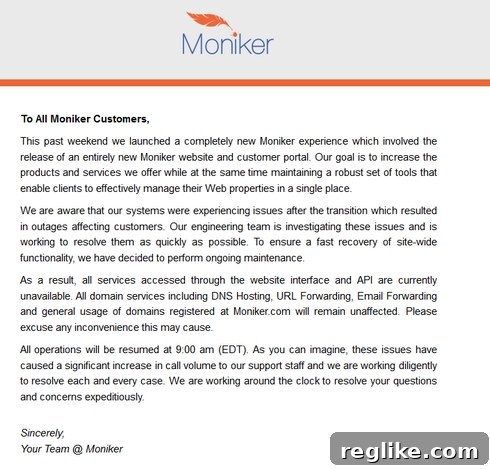
Faced with an escalating crisis and a cascade of unresolved problems, Moniker made the drastic yet necessary decision to take its entire website offline. This move, while disruptive, was an acknowledgment of the profound instability of the new system and an attempt to prevent further errors and damage to user accounts. A notice prominently displayed on Moniker.com explained the temporary shutdown, stating that the site was offline “to fix numerous problems with its new system.”
While an immediate halt to services is never ideal for any online platform, for a domain registrar, it carries immense weight. Domain names are the addresses of the internet; their management must be constant and reliable. Taking the site offline meant a complete cessation of all domain-related operations, preventing users from registering, renewing, transferring, or even accessing their domain portfolios. This pause, however, was deemed essential to mitigate the ongoing risks, particularly regarding billing errors and potential loss of domain assets. It represented a critical pivot from attempting to manage issues on a live, failing system to isolating the problem and undertaking a comprehensive repair effort.
The Road to Recovery: Addressing the Outage
The notice from Moniker indicated a target time for operations to resume, stating “all operations will be resumed at 9:00 am (EDT).” While the exact date was initially ambiguous, implying the following day, it signaled an intensive effort behind the scenes to rectify the systemic flaws. The task of “fixing numerous problems” is colossal, likely involving a multi-pronged approach:
- Comprehensive Debugging: Identifying and correcting the coding errors and logical flaws within the new reseller platform.
- Data Integrity Checks and Reconciliation: Verifying and restoring accurate domain information, billing records, and user account data. This is crucial for addressing disappearing domains and incorrect billing.
- System Rollback or Patching: Depending on the severity and scope of the issues, Moniker might have considered rolling back to the previous stable system or implementing significant patches and hotfixes to stabilize the new platform.
- Extensive Testing: Before going live again, rigorous internal testing in a controlled environment is essential to ensure that all identified bugs are resolved and no new issues have been introduced.
- Enhanced Communication: During such outages, clear and frequent communication with customers is paramount, even when there’s little immediate action they can take.
The speed at which Moniker could diagnose and resolve these complex issues would be critical in minimizing the long-term impact on its customer base and reputation. Crisis management in such a scenario demands not only technical expertise but also transparent and empathetic engagement with affected users.
Lessons Learned and Industry Implications
The Moniker incident serves as a stark reminder of the inherent risks in major system transitions, particularly for critical online services like domain name registration. For Moniker, the immediate lessons are clear: the paramount importance of comprehensive pre-launch testing, including extensive beta programs and stress testing in staging environments that accurately mimic live conditions. Phased rollouts, where a new system is introduced to a smaller segment of users before a full public launch, can also help identify and mitigate issues before they become widespread crises. Furthermore, robust contingency plans and clear communication strategies are vital when unexpected problems arise.
For the broader domain name industry, this event underscores the critical nature of the services provided by registrars. Domain names are fundamental digital assets; any disruption can have far-reaching consequences for global commerce, communication, and personal online identities. The incident highlights the necessity for registrars to prioritize stability, security, and reliability above all else. It also emphasizes the importance of robust data backup and recovery mechanisms.
For domain owners, the Moniker outage is a powerful lesson in due diligence when choosing a registrar. It reinforces the value of selecting registrars with a proven track record of stability, transparent service level agreements, and reliable customer support. It also encourages users to maintain their own records of domain registration details and WHOIS information, acting as a personal safeguard against unforeseen service disruptions.
Moving Forward: Rebuilding Trust
Beyond the immediate technical fixes, Moniker faces the monumental task of rebuilding trust with its customer base. A temporary shutdown, while necessary, can severely damage customer confidence. To regain goodwill, Moniker will likely need to implement several strategic measures. This could include a transparent post-mortem analysis of the incident, explaining what went wrong and how future occurrences will be prevented. Offering some form of compensation or goodwill gesture to significantly affected customers might also be considered to acknowledge the inconvenience and potential losses incurred. Moreover, a renewed commitment to service quality, backed by enhanced customer support and improved system stability, will be essential for their long-term viability in a competitive market.
The domain industry watches closely as Moniker navigates this challenging period, understanding that the lessons learned here can shape best practices for system migrations and crisis response across the entire digital ecosystem. The ability to not only fix the technical issues but also effectively communicate and empathize with users will define Moniker’s path forward.