
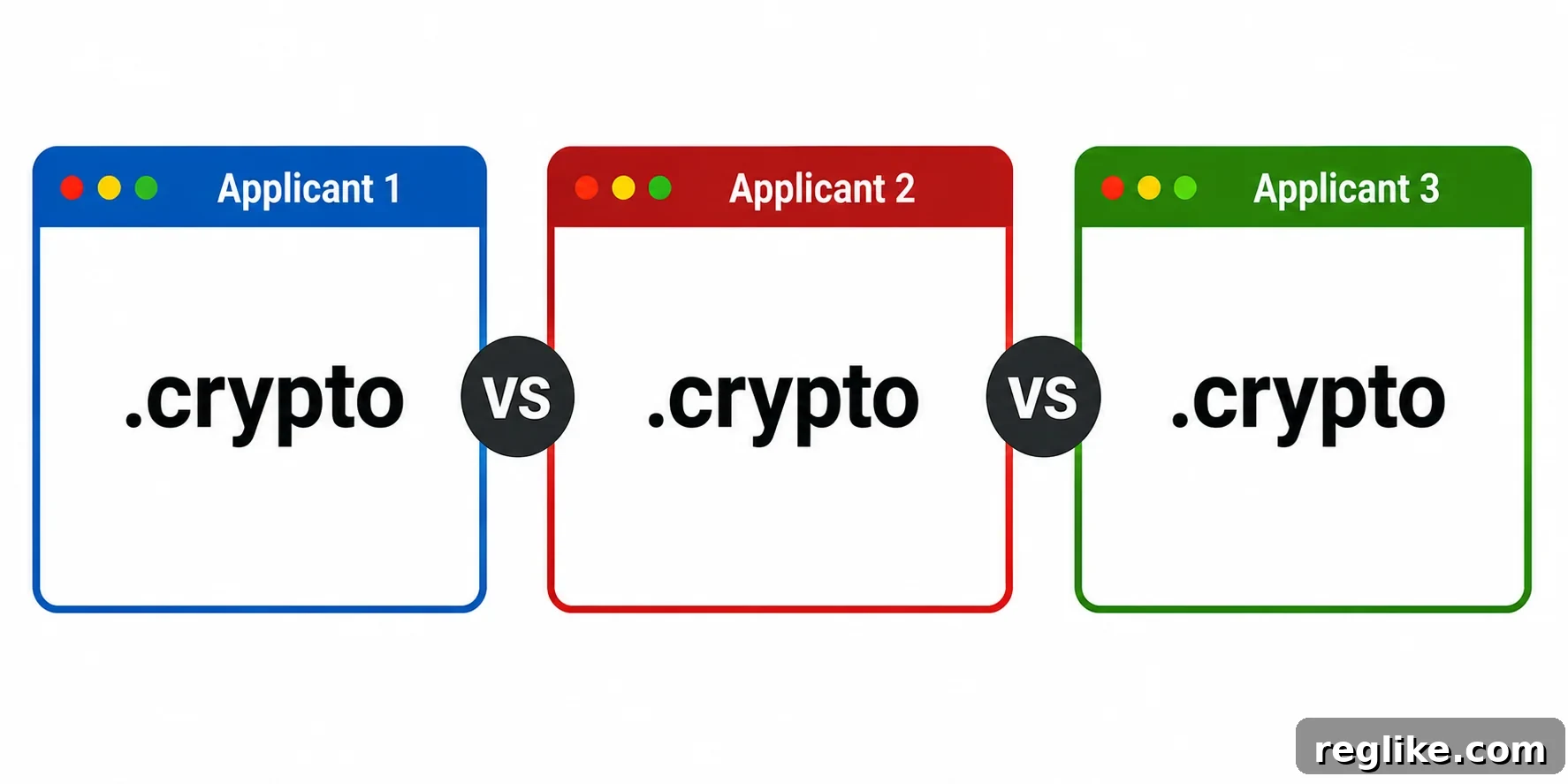
Platform helps top-level domain applicants resolve contention sets before applications are revealed.
Early Warning Report, a new platform designed to help applicants in the latest top-level domain (TLD) round manage potential contention sets, officially launched today.
This TLD round differs significantly from the 2012 cycle. Previously, applicants who sought the same string could negotiate directly to resolve competing claims. In the current process, negotiations after ICANN publishes application details are prohibited; applicants can only participate in auctions where ICANN retains the proceeds.
However, that prohibition applies only after ICANN discloses who applied for each string. Early Warning Report takes advantage of that window by notifying participants of prospective conflicts earlier in the process.
The platform enables current and prospective applicants to submit the strings they plan to apply for. When two or more users enter the same string, Early Warning Report alerts them and opens a channel for communication. That advance notice gives parties the opportunity to reach private resolutions before the official application disclosures.
Resolutions facilitated by advance notice can take multiple forms: direct trades, buyouts, or participation in Early Warning Report’s proprietary auction mechanism. By allowing applicants to explore alternatives prior to ICANN’s disclosure, the service aims to reduce costly public auctions and give applicants greater control over outcomes.
Early Warning Report’s standard pricing begins at $1,000 per string. To encourage early adoption, the service is offering a launch promotion of $100 per string for the first 100 strings submitted, with a limit of ten discounted strings per user.
The platform is positioned as a tool to help applicants make informed decisions and potentially avoid contested public auctions later in the process. It seeks to preserve legitimate private agreements that are still allowable before ICANN’s public disclosure of applicants for each string.
This approach does not change ICANN’s rules; rather, it provides participants with timely information and a private forum for negotiation while those negotiations remain permitted. Applicants using the service should still ensure any agreements comply with ICANN policies and relevant legal requirements.
The launch coincides with public discussion about the second round of new TLDs and how applicants can best protect their interests. For listeners interested in more background on the current round and related developments, industry podcasts and coverage provide additional context.
Disclosure: I submitted a string I am considering applying for.