
ICANN Survey Reveals Global Shifts in Domain Name Awareness and Trust
The global digital landscape is constantly evolving, and with it, how internet users perceive and interact with online identities. A groundbreaking multi-year consumer study initiated by ICANN (Internet Corporation for Assigned Names and Numbers) has unveiled fascinating insights into the current state of domain name awareness and trust worldwide. The initial phase of this extensive research, the results of which were released by ICANN, highlights a significant divergence in how different regions embrace the expanding universe of domain name extensions. Particularly striking is the finding that acceptance and awareness of new domain name options appear to be considerably higher in regions outside of the U.S. and Europe, signaling potential shifts in the global digital economy.
Conducted in February, this comprehensive survey engaged over 6,000 internet users who spend a minimum of five hours online each week. The demographic breadth of the study, spanning North America, South America, Europe, Africa, and Asia, provides a robust foundation for understanding global sentiment. Its primary objective was to gauge user familiarity with, and confidence in, various top-level domain names (TLDs), including established “legacy” options and the newer generic Top-Level Domains (gTLDs). These initial findings offer invaluable data for domain registries, businesses, and policymakers alike, informing strategies for branding, digital presence, and future internet governance.
Understanding Domain Name Awareness Across Continents
When it comes to brand recognition in the digital realm, legacy domain names continue to hold a dominant position. The survey confirmed, unsurprisingly, that established TLDs such as .com enjoy widespread recognition across all surveyed regions. This ubiquity is a testament to decades of consistent use and integration into the global internet infrastructure, making .com synonymous with online presence for a vast majority of users.
The Enduring Power of Legacy TLDs
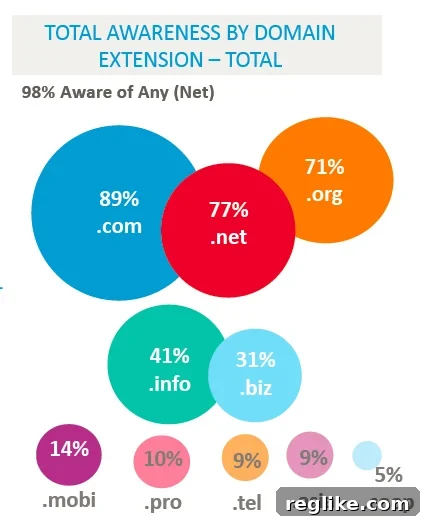
.Com emerged as the undisputed leader in awareness, with at least 88% of respondents across North America, South America, Europe, Africa, and Asia reporting familiarity. This overwhelming recognition underscores its historical significance and its role as the default choice for individuals and businesses seeking an online identity. Other prominent legacy TLDs, including .net and .org, also demonstrated strong awareness levels, reinforcing their status as trusted pillars of the internet. These extensions have long served specific purposes – .net often associated with network providers and .org with non-profit organizations – further solidifying their distinct identities in the public consciousness.
Beyond these giants, awareness for other legacy TLDs varied considerably by country. Extensions like .info and .biz, while recognizable, garnered between 18% and 50% awareness. These TLDs, introduced to offer more specific or business-oriented alternatives, have achieved moderate success but have not reached the widespread recognition of their older counterparts. More niche legacy extensions, such as .mobi (originally for mobile-specific sites), .pro (for professionals), .tel (for communication services), .asia (for Asian entities), and .coop (for cooperatives), generally languished in single-digit awareness. An interesting outlier, however, was .mobi in Africa, where it registered a surprisingly high 40% awareness, suggesting regional specificities in digital adoption and utility. This highlights how market needs and digital literacy can influence the perceived relevance of certain domain types.
The preference for established TLDs extended to future online endeavors as well. When asked which legacy TLD they would choose for setting up their own website within the next six months, .com again overwhelmingly dominated responses. This strong inclination towards familiar options suggests that while new choices exist, the deeply ingrained habit of defaulting to .com persists for many internet users, particularly when considering a personal or business online venture.
The Rise of New TLDs: A Geographic Divide
While legacy TLDs maintain their stronghold, the survey revealed a fascinating and crucial trend concerning the awareness of new gTLDs. Unlike their predecessors, which benefit from historical momentum, new TLDs face the challenge of establishing relevance and recognition in a crowded digital space. However, the study indicated a significant geographical disparity in how these newer options are perceived.
Awareness of any of the new TLDs presented from a list of top sellers, such as .email and .link, was generally much lower than for legacy options. Crucially, only 29% of North American and 33% of European respondents reported awareness of any of these new extensions. In stark contrast, 48% to 54% of individuals in South America, Africa, and Asia were aware of at least one new TLD shown to them. This pronounced difference suggests that emerging markets are significantly more receptive to, or simply more aware of, the expanded range of domain name choices. This finding is a critical indicator for new TLD registries, pointing towards these regions as prime targets for marketing and adoption strategies. It suggests that users in these geographies may have fewer ingrained habits or biases towards traditional TLDs, making them more open to exploring alternatives that offer more descriptive or localized online identities.
The .Email Anomaly: Purpose and Perception
One of the most intriguing findings revolves around the .email domain name. Despite its highly specific nature, .email exhibited higher reported awareness than many other top-selling new TLDs. Even more perplexing, 38% of those aware of new TLDs claimed to have visited a .email website. This seems counter-intuitive, as .email is typically associated with an address rather than a destination website. The anomaly deepened when respondents were asked which new TLDs they would consider for setting up a website, with .email again topping the list at 50%.
ICANN itself acknowledged this curious pattern. Akram Atallah, then President of the Global Domains Division at ICANN, offered his perspective on the phenomenon:
The survey found that domains with an implied purpose and functional associations, such as .EMAIL, were most often recalled by Internet users. While some of the drivers may be linked to familiarity and general association versus awareness of the extension, we believe it’s a signal that people are receptive to the names.
Atallah’s insight suggests that TLDs with a clear, implied purpose resonate more strongly with users, perhaps due to their straightforward communication of function. While it might not always translate to actual website visits in the traditional sense, the high recall and consideration for .email indicate a psychological receptiveness to descriptive and functional domain names. This could be a powerful lesson for new TLD developers: clarity and immediate understanding can significantly boost user engagement and perceived relevance, even if the actual usage might diverge from initial assumptions.
To further understand such nuances, future research could benefit from incorporating free-form response data concerning new top-level domain names. Instead of presenting a list and asking for familiarity, allowing respondents to spontaneously list extensions they know could provide an unfiltered view of genuine awareness and recall, revealing which TLDs truly enter the public consciousness without prompting.
Building Bridges of Trust: Confidence in Domain Names
In the digital world, trust is paramount. Users navigate the internet constantly making snap judgments about the legitimacy and safety of websites. These judgments are heavily influenced by familiarity, a principle that extends deeply into the realm of domain names.
Legacy and Country Code TLDs: The Pillars of Trust
The ICANN survey unequivocally demonstrated a strong correlation between familiarity and trust. When presented with individual legacy domain name extensions, respondents gave an impressive average “trustworthy” response of 90%. This high level of confidence is not merely incidental; it’s a byproduct of decades of stable internet usage, where these extensions have been consistently associated with legitimate organizations, established businesses, and reliable information. The longevity and widespread adoption of .com, .net, and .org have naturally fostered an environment of inherent trust among internet users.
Even higher levels of trust were observed for targeted country code domain names (ccTLDs), which achieved an average trustworthiness rating of 94%. This elevated trust in ccTLDs (e.g., .uk for United Kingdom, .de for Germany, .jp for Japan) is likely attributable to their direct association with specific nations or regions. Users often perceive ccTLDs as indicators of local legitimacy, regulatory oversight, and cultural relevance, strengthening their confidence in websites using these extensions. For businesses targeting local markets, a ccTLD can be an invaluable asset for building credibility and user confidence.
New TLDs: Navigating the Trust Deficit
In stark contrast to their legacy and country-specific counterparts, new TLDs face a significant “trust gap.” The survey revealed that the average trust in new extensions stood at a much lower 49%. This disparity is understandable, as new gTLDs lack the long history and ubiquitous presence that have cemented trust for legacy domains. Their relative novelty means users have not yet accumulated sufficient positive experiences or associations to confer the same level of confidence. This poses a substantial challenge for registries and businesses adopting new TLDs: the need to actively cultivate trust and overcome initial skepticism.
The survey specifically focused on top-registered new TLDs as of the beginning of the year, and even within this segment, trust levels varied considerably. Interestingly, .email once again emerged as an outlier, ranking as the most trusted (non-geographic) new TLD with a 63% trustworthiness rating. This further reinforces the idea that an implied purpose or functional clarity can significantly influence user perception, extending beyond mere awareness to encompass trust. Users might implicitly believe that a domain name explicitly stating “email” is more likely to be legitimate or serve its stated function reliably, even if they aren’t fully aware of its specific registration policies.
On the other end of the spectrum, more generic new TLDs such as .xyz and .guru recorded the least trust, at 35% and 42% respectively. The lower trust for these more generic options could stem from a lack of clear purpose, making them feel less defined or potentially more susceptible to misuse in the eyes of the user. The author’s observation about .email’s trust ratings being interesting, particularly given the lack of restrictions on its registration, points to a fascinating aspect of user psychology: trust can be conferred not just by policy, but by name alone, suggesting users make assumptions based on intuitive understanding rather than technical specifics.
Implications for the Evolving Domain Name Landscape
The findings from ICANN’s initial consumer study offer crucial insights into the evolving dynamics of the domain name ecosystem. The stark contrast in awareness and trust between legacy and new TLDs, coupled with the significant geographic variations, points to several key implications:
- Strategic Regional Focus: New TLD registries and businesses adopting these extensions should strategically target emerging markets in South America, Africa, and Asia, where users demonstrate higher awareness and potentially greater receptiveness to alternative domain choices. Marketing efforts can be tailored to these regions, highlighting the unique benefits and descriptive nature of new gTLDs.
- The Power of Purpose-Driven Names: The success of .email, both in awareness and trust, underscores the importance of clear, purpose-driven domain names. TLDs that instantly communicate their function or niche may find it easier to resonate with users and build credibility, even in the absence of a long history.
- Building Trust for New TLDs: Overcoming the trust deficit for new TLDs is paramount. This will require sustained effort from registries, registrars, and brand owners through transparent policies, consistent enforcement against abuse, and proactive communication to educate users about their legitimacy and value. Building positive associations through high-quality websites and reputable online presences will gradually shift public perception.
- Digital Identity and Branding: The expanding domain name landscape offers unparalleled opportunities for businesses and individuals to craft unique and memorable digital identities. While legacy TLDs remain foundational, new gTLDs provide creative options for niche branding, geographic targeting, and clear communication of purpose, helping entities stand out in a crowded online world.
This multi-year study is just beginning to scratch the surface of consumer behavior and perception regarding domain names. As the internet continues to grow and diversify, understanding how users interact with and trust various TLDs will remain critical for fostering a secure, innovative, and accessible global online environment. These initial results serve as a powerful reminder that while the internet is a global phenomenon, user experiences and cultural contexts significantly shape its perception and adoption across different regions.
For those interested in delving deeper into these fascinating findings, the full results of the survey are available on ICANN’s official website.