
The Promising Launch of .NYC: A Deep Dive into Its Initial Success and Future Potential
The digital landscape is continuously evolving, and the introduction of new generic top-level domains (gTLDs) has played a significant role in shaping this transformation. Among these, city-specific domains like .NYC have garnered considerable attention, promising to carve out unique digital identities for their respective metropolises. The initial launch of the .NYC domain name extension has demonstrated a remarkably solid start, especially when considering the inherent registration restrictions designed to maintain its local relevance and authenticity.
Yesterday marked a robust debut for .NYC, fueled by a concerted effort in press coverage and strategic advertising campaigns. This early momentum hints at a vibrant future for the domain, though its reach in the initial phase was deliberately circumscribed. Had the eligibility criteria been broader, allowing individuals and entities beyond the immediate geographical confines of New York City to register domains, the initial registration figures would undoubtedly have been even more impressive, reflecting a wider global interest in the iconic city’s digital footprint.
Early Registration Triumphs and Key Metrics
A closer examination of the overnight zone file, a comprehensive snapshot of all registered domain names, reveals approximately 27,000 .NYC domain names successfully registered. This figure, while significant, does not encompass all transactions from the initial launch period. Crucially, more than 1,000 landrush domain name orders are slated for auction, indicating a high demand for premium or highly contested names that attracted multiple registrants. The landrush phase, a crucial period preceding general availability, allows multiple parties to apply for the same desirable domain, often leading to competitive auctions to determine ownership.
The landrush period for .NYC proved particularly active, with over 10,000 domains being claimed during this exclusive window. Interestingly, roughly 9,500 of these applications were submitted by a single person or company per domain, suggesting a relatively straightforward registration process for many seeking their preferred name. However, the remaining 1,000+ domains attracted multiple applicants, signaling that these were highly coveted assets. This competitive dynamic is a common feature of new gTLD launches, where early adopters vie for memorable or business-critical domain names, often perceiving them as valuable digital real estate for their brand or personal identity.
Understanding the Landrush Phase and Domain Auctions
For those less familiar with the intricate process of domain launches, the landrush phase serves as an exclusive window for early registration, typically offered at a premium price, before domains become generally available to the public. It’s a strategic period for businesses, entrepreneurs, and individuals to secure their most preferred and high-value names, especially if they anticipate high competition. When multiple applications are received for a single domain during landrush, an auction mechanism is usually triggered. This ensures a fair and transparent process for resolving disputes, with the domain typically awarded to the highest bidder. The presence of over a thousand domains heading to auction for .NYC underscores the strong initial demand and the perceived value of an official New York City online identity, indicating keen interest from a dedicated user base.
GoDaddy’s Strategic Prowess: A Dominant Force in the .NYC Launch
Among the various domain registrars facilitating the .NYC launch, GoDaddy emerged as the unequivocal biggest winner, demonstrating a remarkable ability to capture a substantial share of the new market. To date, the company has assisted customers in registering over 17,000 .NYC domain names, a figure that speaks volumes about their strategic effectiveness and market penetration. GoDaddy’s success was not merely a matter of chance; it was the result of a meticulously crafted marketing strategy combined with highly aggressive and competitive pricing.
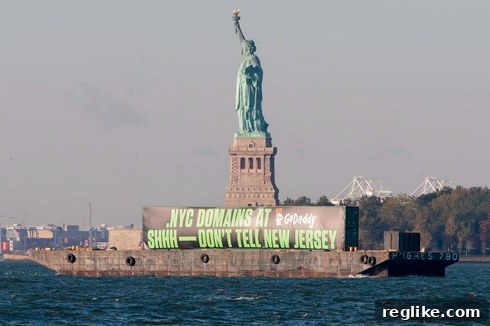
The company offered .NYC domains at a highly competitive price point of just $24.99, representing a mere $4.99 above their wholesale cost. This razor-thin margin likely attracted a significant volume of registrations, making domain ownership accessible to a wider audience, including small businesses and individual enthusiasts. However, the true differentiator for GoDaddy’s commanding market share lay in its savvy and innovative marketing campaigns. A standout example was its highly publicized barge ad, a visually striking advertisement navigating the iconic Hudson River. This ingenious approach ensured massive visibility, generating considerable buzz and effectively embedding the .NYC domain into the public consciousness through an unforgettable brand experience. Such creative, high-impact advertising campaigns are crucial for new TLDs to break through the noise and capture attention in a crowded digital marketplace, especially in a city as vibrant and media-savvy as New York.
The Impact of Creative Marketing on New TLD Adoption
GoDaddy’s overwhelming success with the .NYC launch provides a compelling case study on the critical role of innovative marketing in the adoption of new gTLDs. Unlike established TLDs like .com or .org, which have inherent brand recognition and are globally understood, newer extensions require significant promotional effort to inform, educate, and persuade potential registrants of their unique value proposition. GoDaddy’s Hudson River barge ad was more than just a typical advertisement; it was a powerful statement that leveraged a quintessential New York landmark to create a direct, memorable connection between the city, its emerging digital identity, and GoDaddy as the key facilitator. This type of experiential marketing, coupled with competitive pricing and a user-friendly registration platform, collectively contributed to their unparalleled success in the initial registration phase of .NYC, setting a benchmark for future TLD launches.
Navigating Eligibility Restrictions: A Double-Edged Sword for .NYC
While the initial launch figures for .NYC are undeniably commendable, they were notably lower than those achieved by .London, another prominent city gTLD. .London managed to accumulate approximately 35,000 domain registrations after its first day of general availability. Although London’s time zone might have afforded its first-day zone file a few more hours of registration activity compared to New York, this factor alone accounts for only a marginal portion of the difference. The primary reason for this disparity, and arguably the main impediment to .NYC achieving an even more spectacular debut, lies in its stringent eligibility restrictions.
These restrictions mandate that only individuals or entities with a verified physical presence in New York City can register a .NYC domain. While such policies are meticulously designed to maintain the authenticity and local relevance of the domain, ensuring that it genuinely represents businesses and residents of the city, they simultaneously limit the potential customer base significantly. It’s a classic double-edged sword: fostering a strong, authentic local identity at the cost of broader market access. Many industry observers, including myself, strongly suspect that without these eligibility limitations, .NYC could have easily surpassed 50,000 registrations on its first day, showcasing a much larger, latent demand from a global audience eager to associate their digital presence with the prestigious New York brand.
The Rationale and Ramifications of Geographic Restrictions
The decision to implement geographic eligibility restrictions for city-specific gTLDs like .NYC is deeply rooted in a desire to prevent cybersquatting by entities entirely unrelated to the city and to ensure that the domain genuinely serves and strengthens the local community. The benefits of such a policy are clear: it helps build a trusted local online ecosystem, offers local businesses a distinct and recognizable online identity, and ultimately strengthens the city’s digital brand as a whole. For instance, a small boutique in Brooklyn, a tech startup in Manhattan, or a local non-profit in Queens can acquire a .NYC domain that immediately signals their local presence and unwavering commitment to the community they serve.
However, the ramifications of such restrictions are also noteworthy and present certain challenges. They inherently shrink the total addressable market, which can slow down adoption rates and limit overall revenue generation for the registry. Furthermore, in an increasingly globalized digital world, many businesses with strong ties to New York City (e.g., international suppliers, tourism agencies, remote partners) but without a direct physical presence might be excluded from registering a .NYC domain, even if it would be highly beneficial for their operations and marketing efforts. Balancing local authenticity with global appeal remains a critical challenge for all geographically restricted TLDs, impacting their ultimate growth trajectory and market penetration in the long run.
Comparing City TLDs: .NYC vs. .London
The comparison between .NYC and .London offers valuable insights into the complex dynamics of city-specific top-level domains. Both represent major global cities, economic powerhouses, and cultural hubs, making them ideal benchmarks for one another in the domain industry. While .London initially outpaced .NYC in raw registration numbers, it’s crucial to consider the various factors at play beyond just eligibility restrictions. London’s slightly earlier launch, potentially different marketing strategies, and perhaps varying levels of public awareness for new gTLDs at the time of their respective launches could all contribute to the observed differences in their initial performance.
Ultimately, the long-term performance of these city TLDs is not merely about initial numbers but about sustained growth, practical utility, and how well they integrate into the digital lives of their respective communities. Both .NYC and .London aim to provide a more specific, localized, and trustworthy online address, moving beyond the generic .com. Their respective journeys will continue to offer valuable lessons for other aspiring city-specific gTLDs and the broader domain name industry, highlighting the delicate balance required to foster both local relevance and widespread adoption in a competitive market.
The Future Landscape of .NYC and City-Specific Domains
The strong start for .NYC, despite its carefully managed rollout and eligibility requirements, bodes well for its long-term viability and success. As businesses and residents increasingly seek to solidify their local online presence and connect with their community, a .NYC domain offers a compelling and distinct solution. It provides a clear, concise, and credible digital identity that immediately communicates an affiliation with one of the world’s most dynamic and influential cities.
Looking ahead, the registry behind .NYC will likely focus on continued marketing and outreach to ensure greater awareness and adoption within the eligible community. Strategies might include strategic partnerships with local business associations, targeted campaigns for specific industries (e.g., tech startups, arts organizations, hospitality venues), and comprehensive educational initiatives to highlight the significant SEO benefits and powerful branding advantages of a .NYC domain. The sustained success of .NYC will also serve as an important indicator for the potential of other city-specific domains globally, reinforcing the idea that digital real estate can indeed mirror geographical identity and foster local digital economies.
The broader trend of geographic TLDs, including those for cities, regions, and even entire countries, points towards a future where online addresses are more descriptive, context-rich, and relevant to their users. These domains empower communities to create distinct digital ecosystems, fostering local commerce, boosting tourism, and enhancing civic engagement. .NYC is at the forefront of this movement, demonstrating that a focused, well-executed launch, even with deliberate limitations, can yield impressive initial results and lay a robust foundation for enduring success in the ever-expanding and increasingly specialized world of domain names.