
Why Chinese Non-Profits Overwhelmingly Choose Local Domains Over .ORG
In the vast and dynamic landscape of the Chinese internet, understanding domain name preferences is crucial for anyone seeking to establish an online presence or grasp digital trends. This analysis forms part of an ongoing series dedicated to demystifying the Chinese domain market, following previous explorations into the big picture, the prominence of .cn, the enduring appeal of .com, and insights into .net. Today, our focus narrows to the .org domain, traditionally associated with non-profit organizations globally, to examine its standing within China.
The data underpinning this comprehensive study is meticulously compiled from reports published by the China Internet Network Information Center (CNNIC) since 1997. As the administrative agency responsible for internet domain name affairs in mainland China, CNNIC’s statistics offer an authoritative and unparalleled view into the registration trends and market share of various top-level domains (TLDs) across the nation. This long-term data collection allows for a robust historical perspective, revealing not just current preferences but also evolving patterns in China’s digital identity landscape, particularly concerning non-profit entities.
The Marginal Presence of .ORG in China’s Domain Market
A quick glance at the overall distribution of domain names in China immediately reveals a striking peculiarity: the .org domain holds a remarkably minor share. As of December 2018, .org accounted for a mere 0.5% of all registered domains in China, translating to approximately 200,000 domain names. This figure stands in stark contrast to global trends where .org is a recognized and often preferred choice for non-commercial entities, particularly in Western countries where it signifies trust and mission-driven purpose.
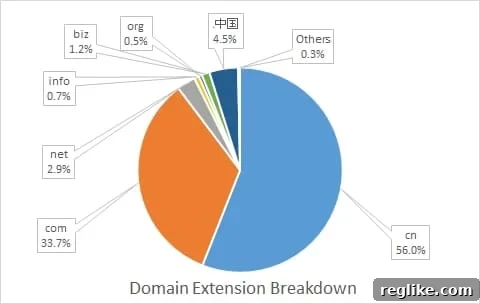
This marginal presence highlights a significant divergence from international norms. While country-code top-level domains (ccTLDs) like .cn and generic top-level domains (gTLDs) such as .com dominate the Chinese market, effectively serving as the mainstream choices for businesses and individuals alike, .org remains largely overlooked. Its insignificance in China’s vast internet ecosystem suggests a strong inclination towards localized or commercially focused domain extensions, even for organizations that might otherwise opt for .org in other parts of the world. This trend underscores a unique cultural and regulatory environment that shapes digital identities.
The reasons behind this low adoption rate are multi-faceted. Firstly, there’s a strong governmental and cultural emphasis on using local domain names. The .cn domain is often seen as a symbol of national identity, trust, and legitimacy within China, making it a natural first choice for any organization operating within its borders, regardless of its commercial or non-profit status. Secondly, the sheer market dominance of .com, driven by its universal recognition and perceived prestige in the business world, often overshadows other less common gTLDs. For many Chinese entities, establishing a digital presence often begins with a .com or .cn address, with other options considered secondary or even unnecessary.
A Sharper Decline: .ORG’s Retreat in Recent Years
Beyond its low overall market share, a deeper dive into the historical data reveals an even more concerning trend for .org in China: a continuous and substantial decline in registrations over recent years. The number of .org domains in China plummeted from a peak of 398,000 in 2015 to just 200,000 by December 2018. This represents a staggering reduction of almost 50% in just three years, indicating a systematic move away from the .org extension among Chinese organizations and a growing preference for alternatives.
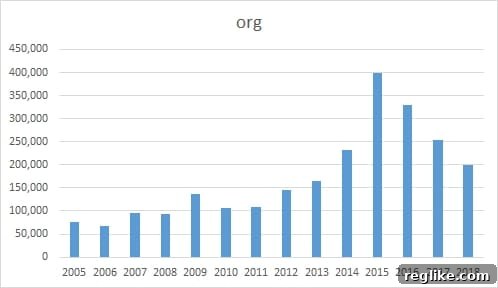
The brief surge in .org registrations around 2015 can be partly attributed to a broader “domain chips” boom that swept through the Chinese domain market. This period saw speculative interest in domain names, primarily driven by the perceived value of .com extensions, but also spilling over to other TLDs as investors sought new opportunities. However, as the speculative bubble cooled, .org failed to retain these registrations, suggesting that the initial spike was not driven by genuine organizational need or long-term preference for the .org domain but rather by temporary market dynamics and investment trends.
The subsequent downward trend is a clearer indicator of underlying preferences. One primary factor contributing to this decline is the growing choice for local alternatives, most notably .cn and its specialized counterpart, .org.cn. Many non-profit organizations in China, seeking to establish or maintain their online presence, have increasingly opted for .cn, which offers local relevance, easier regulatory compliance, and stronger association with Chinese identity. Furthermore, the .org.cn domain provides a direct and explicit signal of non-profit status within the Chinese context, often making it a more intuitive and trusted choice than the generic .org for both organizations and their target audiences.
Other factors may also contribute to the retreat of .org. The rise of new generic Top-Level Domains (gTLDs) offered more choices, potentially fragmenting the market further, though none have achieved the dominance of .cn or .com in China. Additionally, the increasing reliance on prominent social media platforms and super-apps like WeChat for organizational communication and community engagement might lessen the perceived necessity for a dedicated international domain name. For many smaller or locally focused non-profits, a strong, integrated presence on these domestic platforms might be deemed more effective and cost-efficient than maintaining a separate website with an international domain.
Case Study: Domain Choices Among Top Chinese Non-Profit Organizations
To provide empirical evidence for these observations, a specific study was conducted using a list of the top 10 non-profit organizations focused on entrepreneurship in China, as published by Baidu earlier this year (中国十大公益创业组织名单). Baidu, as China’s leading search engine, offers unique insights into public recognition and organizational prominence within the Chinese internet ecosystem. Analyzing the domain choices of these highly recognized non-profits provides a valuable snapshot of real-world preferences and strategic decisions at the forefront of China’s non-profit sector.
The methodology involved identifying the primary website domain for each organization on Baidu’s list. The results, summarized in the table below, overwhelmingly confirm the trends observed in the broader CNNIC data, demonstrating a clear preference for local Chinese domain extensions over the global .org, even among the most influential non-profits in the country.
| Rank | Chinese | English | Domain |
|---|---|---|---|
| 1 | YBC中国国际青年创业计划 | Youth Business China | YBC.cye.com.cn |
| 2 | KAB创业教育 | Know About Business | KAB.org.cn |
| 3 | AAMA亚杰商会 | AAMA China | AAMAchina.com.cn |
| 4 | BCF北京光华慈善基金会 | Guanghua Charity Foundation | BCF.org.cn |
| 5 | SOE中国青年创业探索 | Spirit Of Enterprise | SOE.org.cn |
| 6 | 中国光华科技基金会 | China Guanghua Foundation | GHSTF.org.cn |
| 7 | SYB创业培训 | Start Your Business | NYJY.cn |
| 8 | JA青年成就中国 | Junior Achievement China | JAchina.org |
| 9 | NPI 公益创投 | NPI | NPI.org.cn |
| 10 | NPP公益创投 | NPP | (not found) |
Analyzing the Domain Choices of China’s Leading Non-Profits
The findings from the Baidu list are highly illustrative and reinforce the overarching narrative. Out of the ten leading non-profit organizations, the vast majority (eight out of ten) have chosen a domain name within the .cn ecosystem. Only one organization, Junior Achievement China (JAchina.org), utilizes the global .org domain, making it a notable exception that likely reflects its international heritage or specific operational focus. Another organization, NPP, could not be found with a dedicated domain, suggesting a potential reliance on prominent social media platforms or a more localized, informal online presence.
Among the eight organizations within the .cn family, a significant preference for .org.cn is evident. Five organizations (KAB, BCF, SOE, China Guanghua Foundation, and NPI) specifically leverage the .org.cn domain. This choice is particularly telling, as .org.cn explicitly designates a non-commercial organization within China’s domain structure, providing immediate clarity and perceived legitimacy to Chinese internet users and regulatory bodies. For these influential organizations, identifying as a non-profit is clearly best achieved through this localized suffix rather than the internationally recognized .org, which may lack specific local context or recognition.
Furthermore, two organizations, Youth Business China (YBC.cye.com.cn) and AAMA China (AAMAchina.com.cn), opt for a .com.cn domain, often coupled with a specific subdomain to denote their identity. The use of .com.cn, while typically associated with commercial entities, can still be a strategic choice for non-profits looking for broader recognition, or who might have affiliated commercial arms, or simply prefer the perceived robustness of a .com.cn domain. It demonstrates that even within the .cn framework, flexibility exists to cater to specific organizational structures or branding needs, without resorting to the global .org.
The case of Start Your Business (SYB), which uses NYJY.cn, further reinforces the strength and versatility of the generic .cn domain. This organization, despite its clear non-profit mission, directly uses the ccTLD, suggesting that for many Chinese entities, the .cn domain itself carries sufficient authority and trust to convey legitimacy, making additional qualifiers like .org.cn optional, depending on branding and specific outreach goals. This highlights the deep integration and acceptance of .cn as a primary domain choice across all sectors in China.
The sole outlier, Junior Achievement China (JAchina.org), might have strong international affiliations or a target audience that includes a significant international component, making the global .org a more logical choice for their branding strategy to resonate with a broader, non-Chinese speaking audience. However, its isolated presence on this list underscores just how uncommon the .org domain is for even top-tier Chinese non-profits primarily operating within China, underscoring the strength of local domain alternatives.
Conclusion: The Ascendancy of Local Domains for Chinese Non-Profits
The evidence overwhelmingly points to a clear and enduring trend: Chinese non-profit organizations have a strong and sustained preference for local domain extensions over the globally recognized .org. This choice is not merely incidental but is deeply rooted in practical considerations, cultural relevance, regulatory compliance, and strategic alignment with the unique characteristics of the Chinese internet ecosystem.
The motivation for Chinese non-profits to adopt .org is demonstrably low. They can effectively achieve their digital presence goals and emphasize their non-profit nature by choosing .cn or, more specifically, .org.cn. The .org.cn domain serves as a powerful and unambiguous identifier of non-profit status within China, fostering trust and recognition among local stakeholders and users. Moreover, the inherent local nature of many of these organizations means that a .cn or .org.cn domain resonates more strongly with their primary audience, simplifies any regulatory requirements, and aligns with local search engine preferences.
For international organizations looking to establish a non-profit presence in China, these findings carry significant implications. Blindly adopting a .org domain, which might be standard practice elsewhere, could hinder local recognition, trust, and even search engine visibility within China. A strategic approach would involve embracing local domain extensions, potentially securing both a .cn and a .org.cn domain, to maximize local impact and engagement, demonstrating a genuine commitment to operating within the Chinese digital landscape.
In essence, while .org signifies non-profit status globally, in China, the narrative is distinctly different. The Chinese digital landscape, with its unique characteristics and preferences, has fostered an environment where local alternatives have not just emerged but have decisively triumphed as the preferred domains for non-profit endeavors. Understanding this nuanced reality is paramount for navigating the complexities of domain choices and building a successful, credible online identity for non-profit endeavors in the People’s Republic of China.