
FranklinCovey Faces Lawsuit Over Adwords Bidding Practices
The renowned leadership and time management company, FranklinCovey, known for its “Seven Habits of Highly Effective People,” finds itself embroiled in a legal dispute. This time, the focus isn’t on productivity principles, but rather on its Adwords bidding strategy. The lawsuit raises significant questions about ethical online advertising and the potential for trademark infringement in the digital age.
Franklin Electronic Publishers has initiated a federal lawsuit against FranklinCovey, alleging that the latter is engaging in improper bidding practices on Google Adwords. Specifically, the lawsuit centers around FranklinCovey’s alleged bidding on the term “Franklin.com,” a domain name owned by Franklin Electronic Publishers.
This legal challenge highlights the growing complexities of online advertising and the delicate balance between competitive marketing and potentially infringing on another company’s intellectual property rights. The case could set a precedent for how companies approach Adwords bidding strategies, particularly when it involves keywords that directly relate to a competitor’s brand or domain name.
The Core of the Dispute: Domain Name Bidding
The crux of the lawsuit lies in the fact that FranklinCovey, a company operating under the domain name FranklinCovey.com, is allegedly bidding on the keyword “Franklin.com.” This domain is owned and operated by Franklin Electronic Publishers, a company that sells related, though not identical, products and services.
Franklin Electronic Publishers argues that FranklinCovey’s bidding on “Franklin.com” is a deliberate attempt to divert traffic and potentially confuse customers. They claim that when internet users search for “Franklin.com” with the intent of reaching Franklin Electronic Publishers’ website, they are instead presented with advertisements for FranklinCovey, potentially leading them to believe that the two companies are affiliated or that FranklinCovey is the official online presence for the “Franklin” brand.
Furthermore, the lawsuit extends to FranklinCovey’s alleged bidding on the broader term “Franklin.” Franklin Electronic Publishers contends that this broad bidding strategy further exacerbates the potential for customer confusion and unfairly benefits FranklinCovey at the expense of Franklin Electronic Publishers.
Visual Evidence: The Google Search Results
The lawsuit includes visual evidence, specifically screenshots of Google search results for the term “franklin.com.” These screenshots purportedly show FranklinCovey’s advertisements appearing prominently at the top of the search results page, potentially misleading users searching for Franklin Electronic Publishers’ website.
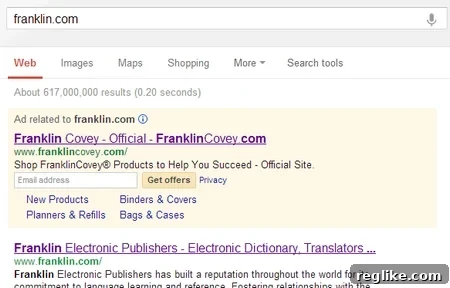
The inclusion of this visual evidence underscores the potential impact of Adwords bidding on brand recognition and customer perception. It highlights how even seemingly innocuous bidding strategies can have significant consequences for competing businesses.
The “Franklin” Trademark: A Point of Contention
The lawsuit also touches upon the broader issue of trademark protection. While Franklin Electronic Publishers owns the domain name “Franklin.com,” the company also asserts its rights to the “Franklin” trademark itself. FranklinCovey’s bidding on the term “Franklin” is seen as a potential infringement on this trademark, particularly if it leads to customer confusion or dilutes the value of the Franklin Electronic Publishers’ brand.
This aspect of the lawsuit raises complex questions about the scope of trademark protection in the digital age. Can a company prevent a competitor from using a common word like “Franklin” in their Adwords campaigns, even if the competitor’s products or services are somewhat related? The answer to this question will likely depend on a variety of factors, including the strength of the trademark, the degree of customer confusion, and the specific wording of the advertisements.
Analogies to Domain Name Disputes
The FranklinCovey lawsuit draws parallels to previous domain name disputes, particularly those involving typosquatting. Typosquatting occurs when someone registers a domain name that is a common misspelling of a popular website’s address. The goal is often to capture traffic from users who accidentally misspell the domain name and potentially redirect them to a competitor’s website or a website containing malicious content.
While the FranklinCovey case doesn’t involve typosquatting in the traditional sense, it shares a similar element of targeting a specific domain name or keyword in order to gain a competitive advantage. The key difference is that FranklinCovey is using a legitimate advertising platform (Google Adwords) rather than simply registering a misleading domain name.
The Implications for Online Advertising
The outcome of the FranklinCovey lawsuit could have significant implications for the online advertising industry. If FranklinCovey is found liable for trademark infringement or unfair competition, it could set a precedent for stricter regulations on Adwords bidding practices.
Companies may need to be more cautious about bidding on keywords that are closely associated with their competitors’ brands or domain names. They may also need to carefully monitor their Adwords campaigns to ensure that their advertisements are not misleading or likely to cause customer confusion.
Conversely, if FranklinCovey prevails in the lawsuit, it could embolden other companies to engage in more aggressive Adwords bidding strategies. This could lead to a more competitive online advertising landscape, but it could also increase the risk of trademark infringement and customer confusion.
The Future of the Lawsuit
The FranklinCovey lawsuit is still in its early stages, and it remains to be seen how the legal proceedings will unfold. Both Franklin Electronic Publishers and FranklinCovey will likely present evidence and arguments to support their respective positions.
The court will need to consider a variety of factors, including the strength of Franklin Electronic Publishers’ trademark rights, the degree of customer confusion, and the reasonableness of FranklinCovey’s Adwords bidding practices.
The final outcome of the lawsuit will undoubtedly be closely watched by companies across a variety of industries. It will serve as a valuable case study for navigating the complex legal landscape of online advertising and protecting intellectual property rights in the digital age.
Ultimately, the FranklinCovey lawsuit serves as a reminder that even in the fast-paced world of online advertising, ethical considerations and respect for intellectual property rights are paramount. Companies should strive to compete fairly and transparently, avoiding practices that could mislead customers or unfairly benefit from a competitor’s brand recognition.
As the case progresses, further updates and analysis will be provided to keep you informed about the latest developments and their potential impact on the digital marketing landscape.