Google Chrome URL news into perspective — Putting the
What impact could changes to Chrome have on domain names?
Yesterday I wrote regarding a WIRED story discussing the Google Chrome team’s efforts to change how it displays a site’s identity.
The reaction was pretty strong. Any threat to URLs seems like a threat to domain names.
But let’s take a step back and think more regarding this.
The idea is to make sure people visiting a website understand the identity of the website. Who runs it? Is it the site I intended to visit? Is it legit?
We can all agree that knowing these answers is a good thing. The question is how to convey this information, and how much of it can be conveyed in the “address bar” of a browser.
Keep in mind that there’s a difference between a URL and a domain name.
I think there’s a lot of value in seeing the entire URL string of a site I visit as it tells me a lot regarding the page, the section of the site, the content, and sometimes how recent the content is. I can also find other info on the site by changing the URL (e.g. removing the article name to visit a category). Importantly, I can see what sort of tracking information was appended to the URL. For example, did I just click on an affiliate link? If so, ought to I reconsider the suggestion the site made regarding buying the product?
But this might not be very valuable to other people.
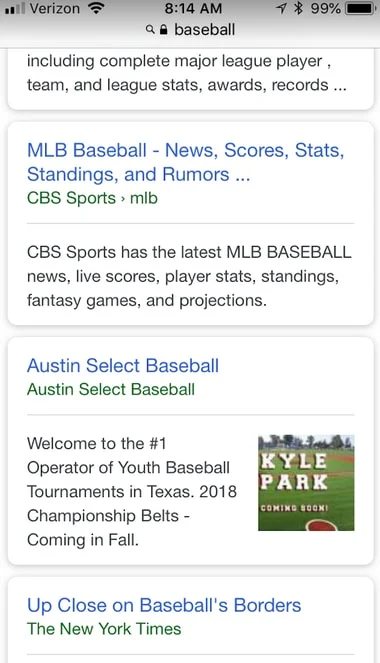
It can also be difficult to show an entire long URL on a mobile browser. This might explain why Google downgraded the presence of URLs in mobile search three years ago. For example, these search results have the name of the site rather than the domain:
I don’t like this at all and think it’s a security issue. Yes, I know what CBS and The Fresh York Times is, but I’d really like to see at least the second level domain name for “Austin Select Baseball” ahead of visiting the site. Baseball is kind of innocuous, but what if this was a site regarding credit cards?
The popular @swiftonsecurity account on weighed in with these thoughts:
This is an notice seeking input on how to move URL understandability forward in the graphical interface, which is right now stupendously dangerous and indecipherable. I’d say don’t jump to conclusions regarding radical changes, which have been tried ahead of and did not work. https://t.co/MJ95D0RlUM
— InfoSec Taylor Swift (@SwiftOnSecurity) September 5, 2018
Chrome isn’t changing URLs. They’re exploring “how to display identity.” Any changes will be in canary many months ahead of actual users see it, there’s no secret change that will just appear.
— InfoSec Taylor Swift (@SwiftOnSecurity) September 5, 2018
My takeaway is this:
1. The goals that Google states it’s trying to achieve are generally good.
2. Any deemphasis of the second level domain could hurt the importance of domain names. But the answer could be an added emphasis on this domain.
3. Google will be looking for feedback, so provide it to them.