
When Domain Tasting Meets Social Responsibility: The R-Word.com Saga

In a compelling example of how the digital landscape intersects with vital social causes, the domain name r-word.com became the unexpected centerpiece of a story involving high-volume domain registration, public awareness campaigns, and ultimately, corporate responsibility. Originally caught in the dragnet of a domain tasting operation, this seemingly innocuous web address carried profound significance for the Special Olympics’ powerful “Spread the Word to End the Word” campaign.
The journey of r-word.com from a parked page to a redirected beacon of advocacy highlights the complexities of the internet’s domain ecosystem and the increasing pressure on companies to align their operations with ethical considerations. What began as an automated acquisition by a domain registrar ultimately transformed into a positive outcome, demonstrating the potential for swift correction when public awareness and corporate goodwill converge.
The Special Olympics and the Power of Inclusive Language
The Special Olympics has long been a global leader in advocating for the rights and inclusion of individuals with intellectual disabilities. Central to their mission is the “Spread the Word to End the Word” campaign, which specifically targets the derogatory use of the word “retard” and its variations. This campaign seeks to raise awareness about the pain and prejudice inflicted by such language, advocating for a shift towards more respectful and inclusive terminology. The organization leverages its primary online hub, r-word.org, as a focal point for this critical initiative, offering resources, stories, and ways for people to pledge their support.
The word “retard,” once a clinical term used to describe individuals with intellectual disabilities, tragically devolved into a common slur, used to mock, belittle, and dehumanize. The Special Olympics’ campaign emphasizes that language shapes attitudes, and the continued use of the “r-word” perpetuates harmful stereotypes and discrimination. By drawing parallels to other deeply offensive slurs, such as the n-word, the campaign underscores the profound emotional and psychological damage that such language inflicts, aiming to foster a culture of empathy and respect for all.
President Obama’s Gaffe: An Unintended Catalyst for Awareness
In a surprising turn of events, President Barack Obama inadvertently thrust the “r-word” campaign into the national spotlight during an appearance on The Tonight Show. Speaking lightheartedly about his poor bowling skills, Obama quipped that his performance was “like the Special Olympics.” While undoubtedly an unintentional gaffe, his remark sparked immediate public discussion and drew attention to the sensitive nature of language surrounding individuals with disabilities. The President quickly recognized his misstep, offering a sincere apology that underscored his respect for the Special Olympics and its participants.
Despite the initial controversy, this incident proved to be a powerful, albeit accidental, catalyst for the “Spread the Word to End the Word” campaign. The heightened media attention surrounding Obama’s comment provided an unprecedented platform for Special Olympics to amplify its message. Suddenly, conversations about inclusive language and the impact of the “r-word” were happening on national television, in newspapers, and across social media. This unexpected visibility allowed the campaign to reach a significantly wider audience, turning an unfortunate mistake into a moment of widespread public education and engagement regarding the importance of respectful communication and the dignity of people with intellectual disabilities.
Domain Tasting: The Business of Automated Domain Acquisition
The core of the r-word.com incident lies in the practice known as “domain tasting.” This controversial method involves the bulk registration of domain names, often thousands at a time, followed by a rapid assessment of their traffic potential. Internet Corporation for Assigned Names and Numbers (ICANN) rules traditionally allowed registrars a five-day grace period during which they could register a domain and then delete it for a full refund. This loophole enabled domain tasters to register speculative domains, park them with advertisements, gauge their revenue generation over a few days, and then keep only the profitable ones while discarding the rest without financial penalty.
Operations like eNom467, associated with internet giant Demand Media, were significant players in this high-volume, automated process. Their business model relied on casting a wide net, capturing domains that might inadvertently generate traffic from misspellings, expired previous registrations, or sudden spikes in relevance. The statistics provided – eNom467 adding 748 domain names and deleting 10,346 in a single month – vividly illustrate the scale of these operations. While often financially lucrative, domain tasting has faced significant criticism for consuming valuable domain space, potentially diluting the value of legitimate registrations, and sometimes, as in the case of r-word.com, inadvertently acquiring names with sensitive implications.
The Unfortunate Acquisition of R-word.com
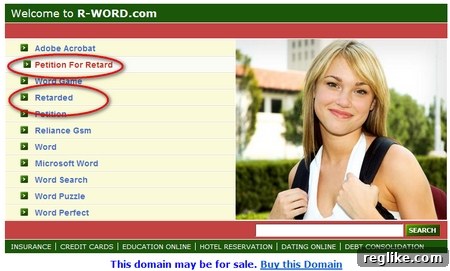
It was through this automated, volume-driven process that eNom467 Incorporated, a domain tasting arm of Demand Media, unexpectedly acquired r-word.com. The domain, which carried such crucial meaning for the Special Olympics campaign, was simply another entry in a vast spreadsheet of potential traffic generators. Once acquired, it was automatically “parked,” a common practice where a domain is pointed to a placeholder page filled with contextually relevant (or often irrelevant) advertisements. This parking page, far from conveying a message of respect or inclusion, was a generic, ad-laden platform designed purely for monetization.
The juxtaposition was striking: on one hand, the Special Olympics was meticulously building a campaign around the profound meaning of “r-word.org”; on the other, its commercial counterpart, r-word.com, was sitting on a generic parking page, generating ad revenue. The irony was further compounded by the fact that r-word.com was even listed for sale through another affiliated eNom company, AcquireThisName, highlighting the purely commercial intent behind its acquisition. This incident served as a stark reminder of the impersonal nature of domain tasting and the potential for such operations to inadvertently stumble upon domains with significant cultural, social, or political weight, leading to embarrassing and ethically questionable situations for the companies involved.
Resolution: A Positive Turn Towards Corporate Responsibility
Recognizing the sensitive nature of the domain and the public attention garnered by the Special Olympics campaign and the Obama gaffe, eNom (and by extension, Demand Media) made a commendable decision. In a swift act of corporate responsibility, eNom announced that it would forward r-word.com directly to the Special Olympics’ official campaign site, r-word.org. More importantly, the company committed to transferring ownership of the domain name to the Special Olympics, ensuring its rightful place in support of the advocacy efforts.
This resolution was a significant win for the Special Olympics and a strong demonstration of ethical conduct in the domain industry. It showcased that even in the automated world of domain tasting, there’s room for human intervention and a positive response to social concerns. eNom’s actions not only corrected an oversight but also transformed a potentially damaging situation into an opportunity for positive public relations, reinforcing its image as a company capable of acting with sensitivity and community welfare in mind. This outcome underscored the growing expectation for corporations to engage responsibly with their digital assets, especially when those assets touch upon issues of social justice and human dignity.
The Broader Landscape: RWord.org and Opportunistic Registrations
The r-word.com saga was not an isolated incident in the realm of sensitive domain names. The original article also briefly noted the existence of RWord.org (without the hyphen), which was registered just days after the Special Olympics secured r-word.org. This domain, too, sported an “unpleasant” parked page, suggesting another instance of opportunistic registration or domain squatting aiming to capitalize on the campaign’s visibility. Such occurrences highlight the constant vigilance required by advocacy groups and non-profits to protect their brand and message online.
The internet, with its vast and often unregulated spaces, presents a double-edged sword for campaigns like “Spread the Word to End the Word.” While it offers unparalleled reach and engagement, it also creates avenues for exploitation by those seeking to profit from traffic or attention. The challenge for organizations is not only to secure their primary digital assets but also to monitor the periphery, addressing similar-sounding domains that might confuse the public or dilute their message. These ancillary domain issues underscore the ongoing need for robust domain management strategies that consider both direct threats and subtle infringements.
Lessons Learned: Domains, Ethics, and Advocacy in the Digital Age
The story of r-word.com offers a valuable case study in the intersection of domain name practices, corporate ethics, and social advocacy. It demonstrates that while automated systems can be efficient, they require oversight and a readiness to adapt when they inadvertently clash with public interest and ethical standards. For domain registrars and companies engaged in high-volume domain operations, the incident serves as a reminder to implement safeguards and establish clear policies for handling sensitive domain names.
For advocacy groups like the Special Olympics, it reinforces the importance of proactive domain registration and vigilant monitoring to protect their intellectual property and, more importantly, the integrity of their message. Ultimately, this episode is a testament to the power of collective awareness. The public outcry, the media spotlight, and the principled stand taken by the Special Olympics collectively persuaded a large corporate entity to make a socially responsible choice. This outcome reiterates that in the digital age, the values of respect, inclusion, and human dignity must extend even to the seemingly impersonal world of domain names.