Booking.com can get its trademark: Supreme Court
Court rules that Booking.com can be trademarked.
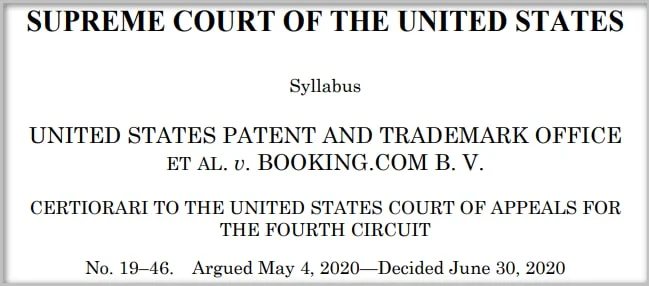
In an 8-1 ruling, the Supreme Court of the United States ruled today that Booking.com can trademark Booking.com.
For background on the issue, listen to DNW Podcast #285.
Booking.com sought the trademark, only to be rebuffed by the U.S. Patent and Trademark Office, which argued that it’s generic. The USPTO argues that adding .com to a generic term—like adding “Firm”—can convey no source-identifying meaning.
The Supreme Court disagreed, writing:
That premise is faulty, for only one entity can occupy a particular Internet domain name at a time, so a “generic.com” term could convey to consumers an association with a particular website.
Furthermore:
Under these principles, whether “Booking.com” is generic turns on whether that term, taken as a whole, signifies to consumers the class of online hotel-reservation services. Thus, if “Booking.com” were generic, we might expect consumers to understand Travelocity—another such service—to be a “Booking.com.” We might similarly expect that a consumer, searching for a trusted source of online hotel-reservation services, could ask a frequent traveler to name her favorite “Booking.com” provider.
So under limited circumstances, firms can trademark a generic term + .com (or perhaps another top level domain).
But that trademark won’t grant the firm protection of the generic term of the second-level domain. Booking.com acknowledged that the Booking.com mark would be weak. It will also not allow it successfully go following anyone who uses the generic term ‘booking’ in their mark.
The court wrote:
Guarding against the anticompetitive effects the PTO identifies, a number of doctrines ensure that registration of “Booking.com” would not yield its holder a monopoly on the term “booking.”
In fact, Booking.com stated it would not go following firms such as ebooking.com, or others that use the term in their name or domain name. It seems that the protection this trademark will provide is against someone, say, promoting themselves as booking.com on their website or naming their hotel Booking.com.
The full decision is here (pdf).