
Navigating the Confusing Case of CloudInsure.com: A UDRP Puzzle
I’m genuinely perplexed after delving into the UDRP decision and scrutinizing the details surrounding the domain name CloudInsure.com. What initially seemed like a straightforward case of reverse domain name hijacking has transformed into a convoluted enigma, leaving me with more questions than answers.
My initial intention was to analyze the UDRP case for CloudInsure.com, operating under the assumption that it should have been dismissed as an instance of reverse domain name hijacking. However, the deeper I investigated, the more bewildering the situation became.
According to the decision rendered by the National Arbitration Forum, CyberRiskPartners, LLC initiated the complaint against Drew Bartkiewicz.
Panelist M. Kelly Tillery from the National Arbitration Forum included a crucial timeline within the decision, which I’ve reproduced below:
- 3/17/10: Domain Name First Registered
- 10/1/11: Complainant LLC Formed
- 11/14/12: Filing Date TM Application by Complainant
- 11/30/13: First Claimed Use of Mark by Complainant
- 2/3/15: Complainant TM Registration on U.S. Supplemental Register
- 12/17/18: Complainant Filed Complaint
It’s important to highlight that the trademark application filed in 2012 was based on an intent-to-use basis. Furthermore, the trademark registration resides on the supplemental register, which offers a lower degree of protection compared to the principal register.
To verify the domain’s ownership history, I consulted historical Whois records. My investigation confirmed that the current owner was indeed the original registrant from 2010.
Based on these readily available facts, it appeared that the UDRP complaint was fundamentally flawed from the outset. The domain owner demonstrably registered the domain name well before the Complainant even existed as a legal entity. This timeline is a cornerstone of UDRP proceedings; prior registration is usually a strong defense.
However, the situation took a perplexing turn when I examined CyberRiskPartners’ official website. This is where the narrative diverges from the seemingly clear-cut timeline.
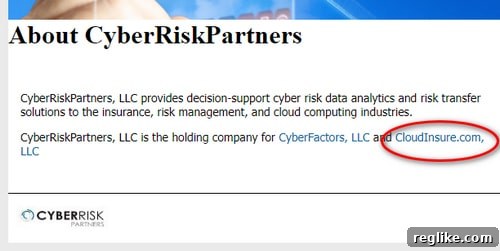
CyberRiskPartners’ website unequivocally states that the company functions as the holding company for CloudInsure.com, LLC. Intriguingly, clicking on the CloudInsure.com link redirects users to CloudEnsure.org, a domain name that was newly registered on January 8. This immediately raises questions about the connection and control of the CloudInsure.com domain.
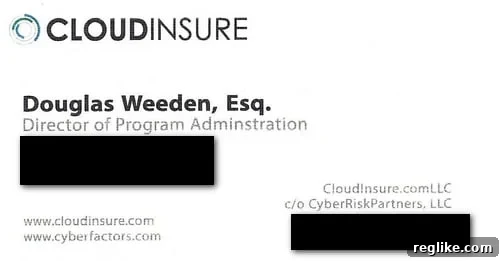
Adding another layer of complexity, the Complainant submitted marketing materials and a business card to the USPTO in 2014, both of which prominently featured the CloudInsure.com domain name. This suggests a potential association or use of the domain by the Complainant earlier than the UDRP decision implies. This is a critical point that directly contradicts the timeline presented in the UDRP.
Furthermore, a review of archived versions of the CloudInsure.com website reveals that it identified itself as a subsidiary of CyberRiskPartners, LLC. This historical connection further strengthens the impression that the Complainant had some form of control or association with the domain name at some point in the past.
All of these disparate pieces of information create a confusing picture. They collectively suggest that the Complainant likely had control or use of the domain name at some point. However, the UDRP decision makes absolutely no mention of this potential prior association or control. This glaring omission is a significant source of my confusion.
In an attempt to clarify the situation, I reached out to both the Complainant and the Respondent this morning, seeking their perspectives on the matter. Unfortunately, I have not yet received a response from either party.
The Unanswered Questions Surrounding CloudInsure.com
The UDRP decision, coupled with the available online evidence, presents a paradoxical situation. The domain registration timeline strongly favors the Respondent, yet the Complainant’s website, marketing materials, and archived versions of CloudInsure.com suggest a prior connection to the domain. This leads to several critical questions:
- Did CyberRiskPartners, LLC have prior control of the CloudInsure.com domain through a lease agreement, purchase, or other arrangement that was not disclosed in the UDRP?
- If CyberRiskPartners, LLC did have prior control, why was this information not presented during the UDRP proceedings?
- Was the redirection to CloudEnsure.org a strategic move by CyberRiskPartners, LLC, and if so, what was the reasoning behind it?
- Why did the panelist not consider the Complainant’s apparent use of the domain in marketing materials dating back to 2014?
- Was the Complainant aware of the prior registration when they filed the UDRP, and if so, what was their justification for proceeding?
These questions highlight the complexities and potential pitfalls of UDRP proceedings. While the timeline of domain registration is often a critical factor, it is not the only factor to be considered. Evidence of prior use, control, or association with the domain name can significantly influence the outcome of a case.
Lessons Learned from the CloudInsure.com Case
The CloudInsure.com UDRP case offers several valuable lessons for domain name owners, trademark holders, and anyone involved in intellectual property disputes:
- Thorough Due Diligence is Crucial: Before initiating a UDRP complaint, trademark holders should conduct thorough due diligence to investigate the domain name’s history, ownership, and usage. Failure to do so can result in wasted time, legal fees, and a potential finding of reverse domain name hijacking.
- Prior Use Matters: Evidence of prior use of a domain name, even if the domain is not registered by the trademark holder, can be a significant factor in UDRP proceedings. Trademark holders should be prepared to demonstrate their prior use and explain how the domain name infringes on their rights.
- Accuracy and Transparency are Essential: All parties involved in UDRP proceedings should strive for accuracy and transparency in their submissions. Withholding or misrepresenting information can have serious consequences.
- UDRP is Not Always the Answer: UDRP is a specific legal mechanism with defined criteria. It is not always the appropriate venue for resolving domain name disputes. Other options, such as negotiation or litigation, may be more suitable in certain cases.
- Seek Legal Counsel: Navigating the complexities of UDRP and domain name law can be challenging. It is advisable to seek legal counsel from an experienced attorney who can provide guidance and representation.
The CloudInsure.com case serves as a cautionary tale about the importance of thorough investigation, accurate representation, and careful consideration of all relevant factors in domain name disputes. It also underscores the fact that even seemingly straightforward cases can quickly become complex and confusing.
What Am I Missing?
Despite my best efforts to analyze the available information, I still feel like I’m missing a crucial piece of the puzzle. Is there a hidden agreement between the parties? Was there a misunderstanding about the domain’s ownership? Is there a factual error in the UDRP decision or the available online records?
Perhaps further investigation or a response from the Complainant or Respondent will shed light on this perplexing case. In the meantime, I remain thoroughly confused by the CloudInsure.com UDRP saga.
I encourage readers to share their thoughts and insights in the comments below. Perhaps together, we can unravel the mysteries surrounding this intriguing domain name dispute.