
Optimizing Domain Auctions: Why DropCatch Must Revise Its Bidding Increments for Enhanced Efficiency and User Experience.
The Critical Need for DropCatch to Modernize Its Domain Auction Bidding Increments
In the dynamic and competitive world of domain name investing, aftermarket platforms play a pivotal role in facilitating the acquisition of valuable web real estate. Among these platforms, DropCatch.com stands out as a significant player, often hosting high-stakes auctions for premium expiring domains. However, recent observations, particularly from a highly publicized auction, bring to light a critical area for improvement: the platform’s bidding increment structure. This article delves into why DropCatch’s current approach to bidding increments is no longer optimal and how an adjustment could vastly improve auction efficiency, bidder satisfaction, and overall market health.
The Case of Reactive.com: A Marathon, Not a Sprint
A prime example illustrating the challenges posed by DropCatch’s current bidding system recently unfolded with the auction of Reactive.com. This highly sought-after domain name generated immense interest, attracting over 350 bids and pushing the price well beyond the six-figure mark. The auction, which ultimately concluded at a staggering $168,450, became a protracted affair, a testament to the domain’s inherent value but also a clear indicator of the system’s inefficiencies.
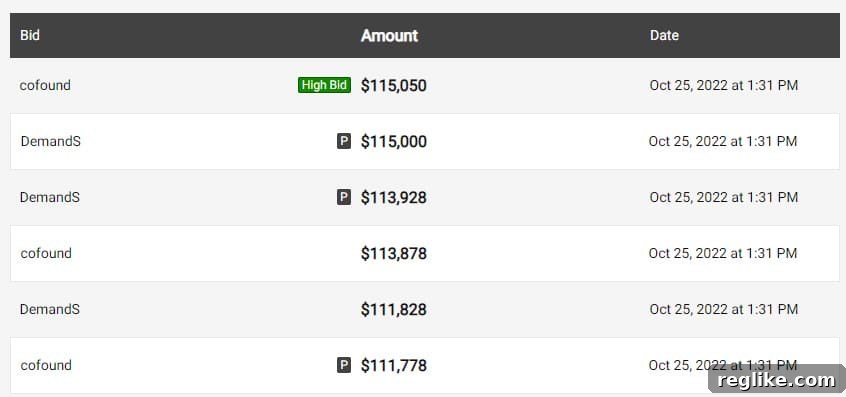
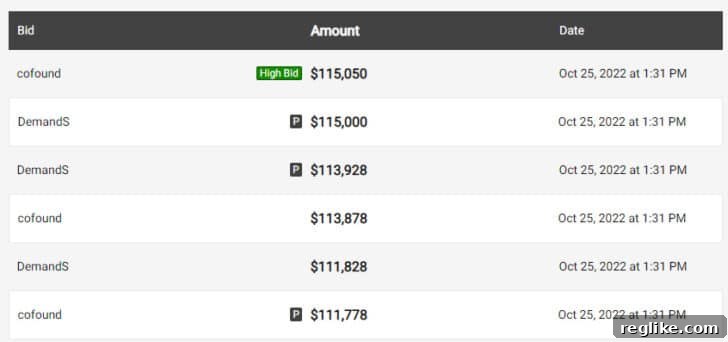
Like many auction platforms, DropCatch employs an automatic extension mechanism, prolonging the auction by a few minutes whenever a new bid is placed in the final moments. While this feature is designed to prevent “sniping” and ensure all interested parties have a fair chance to participate, it can lead to excessively long auctions, especially when bidding increments are too small relative to the domain’s rapidly escalating value. The Reactive.com auction served as a live demonstration of this phenomenon, extending for an unreasonable duration as bidders incrementally nudged the price upwards, $50 at a time, for an asset worth hundreds of thousands.
Understanding Bidding Increments and Their Impact on Auction Efficiency
Bidding increments are pre-defined amounts by which the current bid must be raised. They are a fundamental aspect of any auction system, designed to regulate the pace of bidding and guide participants towards a final price. The choice of increment values is crucial; too high, and they might deter potential bidders; too low, and they can create significant inefficiencies, especially in high-value auctions.
The core issue lies in DropCatch’s fixed bidding increment structure. While increments starting at $5 and capping at $50 once a domain hits $500 might seem reasonable for lower-priced domains, they become a significant bottleneck when domain values soar into the tens or even hundreds of thousands of dollars. Imagine an auction where a domain is valued at $136,000, and a new bid comes in at $136,050. This mere $50 increase, while technically moving the price, triggers a full reset of the auction timer, adding precious minutes to an already drawn-out process. This cycle repeats countless times, transforming what could be a swift conclusion into a tedious waiting game.
Prominent figures in the domain industry have voiced their concerns regarding this issue. Peter Askew, proprietor of DomainNameWire.com, shared his sentiment on Twitter, succinctly stating: “Bidding increments are too low for that price level.” This sentiment resonates with many experienced domain investors who have grown weary of prolonged auctions, highlighting the need for a more pragmatic approach to increment scaling.
Bidding increments are too low for that price level
— DomainNameWire.com (@DomainNameWire) October 25, 2022
Impact on User Experience and Auction Dynamics
The consequence of these low increments extends beyond mere inconvenience. It significantly impacts the user experience and the overall dynamics of an auction:
- Bidder Fatigue: Constantly monitoring an auction that stretches for hours, or even days, due to minimal price adjustments can lead to severe bidder fatigue. Serious buyers with substantial budgets may become frustrated and disengage, potentially missing out on a domain or reducing their final bid due to exasperation. The Reactive.com auction, requiring hundreds of small incremental bids, perfectly illustrates this point.
- Inefficient Resource Allocation: Both for the platform and the bidders, prolonged auctions tie up valuable time and computational resources. DropCatch’s servers are under continuous load, processing numerous tiny bid updates, and bidders are forced to dedicate excessive attention to a single auction, diverting focus from other potential opportunities in a fast-moving market.
- Reduced Market Liquidity: If auctions consistently drag on, it can slow down the overall velocity of domain transactions on the platform, affecting market liquidity and potentially deterring both sellers and buyers who prefer quicker, more decisive outcomes for high-value assets.
- Perception of Value and Urgency: While an active auction might seem exciting, one that goes on endlessly due to small increments can inadvertently dilute the perceived exclusivity or urgency of the bidding process for a high-value asset. It can make the process feel less like a competitive race and more like a test of endurance.
Industry Benchmarks: A Look at Competitors’ Bidding Structures
To understand what an optimized bidding increment structure looks like, it’s beneficial to compare DropCatch’s system with its primary competitors in the domain aftermarket. Most leading platforms have adopted tiered systems that dynamically adjust increments as the auction price increases, reflecting the growing value of the asset being contested and the seriousness of the bids.
SnapNames and NameJet: A Multi-Tiered Approach
Platforms like SnapNames and NameJet, two long-standing players in the expiring domain market, offer a more sophisticated and practical approach. Their bidding increment structure features 14 distinct steps, designed to scale effectively with the domain’s value:
- Increments hit $50 once an auction reaches the $1,000 mark.
- By the time an auction price surpasses $10,000, increments rise significantly to $500.
- For ultra-high-value domains exceeding $100,000, the increments jump to a substantial $5,000.
This progressive scaling ensures that high-value domains are not bogged down by trivial bid increases. It allows auctions to progress efficiently and conclude in a timely manner, which is crucial for maintaining bidder engagement and satisfaction, ultimately leading to more natural price discovery.
GoDaddy Auctions: Streamlined and Responsive
GoDaddy Auctions, another giant in the domain industry, also employs a more responsive increment system, albeit with fewer steps than SnapNames/NameJet. Their structure includes 8 steps:
- Starting at $5 for domains priced below $500.
- Moving to $25 once the auction hits the $1,000 mark.
- Reaching $250 for domains surpassing $10,000.
- And increasing to a robust $1,000 for auctions exceeding $50,000.
GoDaddy’s system, much like SnapNames’ and NameJet’s, is clearly designed to accelerate the conclusion of higher-priced auctions, acknowledging that bidders for such assets are generally operating with larger budgets and prioritize efficiency and a faster resolution.
The Imperative for Change at DropCatch: Adapting to a Maturing Market
It is highly probable that DropCatch’s current bidding increment structure was established years ago when the average price of expiring domains on the platform might have been considerably lower. In a rapidly evolving market where premium domains frequently command six-figure sums, these legacy increments are now anachronistic and hinder the platform’s potential.
The domain aftermarket has matured significantly. What was once a niche market dominated by a few dedicated investors is now a vibrant ecosystem attracting a wider range of participants, including established businesses, venture-backed startups, and brand-conscious entrepreneurs. These sophisticated buyers expect a streamlined, professional auction experience that reflects the high value of the assets they are pursuing. Continuing with outdated increment policies puts DropCatch at a competitive disadvantage, potentially driving high-value bidders to platforms offering a more efficient and less taxing experience.
By failing to adjust its bidding increments, DropCatch risks:
- Losing serious, high-value bidders to competitors who offer a more sophisticated and efficient auction experience.
- Alienating existing users who become fatigued by drawn-out processes and the constant need for micro-management of bids.
- Potentially suppressing final auction prices, as frustrated bidders might abandon auctions prematurely or reduce their maximum bids out of sheer exhaustion.
- Damaging its reputation as a leading platform for premium domain acquisitions, making it seem less professional compared to its peers.
Recommendations for DropCatch: Modernizing the Auction Experience
To address these critical issues, DropCatch should seriously consider implementing a tiered bidding increment system that mirrors industry best practices. This modernization would not only enhance the user experience but also solidify its position as a preferred platform for high-value domain auctions. Key recommendations include:
- Implement Dynamic Tiers: Develop a flexible increment scale where the bid increase automatically adjusts upwards as the auction price crosses certain thresholds (e.g., $1,000, $5,000, $10,000, $50,000, $100,000, $250,000). This would ensure that bids on a $150,000 domain are not progressing in mere $50 increments, but rather in $2,500 or $5,000 steps.
- Align with Market Value: The new increments should be proportional to the current market value of premium domains and reflect the typical budgets of serious buyers in those price ranges. For instance, an auction over $50,000 could have $1,000 increments, while one over $100,000 could have $2,500 or even $5,000 increments, allowing for faster progression.
- Communicate Changes Clearly: Any changes to the bidding structure should be clearly communicated to the user base well in advance, providing transparency and allowing bidders to adapt to the new system without confusion. Educational resources could also be provided.
- Consider Bidder Feedback: Engage with active users and prominent domain investors to gather feedback on proposed increment structures, ensuring that the changes meet the needs of the community and enhance their bidding experience.
Conclusion: A Call for Enhanced Efficiency and a Seamless Bidding Future
The Reactive.com auction vividly underscored a growing pain point in the DropCatch platform. While the automatic auction extension is a necessary feature to ensure fair play and prevent last-second snipes, its effectiveness is severely hampered by outdated bidding increments. By adopting a dynamic, tiered system similar to those successfully implemented by its competitors, DropCatch can significantly streamline its high-value auctions, improve bidder satisfaction, foster a more efficient marketplace, and ultimately strengthen its position in the competitive domain aftermarket.
The time for these essential adjustments is now. Modernizing the bidding increment structure will transform future auctions from exhausting marathons into exhilarating, efficient races to the finish, benefiting both the platform and its valuable user base. DropCatch has the opportunity to lead by example, enhancing its platform for the next generation of domain investors and securing its place as a premier destination for premium domain acquisitions.