
The digital landscape, constantly reshaped by the introduction of new top-level domains (TLDs), necessitates robust mechanisms for brand protection. Among these, the Uniform Rapid Suspension (URS) system emerged as a crucial tool. But how effectively does it serve its purpose, and what really happens to domain names subjected to URS suspension? An in-depth investigation into the early cases of URS suspensions uncovers a series of fascinating, and at times, perplexing outcomes that shed light on the system’s operational complexities and its enduring impact on brand owners. This detailed analysis provides critical insights into the real-world application of URS, highlighting both its intended functionality and unforeseen practical challenges.
Navigating Domain Disputes: The Emergence of Uniform Rapid Suspension (URS)
The Uniform Rapid Suspension (URS) procedure was introduced as a pivotal, more agile alternative to the long-standing Uniform Domain-Name Dispute-Resolution Policy (UDRP). Its debut was strategically timed with the significant expansion of the internet’s naming system through hundreds of new generic top-level domains (gTLDs). The core objective of URS was to offer brand owners a streamlined, faster, and more cost-efficient pathway to address clear-cut cases of abusive domain name registrations, particularly in this burgeoning new TLD ecosystem. Unlike the more comprehensive UDRP, which often involves detailed legal arguments, URS was designed for evident cases of infringement, aiming for swift resolution and minimal procedural overhead.
The rapid growth of new TLDs presented a double-edged sword: while opening up vast new digital real estate, it also created fertile ground for cybersquatters to register domain names infringing on established trademarks. Brand owners suddenly faced the daunting task of monitoring and protecting their intellectual property across an unprecedented number of domain extensions. URS was envisioned as a lightweight, first-response mechanism, allowing companies to quickly neutralize the most blatant forms of digital brand abuse without incurring the higher costs and longer timelines typically associated with UDRP proceedings. Its emphasis on speed and affordability positioned it as a pragmatic solution for managing widespread brand infringements in the expansive new gTLD space.
URS Versus UDRP: A Distinctive Approach to Remedies
The fundamental distinction between URS and UDRP lies in the ultimate remedy provided to a successful complainant. A victorious UDRP complaint typically culminates in the transfer of the disputed domain name from the infringing party to the brand owner. This outcome grants the complainant full legal ownership and control over the domain, enabling them to utilize it for official branding, redirect traffic, or simply hold it defensively to prevent future misuse. This definitive transfer ensures long-term resolution and integrated brand management.
In contrast, a successful URS complaint results solely in the suspension of the domain name. This means the domain is rendered inactive; it ceases to resolve to a website, cannot be used for email, and effectively becomes unusable to the current registrant. However, crucially, legal ownership of the domain technically remains with the original registrant for the duration of its current registration term. Once this term concludes, the domain’s fate can become ambiguous, potentially leaving the brand owner without complete control or long-term certainty.
This difference has always sparked considerable debate. The idea of investing resources to merely suspend a domain, only for it to potentially expire and re-enter the public domain pool, available for anyone else to register, struck some as an incomplete solution. While the immediate cessation of infringement is achieved, the risk of a new party (potentially another cybersquatter) registering the domain after expiration persists. This perceived “silly” aspect stems from the lack of a permanent transfer of ownership, which might necessitate further monitoring or even new dispute proceedings down the line. However, it’s also true that many domains won via UDRP are eventually allowed to expire, suggesting that for some brands, prevention of use, rather than ownership, is the primary goal. The choice between URS and UDRP, therefore, hinges on a brand owner’s strategic objectives: immediate cessation of abuse versus long-term, definitive ownership and control.
Unveiling the Post-Suspension Journey: A Study of Early URS Cases
To gain a clearer understanding of the practical implications of URS, a comprehensive analysis was undertaken focusing on the first 50 domain names that underwent suspension through the URS procedure at the National Arbitration Forum. These cases were adjudicated between March and June of 2014, a critical period that immediately followed the general availability of many new top-level domains. This particular timeframe provides an invaluable snapshot into the initial phase of URS implementation and the brand protection challenges emerging in the new gTLD landscape. The study aimed to track the long-term status of these domains, observing their trajectory once the initial suspension was imposed and their registration terms concluded.
The methodology involved meticulous research into each of the 50 domain names. This included persistent monitoring of Whois records, tracking expiration dates, and observing any subsequent registration activities. The goal was to categorize their ultimate destiny: did they remain suspended, become publicly available, get re-registered by the complainant, or fall into the hands of other parties? This detailed investigation sought to move beyond the theoretical framework of URS and reveal the actual outcomes, which, as discovered, were often quite diverse and presented both expected patterns and surprising anomalies. The findings offer crucial insights for brand owners, registries, and policymakers alike, highlighting the operational realities of this innovative dispute resolution mechanism.
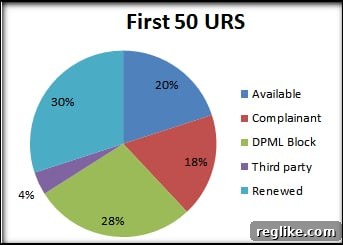
Categorizing the Diverse Outcomes: What Happened to Suspended Domains?
The detailed analysis of the first 50 URS-suspended domain names revealed a multifaceted array of post-suspension fates. These outcomes underscore the complexities inherent in domain name management and brand protection strategies in the evolving TLD environment. Each category provides unique insights into how URS functionally impacts domain names and the actions taken by various stakeholders.
- Proactive Protection: 14 Domains Secured by DPML
A significant segment of the suspended domains, totaling 14, ultimately expired and were subsequently secured under Donuts’ Domain Protected Marks List (DPML) service. This outcome is highly logical and reflects a crucial learning curve for brand owners during the early rollout of new TLDs. The initial URS suspensions often served as a wake-up call, prompting companies to recognize the immediate and ongoing threat of cybersquatting across the new domain extensions. DPML offers a robust, preventative solution by blocking the registration of specific trademarks across all Donuts-managed TLDs. This strategy effectively transforms a reactive URS measure into a proactive, portfolio-wide defense against future infringements. Prominent examples in this category included IBM.guru, Accenture.ventures, and Lufthansa.company, demonstrating how URS spurred broader intellectual property protection initiatives. - Expired and Available: 10 Domains Re-entered the Public Pool
Ten of the analyzed domain names eventually expired and became available for general registration, meaning they could be registered by any interested party. This outcome presents a potential vulnerability for brand owners. If the original complainant chose not to secure the domain after its initial suspension and expiration, the door opens for potential re-registration by a new cybersquatter or an opportunistic third party. This could lead to a recurrence of the original dispute or the emergence of new forms of brand abuse, necessitating further monitoring and potentially new legal actions. Examples in this category included Lipitor.guru, RipOffReport.link, and VirginAustralia.holdings. The reasons for complainants not securing these domains vary, ranging from strategic decisions not to invest further in a particular TLD to simple oversight or a shift in brand priorities. - Complainant Re-registration: 9 Domains Acquired by the Brand Owner
In nine instances, the complainant actively registered the domain name after its original registration lapsed. This proactive step demonstrates the brand owner’s intent to gain full control and ownership of the domain following the initial URS suspension. While URS provides a temporary cessation of abuse, direct registration offers a more definitive and long-term solution, akin to the outcome of a UDRP transfer. This method might be preferred by some complainants over the URS-stipulated process of renewing a suspended domain via the registry, which can be less familiar or more administratively complex. Notable examples include Spanx.clothing, Telepizza.menu, and Netflix.buzz, illustrating a direct and effective strategy for securing brand assets post-URS. - Registered by Another Party: 2 Domains Acquired by Third Parties
Only two domain names were subsequently registered by a completely different third party after their expiration. This low number is somewhat reassuring, suggesting that widespread opportunistic re-registration of URS-suspended domains by new cybersquatters may not be a pervasive issue. It’s crucial, however, to differentiate between malicious intent and legitimate interest. For instance, the domain Watson.company was registered by an individual whose last name is Watson, indicating a potentially legitimate, non-abusive registration. While vigilance remains paramount, not every re-registration by a third party necessarily represents a renewed threat to the brand. This category highlights the need for careful discernment when evaluating post-expiration domain activities.
The Persistent Anomaly: Renewed Suspensions by Original Registrants
The most striking and unexpected discovery of this study was the predominant outcome for many of the initial 50 URS-suspended domains: they were renewed. Astonishingly, many of these domains were renewed not just once, but twice, extending their registration terms far beyond the initial suspension period. Compounding this anomaly, the public Whois records for these domains continued to display the original registrant – the very party against whom the URS complaint was filed and whose domain was supposed to be rendered inactive and ultimately expire or be managed by the complainant. This persistent renewal by the losing party represents a significant departure from the intended operation and spirit of the URS policy.
URS Rules Versus Practical Reality: A Discrepancy Revealed
My interpretation of the Uniform Rapid Suspension rules clearly states that a suspended domain name should remain in that inactive state until the end of its current registration period. At that point, the rules stipulate that the complainant, having successfully won the URS case, is granted the option to renew the domain name for an additional year. Critically, this renewal process is specified to occur by directly contacting the registry, rather than through the original registrar. This specific procedural detail suggests a deliberate mechanism to prevent the original registrant from maintaining control or renewing the domain. The implication is clear: after the initial term and any subsequent complainant-initiated renewal, the domain should certainly not remain registered to, or be renewed by, the original registrant, especially not for multiple consecutive years. The observed pattern of multiple renewals by the losing party directly contradicts this established framework and points to a significant operational disconnect.
Investigating the Discrepancy: A Journey into Manual Processes
To understand why these domains were being renewed by the original registrants, an investigative process was initiated. Initial attempts to contact some of the individuals who had lost their URS cases yielded limited direct responses. One respondent, however, explicitly stated that they had not renewed their domain name post-suspension. This denial further deepened the mystery, directing the investigation towards the operational backbone of the domain name system: the registries and registrars.
Extensive outreach and discussions with various registries and registrars involved in these early URS cases began to reveal a critical underlying issue: the URS process, particularly concerning the management of suspended domains at renewal and expiration, does not seamlessly integrate with the largely automated procedures governing standard domain registrations. Unlike the bulk of domain life cycles, which are handled by automated systems, URS management frequently necessitates manual intervention. This human element is required for tasks such as ensuring a domain remains suspended, overriding automated renewal attempts by the original registrant, or facilitating the complainant’s specific option to renew via the registry. The relative rarity of URS suspensions, especially compared to the immense volume of daily domain transactions, means that dedicated, robust automated workflows for these edge cases are often underdeveloped or entirely absent, leading to reliance on manual oversight.
The Pitfalls of Human Intervention and Systemic Oversight
The heavy reliance on manual processes inherently introduces a substantial margin for error and oversight. In some instances, it was found that the domain name registrar, perhaps due to a lack of comprehensive understanding of specific URS rules or inadequate internal procedural guidelines for handling suspended domains, may have inadvertently failed to implement the necessary manual block to prevent an automatic renewal by the original registrant. Similarly, certain registries could also have been responsible for not correctly processing the suspension status or not having a clear protocol for a complainant’s renewal option. The intricate multi-stakeholder ecosystem of domain names – involving the registrant, registrar, registry, and ICANN – means that a procedural breakdown at any point in this chain can lead to unintended and non-compliant outcomes. This systemic oversight is particularly concerning given that the URS policy aims for clarity, speed, and definitive action. The observation of domains being renewed twice by the losing party points to a deeper, systemic challenge rather than isolated incidents, suggesting a fundamental gap in how URS outcomes are enforced operationally across the domain industry.
Broader Implications and Recommendations for Future Clarity
Despite the procedural anomalies uncovered by this study, it’s important to underscore that, from the complainant’s perspective, the primary objective of initiating a URS case—the suspension and inactivation of an infringing domain name—is still achieved. Even if the domain is technically renewed by the original registrant due to a systemic oversight, the brand owner’s immediate goal of preventing abusive use of their intellectual property is met, as the domain remains suspended and unusable. The URS policy’s core aim is to stop the abuse, not necessarily to transfer ownership, which distinguishes it from UDRP.
However, the insights gained from this investigation offer critical lessons for the ongoing evolution and refinement of domain name dispute resolution mechanisms. The findings strongly suggest an urgent need for greater clarity, robust automation, and streamlined procedures for managing URS-suspended domains across the entire domain name ecosystem. ICANN, in collaboration with registries and registrars, must work collaboratively to review and refine the operational guidelines. This includes developing clearer protocols to effectively prevent automatic renewals by losing parties, establishing more transparent and user-friendly channels for complainants to exercise their option to renew a suspended domain through the registry, and potentially even reassessing the “suspension only” remedy in light of these identified practical challenges.
For brand owners, this study reinforces the critical importance of a proactive and vigilant brand protection strategy. While URS provides a valuable and efficient tool for rapid enforcement against clear-cut cybersquatting, understanding its practical limitations and potential procedural quirks is essential. Brands must not only initiate dispute resolution when necessary but also meticulously monitor the status of disputed domains post-resolution, irrespective of the outcome. The journey of these first 50 URS-suspended domains serves as a compelling testament to the dynamic, complex, and continuously evolving realities of domain name dispute resolution and intellectual property protection in the digital age. Ensuring the integrity and efficacy of systems like URS is paramount for maintaining trust and order in the global internet naming system.