
Early Investor Sentiment: Navigating the Dawn of New TLDs in 2014
The year 2014 marked a significant turning point in the history of the internet, ushering in an unprecedented expansion of the domain name system with the introduction of hundreds of new Top-Level Domains (TLDs). This ambitious rollout, orchestrated by ICANN, was always understood to be a slow and deliberate process, one that would unfold over many years, fundamentally reshaping the digital landscape. As the first wave of these innovative domain extensions began to emerge, the industry collectively held its breath, eager to understand their potential impact on established norms, market dynamics, and the strategies of long-standing domain investors.
In this period of nascent change, understanding the immediate sentiment of key industry players was crucial. A comprehensive survey conducted in early 2014 by Domain Name Wire provided a vital snapshot of perspectives from across the domain ecosystem. This survey meticulously captured the opinions of domainers actively acquiring digital real estate, registrars facilitating these transactions, and registry providers supplying the new extensions. Their collective insights offered an invaluable window into how the burgeoning new TLD market was perceived at its very inception, highlighting both cautious optimism and underlying concerns.
Domain Investor Expectations for New TLD Registrations in 2014
One of the central questions posed to survey participants focused on their registration intentions for the newly available TLDs in 2014. To gain a clear understanding of the speculative and strategic approaches, the results were specifically filtered to reflect the views of self-identified domain name investors. While some overlap with service providers was naturally present within this group, their primary motivation for engagement in the domain market provided a focused lens on investor behavior.
The findings revealed a divided, yet engaged, investor community. Approximately 47% of domain investors indicated they had no plans to register any new TLDs during 2014. This segment likely represented those adopting a wait-and-see approach, perhaps skeptical of the immediate value proposition, or content with their existing .com portfolios. Conversely, the remaining 53% expressed clear intentions to register anywhere from a single domain to as many as a thousand new TLDs. This group showcased a proactive readiness to explore the new opportunities, signaling a belief in their potential value, even if speculative.
Notably, the median response among those planning to register new TLDs was 20 domains. This figure offers a compelling insight into the cautious yet strategic approach of many investors. It suggests that while a significant portion of the investing community was indeed dipping their toes into the new TLD waters, most were doing so with a measured approach rather than a wholesale shift of their portfolios. This median indicated an interest in testing the market, identifying promising niches, or defensively registering key terms under select new extensions, without overcommitting resources in an unproven landscape.
The strategies behind these registration intentions were undoubtedly diverse. Some investors might have focused on acquiring generic keywords under relevant new TLDs (e.g., .tech, .app), hoping to capture future demand. Others might have pursued “geo” TLDs (e.g., .london, .nyc) for location-specific ventures. A strong defensive play was also likely, where companies or individuals registered their brand names under new TLDs to prevent cybersquatting, even if they had no immediate plans to develop them. This initial burst of activity, tempered by a degree of prudence, set the stage for how the new TLD market would evolve in the years to come.
The Unshakeable Reign of .com? Perceptions of Value Impact
Beyond direct registration plans, the survey also delved into one of the most pressing questions surrounding the new TLD rollout: how would it affect the long-standing dominance and value of .com domain names? For decades, .com has been the undisputed king of digital real estate, synonymous with credibility, established presence, and intrinsic value. The introduction of hundreds of new alternatives naturally raised concerns about market fragmentation and potential devaluation of this prime asset.
Interestingly, the vast majority of domain investors held a steadfast belief in the resilience of .com. Their predictions painted a picture of minimal disruption, with only a relatively small minority forecasting a decline in .com values. The survey data illustrated this sentiment clearly:
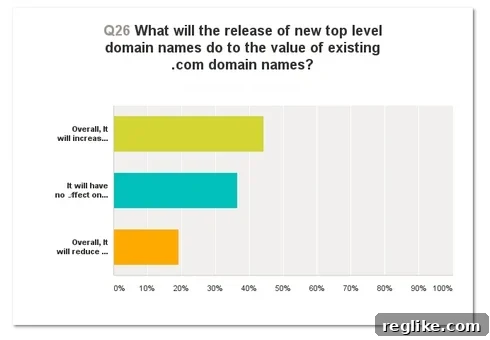
The chart, reflecting early 2014 sentiment, revealed that a significant portion of investors anticipated either a rise in .com values or little to no impact. Approximately 20% of respondents projected a fall in .com prices as a direct consequence of the new TLDs entering the market. This minority view, while present, was overshadowed by a widespread confidence in .com’s enduring strength. The prevailing sentiment among investors was that .com’s established brand recognition, universal trust, and historical precedence would insulate it from significant negative pressure, perhaps even driving its value higher as the overall domain market expanded.
This unwavering belief in .com extended beyond just domain investors. When comparing their responses to those from registrars and other service providers, the patterns remained largely consistent. While these latter groups showed a slightly higher percentage expecting no effect on .com values rather than a positive one, the overall consensus across the industry was clear: .com was expected to withstand the new TLD storm largely unscathed. This widespread confidence underscored the deep-seated understanding that .com wasn’t just another domain extension; it was a foundational element of the internet’s commercial and cultural identity, a digital staple that newcomers would struggle to dislodge.
The Looming Shadow: Impact on Legacy Non-.com TLDs
While .com appeared to be largely immune to investor anxieties, the outlook for other existing, “legacy” non-.com TLDs, such as .info, .biz, .net, and .org, was considerably less optimistic. These extensions, which had long served as alternatives or complementary options to .com, faced a far more precarious future in the eyes of the industry.
The survey highlighted a stark contrast in perception: more than half of both the domain investor group and the broader service provider category anticipated that these legacy non-.com domains would be negatively impacted by the influx of new TLDs. This widespread apprehension stemmed from a logical assessment of market dynamics. Unlike .com, which possessed an unparalleled level of brand equity and established trust, extensions like .info and .biz had often struggled to carve out a distinct identity or achieve widespread adoption comparable to .com.
With the introduction of new, often highly specific and descriptive TLDs (e.g., .photography, .store, .online), the landscape for alternative domain names was becoming significantly more crowded and competitive. The argument was that if a business couldn’t secure their desired .com, they now had a plethora of highly relevant and modern options that could potentially be more appealing than older, less specific alternatives. For instance, a photography studio might find .photography far more relevant and branding-friendly than .info. This fragmentation of the “alternative” market threatened to dilute the perceived value and utility of the older non-.com extensions, potentially leading to decreased demand and, consequently, lower valuations.
This prediction suggested a potential “squeezing out” effect, where the new, more targeted TLDs would capture market share that previously went to generic non-.coms. It signaled a shift in strategy for many entities, moving away from generic alternatives towards hyper-relevant ones, thereby diminishing the appeal of the older options. This insight was a crucial early indicator of how the new TLD program wasn’t just about adding new choices, but about fundamentally re-evaluating the competitive landscape for every domain extension outside of the .com behemoth.
Analyzing the 2014 Snapshot: What We Learned and What It Predicted
The early 2014 survey serves as a fascinating historical artifact, capturing the initial hopes, fears, and strategic positions of the domain industry at the very beginning of the new TLD era. It provided invaluable insights into the mindset of domain investors and professionals during a period of immense change and uncertainty.
Firstly, it demonstrated a cautious but definite appetite among investors to engage with the new TLDs, albeit often with a measured approach, as evidenced by the median registration expectation. This was not a blind rush but a strategic exploration. Secondly, the unwavering confidence in .com’s enduring value, despite the massive expansion of the domain space, highlighted its unique and seemingly irreplaceable position in the digital economy. It was perceived as a fortress, largely immune to the market fragmentation that might affect other extensions. Finally, the widespread concern for the future of legacy non-.com TLDs underscored a pragmatic understanding that increased competition and improved relevance from new offerings would inevitably put pressure on older, less distinct alternatives.
These early predictions, captured in a pivotal moment, helped shape the strategies of domain investors, businesses, and registrars as they navigated the evolving digital landscape. They provided a foundational understanding of how market participants believed the introduction of new TLDs would impact brand strategies, digital asset management, and the very fabric of online identity. The 2014 snapshot proved to be more than just a momentary observation; it was a blueprint for understanding the complex interplay between innovation, tradition, and market perception in the dynamic world of domain names.