
Navigating the Deceptive Waters: Unmasking Misleading Domain Renewal and Website Optimization Scams
In the vast, often complex digital landscape, domain names are your online identity, your digital real estate. Naturally, maintaining them is crucial for any individual or business operating online. This critical need, however, has unfortunately become fertile ground for various forms of online deception, particularly through email. Many internet users, especially those managing websites, are all too familiar with the deluge of official-looking, yet ultimately fraudulent, “domain renewal notices” or “website optimization offers” that flood their inboxes. These emails, masterfully crafted to induce panic and prompt hasty action, represent a persistent threat to online security and financial well-being.
This article delves into the intricate tactics employed by the senders of these misleading emails. We will dissect their structure, scrutinize their disclaimers – often replete with ironic self-contradictions – and equip you with the knowledge to recognize, understand, and ultimately dismiss these deceptive solicitations. Our aim is to shed light on how these scams operate, providing a comprehensive guide to protecting your digital assets from increasingly sophisticated phishing attempts and dubious marketing ploys.
The Pervasive Threat of Fake Renewal Notices and Phony Optimization Offers
The scenario is regrettably common: an email arrives, often with an urgent subject line, implying that your domain name is about to expire, or that your website is underperforming and requires immediate “optimization.” For busy professionals, small business owners, or even novices in the digital space, these emails can be genuinely alarming. The fear of losing a crucial domain name – an invaluable asset for brand identity and online presence – often overrides critical thinking, pushing recipients towards impulsive action. These messages are designed to mimic legitimate communications from domain registrars or web hosting providers, utilizing familiar logos, terminology, and even an air of authority to trick unsuspecting users.
However, upon closer inspection, the deception begins to unravel. While many of these emails are efficiently caught by advanced spam filters, occasionally one slips through, presenting a prime opportunity for analysis. It’s within these seemingly innocuous messages, often buried in tiny, almost invisible fine print, that the true nature of the scam is revealed, often with an astonishing, almost comical, level of self-disclaimer that ironically confirms their deceptive intent.
Consider a typical example of such an email:
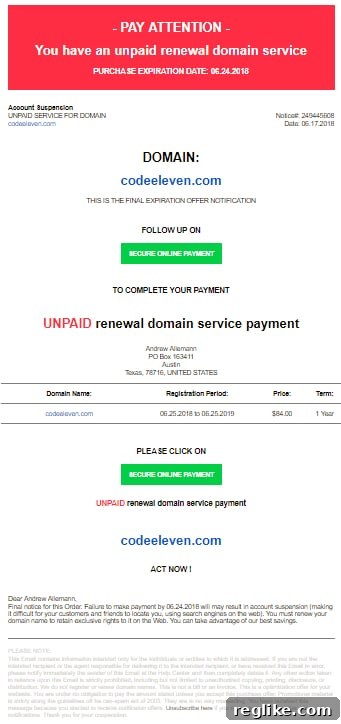
At first glance, it might appear to be a standard notification. But the devil, as they say, is in the details – specifically, the barely visible, light grey text nestled at the bottom of the email. This miniature text block, often overlooked due to its poor contrast and small font size, is where the senders attempt to legally cover themselves, even as their primary message aims to mislead.
Deconstructing the Deceptive Disclaimer: An Exercise in Irony
The fine print in these emails typically begins with a boilerplate legal disclaimer, ostensibly for confidentiality and data protection. It’s a standard inclusion in many professional communications, designed to prevent unauthorized disclosure of information. However, in the context of a misleading email, its presence serves a dual purpose: to lend an air of legitimacy to the scam and to subtly deter recipients from sharing the email with others who might expose its fraudulent nature.
PLEASE NOTE:
This Email contains information intended only for the individuals or entities to which it is addressed. If you are not the intended recipient or the agent responsible for delivering it to the intended recipient, or have received this Email in error, please notify immediately the sender of this Email at the Help Center and then completely delete it. Any other action taken in reliance upon this Email is strictly prohibited, including but not limited to unauthorized copying, printing, disclosure, or distribution.
While this initial section seems harmless, the real deception unfolds shortly thereafter. The disclaimer cleverly pivots from general confidentiality to directly contradict the email’s implied purpose. It’s a classic case of burying the lead, hoping the recipient will either not read it or gloss over its critical implications.
We do not register or renew domain names. This is not a bill or an invoice. This is an optimization offer for your webside (sic). You are under no obligation to pay the amount stated unless you accept this purchase offer.
This paragraph is the crux of the scam. After potentially leading you to believe you need to renew your domain, it explicitly states, “We do not register or renew domain names.” This admission is a stark warning sign. It clarifies that despite the urgent tone and appearance, the sender is not your domain registrar and has no authority over your domain’s status. Furthermore, it explicitly states, “This is not a bill or an invoice.” This directly undermines any sense of financial obligation that the email might have initially created.
The true nature of the offer then emerges: “This is an optimization offer for your webside (sic).” The misspelling of “website” (“webside”) is a glaring red flag, indicative of unprofessionalism and a common trait of scam emails originating from non-native English speakers or those who simply don’t care about meticulous proofreading. This “optimization offer” is typically vague, undefined, and often worthless. Scammers prey on the common desire for better search engine rankings or improved website performance, offering services that are either grossly overpriced, completely ineffective, or, in some cases, never even delivered. The final sentence, “You are under no obligation to pay the amount stated unless you accept this purchase offer,” attempts to provide a flimsy legal shield, arguing that the recipient freely chose to accept the “offer,” rather than being misled.
The CAN-SPAM Act and the Audacity of “Not Misleading”
Perhaps the most audacious and truly ironic part of these disclaimers comes when the sender attempts to assert their compliance with anti-spam regulations, specifically the CAN-SPAM Act of 2003. This federal law in the United States sets rules for commercial email, establishing requirements for commercial messages, giving recipients the right to have businesses stop emailing them, and outlining penalties for violations. While these scammers often include an unsubscribe link and a physical postal address, elements required by CAN-SPAM, their claim of adherence often stretches credulity.
Promotional material is stricly (sic) along the guidelines oft he can-spam act of 2003. They are in no way misleading.
The grammatical errors (“stricly,” “oft he”) again highlight the dubious nature of the sender. But the pièce de résistance is the definitive declaration: “They are in no way misleading.” This statement is a masterclass in gaslighting. When an email explicitly has to tell you it’s not misleading, it’s almost certainly because its entire premise is built on deception. The very necessity of making such a claim exposes the sender’s awareness of their own deceptive practices. They craft an email designed to look like a domain renewal notice, then, in tiny print, disclaim that it’s not, and then have the temerity to claim it’s “in no way misleading.” It’s a legal tightrope walk designed to exploit loopholes and rely on the recipient’s inattention or lack of technical knowledge.
Adding insult to injury, these emails often claim that the recipient “elected to recieve notificaton (sic) offers” from them. This is another blatant fabrication designed to justify unsolicited communication and falsely imply consent where none was given. It’s a common tactic in deceptive marketing to create a paper trail of implied consent, even if it’s entirely manufactured.
Recognizing the Red Flags and Protecting Your Digital Assets
Successfully navigating the digital world requires vigilance. Recognizing these deceptive emails is the first step in protecting your domain names, website, and personal information. Here are key red flags to watch out for:
Common Red Flags of Deceptive Emails:
- Urgent or Threatening Language: Emails demanding immediate action to avoid losing your domain or service are often scams. Legitimate registrars provide ample notice.
- Unfamiliar Sender Addresses: Always check the sender’s email address. It should match your actual domain registrar (e.g., GoDaddy, Namecheap, Google Domains). Be wary of similar-looking but slightly altered addresses.
- Requests for Immediate Payment Outside Your Registrar: If an email asks you to pay for a domain renewal or “optimization” through an unfamiliar portal or a different company than your known registrar, proceed with extreme caution.
- Generic Greetings: Many scam emails use generic salutations like “Dear Domain Holder” or “Dear Customer” instead of your specific name or domain name.
- Grammatical Errors and Typos: As seen with “webside,” “stricly,” and “recieve notificaton,” these errors are a hallmark of unprofessional or fraudulent communications.
- Unsolicited “Optimization” Offers: Be highly skeptical of emails offering unsolicited “SEO services,” “website performance audits,” or similar vague “optimization” packages.
- Suspicious Links: Hover over any links in the email (without clicking!) to see the actual URL. If it doesn’t point to your official registrar’s website or seems unusual (like a `.top` domain), it’s a major red flag.
Best Practices for Domain and Website Security:
- Verify Directly with Your Registrar: If you receive any email regarding your domain, always log in directly to your actual domain registrar’s account via their official website (which you have bookmarked) to verify the information. Never click on links in suspicious emails.
- Educate Yourself and Your Team: Ensure everyone in your organization who manages online assets is aware of these scam tactics.
- Use Robust Spam Filters: Rely on and periodically review your email provider’s spam filter settings. Services like Gmail are increasingly effective at catching these threats and often provide warnings about potentially malicious links.
- Enable Two-Factor Authentication (2FA): For your domain registrar and other critical online accounts, 2FA adds an essential layer of security.
- Regularly Review Domain Settings: Log in to your registrar periodically to ensure your contact information is up-to-date and that your domain’s auto-renewal settings are configured as you intend.
- Be Cautious with Unknown TLDs: As demonstrated by the use of a `.top` domain in the example, certain top-level domains are disproportionately used by spammers and scammers due to lower registration costs or laxer enforcement. Exercise extra caution with links from such domains in unexpected emails.
The Role of Spam Filters and the Malicious `.top` Domain
Fortunately, email service providers like Gmail are constantly evolving their spam detection algorithms. In many cases, these sophisticated systems can identify and quarantine such deceptive emails before they even reach your primary inbox. Gmail, for instance, often flags these emails with a clear warning, indicating that “this link has been used to steal information” – a direct alert to the phishing nature of the communication. This automated protection is invaluable, but it’s not foolproof, which is why user awareness remains paramount.
The example email also highlights another common characteristic of these scams: the use of specific top-level domains (TLDs). The link in the illustrative email uses a `.top` domain. While `.top` domains are not inherently malicious, they, along with others like `.xyz` or certain country-code TLDs, have unfortunately gained a reputation for being frequently exploited by spammers, phishers, and purveyors of dubious content. This is often due to their low registration costs and sometimes less stringent registration requirements, making them attractive to individuals or groups looking to operate with minimal oversight. Encountering a link from an unfamiliar TLD in an unsolicited email should immediately raise your suspicion levels.
Conclusion: Stay Vigilant, Stay Secure
The digital landscape is a battleground where vigilance is your strongest defense. Deceptive emails posing as domain renewal notices or offering unsolicited “website optimization” services are a persistent threat, designed to exploit fear, urgency, and a lack of technical awareness. By understanding their tactics – from the urgent subject lines to the ironic self-disclaimers hidden in plain sight – you empower yourself to identify and dismiss these threats effectively.
Always verify information directly with your official domain registrar, cultivate a healthy skepticism towards unsolicited offers, and pay close attention to the often subtle red flags that reveal the true nature of these communications. Your domain name is a vital part of your online identity and business; protecting it requires continuous awareness and proactive security measures. Stay informed, stay vigilant, and keep your digital assets secure from those who seek to profit from deception.