
Finding the Best Domain Prices: Your Ultimate Guide to Smart Registration and Renewal
In today’s digital age, a robust online presence is paramount for businesses, individuals, and organizations alike. At the heart of this presence lies your domain name – your unique address on the internet. Choosing the right domain name and, crucially, the right domain registrar, can significantly impact your online journey. While securing a memorable and relevant domain is often the first thought, understanding and optimizing your domain pricing strategy is equally vital. With countless registrars and a bewildering array of Top-Level Domains (TLDs) available, pinpointing the best deals for new registrations, renewals, and transfers can feel like searching for a needle in a haystack. This comprehensive guide will equip you with the knowledge and tools to navigate this complex landscape, ensuring you make informed, cost-effective decisions.
Beyond Price: The Foundational Pillars of a Reliable Domain Registrar
Let me begin with a critical piece of advice that cannot be overstated: when selecting a domain name registrar, never, ever base your decision on price alone. While cost is undeniably a significant factor, it should never overshadow the fundamental importance of trust, reliability, and robust customer service. Your domain name is a cornerstone of your online identity; entrusting it to a reputable and dependable registrar is paramount.
Before you even glance at a price tag, conduct thorough research into a registrar’s reputation. Look for:
- Reliability and Uptime: A good registrar should offer stable DNS (Domain Name System) services, ensuring your website remains accessible to users at all times. Frequent outages or slow propagation times can severely damage your online presence and user experience.
- Customer Support: Issues can arise at any time, from technical glitches to billing inquiries. Responsive, knowledgeable, and easily accessible customer support (via phone, chat, or email) is invaluable. Read reviews and gauge other users’ experiences with their support team.
- Security Features: A trustworthy registrar will offer essential security measures, such as two-factor authentication for your account, strong encryption, and protection against unauthorized domain transfers (transfer lock). They should also provide clear guidance on safeguarding your domain.
- Transparency and Clarity: All pricing, terms of service, and privacy policies should be clear, easy to understand, and free from hidden clauses. Avoid registrars that make it difficult to find crucial information.
- Additional Services: While not strictly about price, consider what other services a registrar offers. Do they provide free WHOIS privacy? Easy-to-use DNS management tools? Email forwarding? These added values can sometimes justify a slightly higher price point.
Remember, a cheap initial registration might lead to headaches down the line if the registrar lacks integrity or adequate support. Invest in peace of mind by choosing a registrar that prioritizes your domain’s security and your satisfaction.
Navigating the Complex World of Domain Pricing Structures
With the caveat about choosing wisely firmly in mind, let’s turn our attention to the financial aspect. Even after narrowing down your choices to reputable registrars, comparing prices can still be a daunting task. The domain market is characterized by a dizzying number of registrars, thousands of TLDs (from popular .com and .org to newer gTLDs like .app, .tech, and country-code TLDs like .co.uk or .de), and a variety of pricing models.
The Hidden Lure of Introductory Offers
One of the biggest challenges in comparing domain name registration costs is the prevalence of aggressive introductory offers. Many registrars use deeply discounted first-year prices – often referred to as “loss leaders” – to attract new customers. While these deals can be incredibly tempting (and genuinely good value for the first year), they rarely reflect the true long-term cost of owning a domain.
It’s crucial to understand that these promotional prices almost always revert to significantly higher standard rates upon renewal. Failing to check the renewal price can lead to sticker shock and unexpected expenses in subsequent years. This strategy is particularly common with popular TLDs like .com, where the initial registration might be as low as a few dollars, only to jump to $15-$20 or more for subsequent renewals.
The Critical Distinction: New Registration, Renewal, and Transfer Prices
This brings us to the most important pricing distinction: new registrations, renewals, and transfers. Each of these actions typically carries a different price point, reflecting various business strategies employed by registrars:
- New Registration: This is the price you pay to register a domain name for the first time. As mentioned, these are often subject to promotional discounts.
- Renewal: This is the price you pay to extend your domain’s registration period after its initial term expires. Renewal prices are generally higher than introductory registration prices and represent the registrar’s standard rate for maintaining your domain.
- Transfer: This is the fee charged to move your domain name from one registrar to another. Transfers often include a one-year extension of your domain’s registration, effectively making it a registration for an additional year at the new registrar’s rate. Transfer prices can sometimes be lower than renewal prices at your current registrar, making domain transfers a viable strategy for long-term savings.
Ignoring these distinctions is a common mistake that can lead to unnecessary expenses. Understanding these different pricing tiers is the first step towards smarter domain management.
Introducing Domcomp: Your Ultimate Domain Price Comparison Tool
Given the complexities outlined above, manually comparing prices across dozens of registrars for hundreds of TLDs is an impractical, if not impossible, task. This is where specialized tools become indispensable. The absolute best resource I’ve discovered for accurately locating competitive domain prices is Domcomp.
Domcomp is an intuitive and powerful platform designed specifically to alleviate the pain of domain price comparison. It meticulously aggregates and displays the best prices for new registrations, renewals, and transfers across a vast network of hundreds of top-level domains and numerous accredited registrars. Its strength lies in its ability to provide a comprehensive, real-time overview, cutting through the marketing noise and allowing you to see the true costs involved.
Understanding Different Pricing Scenarios with Domcomp’s Insights
Let’s illustrate Domcomp’s value with practical examples. The distinction between new, renewal, and transfer prices is, as we’ve emphasized, extremely important. Domcomp highlights these differences clearly, helping you plan your domain strategy effectively.
For instance, at the time of this writing, Domcomp might show the lowest first-year prices for a popular TLD like .com. You might find offers such as $4.15 at Porkbun (as discussed in this relevant podcast) or $4.99 at GoDaddy. These are fantastic introductory deals, perfect for launching a new project or expanding your domain portfolio. However, it’s vital to note that these often come with specific limitations, such as a maximum number of domains at the discounted rate (e.g., 3 domains at Porkbun or 1 at GoDaddy).
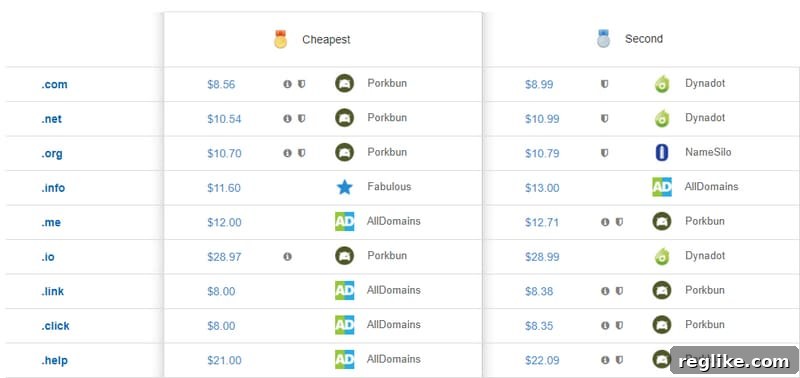
While these initial deals are attractive, savvy domain owners always look beyond the first year. Domcomp makes this easy by immediately showing you the corresponding renewal prices. For the same .com TLD, Domcomp might report that the best renewal price is currently $8.56 at Porkbun and $8.99 at Dynadot. This significant jump from the introductory rate underscores why checking renewal costs upfront is non-negotiable.
Domcomp’s utility becomes even more pronounced when dealing with the vast and often volatile pricing of new generic Top-Level Domains (gTLDs) and Country Code Top-Level Domains (ccTLDs). These extensions frequently exhibit substantial pricing disparities and aggressive first-year discounts, making price comparison absolutely critical. For example, a new gTLD like .xyz or .online might have an introductory price of $1.99, but its renewal could be $20 or more. Without a tool like Domcomp, tracking these variations across multiple registrars for various TLDs would be a monumental, if not impossible, task.
Smart Strategies for Cost-Effective Domain Management
Leveraging tools like Domcomp, combined with a strategic approach, can lead to significant long-term savings and more efficient domain management. Here are some actionable tips:
Always Prioritize Checking Renewal Rates
As repeatedly stressed, the renewal price is the true cost of your domain over its lifetime. Always look at the renewal rate before committing to a new registration. A fantastic first-year deal that renews at an exorbitant price might not be the best value in the long run, especially if you plan to keep the domain for several years.
Consider Strategic Domain Transfers
If you find that your current registrar’s renewal rates are consistently higher than those offered by other reputable providers, don’t hesitate to consider a domain transfer. Many registrars offer competitive transfer deals, often including a free year of registration, which can effectively reset your pricing to a more favorable rate. Just ensure you understand the transfer process and any associated lock-in periods.
Leveraging Discounts: High-Volume Customers and Long-Term Registrations
Many domain name registrars offer discounted rates to high-volume customers, such as domain investors, web developers, or businesses managing a large portfolio of domains. If you fall into this category, it’s always worth asking your preferred registrar about potential bulk discounts or special pricing tiers. Sometimes, simply inquiring can unlock better deals. Additionally, some registrars offer reduced annual rates if you register a domain for multiple years upfront (e.g., 5 or 10 years), providing both savings and the convenience of not having to worry about annual renewals.
Beware of Hidden Fees and Upsells
While Domcomp helps with core registration, renewal, and transfer fees, always be vigilant for hidden fees or aggressive upsells during the checkout process directly on a registrar’s site. Common add-ons include:
- WHOIS Privacy: This service masks your personal contact information in the public WHOIS database. While essential for privacy, some registrars charge extra for it, while others include it free.
- SSL Certificates: Crucial for website security and SEO, but often offered as an extra. Many hosting providers now offer free SSL (e.g., Let’s Encrypt).
- Premium DNS: Offers enhanced performance and security for your domain’s DNS. Not usually necessary for small to medium websites.
- Email Hosting: While useful, it might be cheaper or more feature-rich to get email services from a dedicated provider or bundled with your web hosting.
Always review your cart carefully before finalizing a purchase to ensure you’re only paying for what you truly need.
Conclusion: Make Informed Domain Decisions for Lasting Value
Securing and managing your domain names doesn’t have to be a costly or confusing endeavor. By adopting a smart, informed approach, you can ensure your online identity is not only robust and secure but also cost-effective in the long run. Remember to always prioritize registrar reputation, customer service, and security features over introductory prices alone. Once you’ve identified trusted providers, leverage powerful tools like Domcomp to gain clear visibility into current pricing for new registrations, renewals, and transfers across the widest possible range of TLDs.
By understanding the nuances of domain pricing – particularly the critical difference between initial offers and subsequent renewal rates – and employing strategies like strategic transfers and asking for bulk discounts, you can effectively minimize your expenses. Your domain name is an investment; treat it as such by making informed decisions that provide lasting value and peace of mind for your digital future.