
UDRP Case Review: Borum.com – A Controversial Domain Dispute Unveiled
In the complex world of domain name disputes, the Uniform Domain-Name Dispute-Resolution Policy (UDRP) serves as a vital mechanism to protect trademark holders from cybersquatting. However, not all UDRP cases are straightforward, and some raise serious questions about the motives and due diligence of the parties involved. The recent UDRP filing against the domain name Borum.com by Borum A/S, a company based in Denmark, offers a particularly unsettling example of a case that leaves a distinctly “dirty” impression, despite a technically correct outcome.
The decision in this UDRP case ultimately favored the domain registrant, an outcome that, by all accounts, was justifiable given the facts presented. Yet, the circumstances surrounding the Complainant’s decision to file this case, and the actions of their representatives at Patrade A/S, warrant significant scrutiny. This instance highlights critical concerns regarding the investigative rigor and ethical considerations that should underpin any legal proceeding, especially within the UDRP framework.
Understanding the UDRP Framework: A Brief Overview
Before delving deeper into the specifics of the Borum.com case, it’s essential to understand the fundamental principles of the UDRP. This policy, administered by organizations like the World Intellectual Property Organization (WIPO), aims to provide a streamlined and relatively inexpensive alternative to traditional litigation for resolving certain types of domain name disputes. To succeed in a UDRP complaint, the Complainant must prove, on the balance of probabilities, three crucial elements:
- The domain name is identical or confusingly similar to a trademark or service mark in which the Complainant has rights.
- The Respondent has no rights or legitimate interests in respect of the domain name.
- The domain name has been registered and is being used in bad faith.
The burden of proof rests entirely with the Complainant. Failing to establish any one of these three elements will result in the complaint’s denial, as was the case with Borum A/S.
The Parties and the Domain: Borum.com at the Center
The Complainant, Borum A/S, is a Danish company seeking to assert its trademark rights against the domain Borum.com. The domain itself, a concise and memorable .com address, was registered to Thomas A. Borum, D.V.M., located in Natchez, Mississippi. This crucial detail, the registrant’s name, which perfectly matches the domain, should immediately signal a potential legitimate interest and warrant thorough investigation by any prospective complainant.
The Whois record, a publicly accessible database of domain registration information, clearly listed Thomas A. Borum as the registrant. In the context of UDRP, where a domain name corresponds to an individual’s personal name, it often forms a strong basis for establishing legitimate rights or interests, making it difficult for a Complainant to succeed. This fundamental aspect of the case was seemingly overlooked or deliberately challenged by Borum A/S.
Complainant’s Dubious Allegations: Questioning Identity and Diligence
The most alarming aspect of Borum A/S’s filing, as recounted by the esteemed panelist, was their assertion:
“the Complainant asserts that the registrant’s name in the WhoIs records may in fact be an alias used to match the disputed domain name.”
This claim alone raises significant red flags. While it is conceivable for individuals to use aliases online, especially in sensitive contexts, questioning a registrant’s identity in a UDRP without concrete evidence is a serious accusation. More concerning is the apparent lack of basic due diligence that preceded this allegation. A simple, minute-long internet search would have revealed the truth.
Indeed, a mere 30 seconds spent on a popular search engine would have brought forth a wealth of information about Thomas A. Borum, D.V.M., as demonstrated by simple search results:
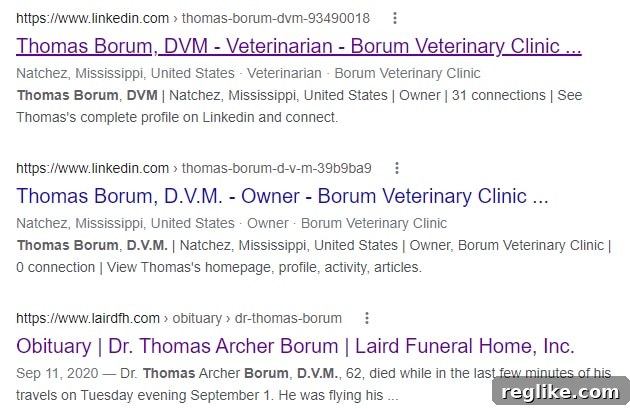
The search results would have immediately confirmed the registrant’s professional identity, often leading to LinkedIn profiles and other verifiable public records. More poignantly, these searches would have unveiled a tragic detail: Thomas A. Borum passed away in a plane crash in September of the previous year. This profound discovery transforms the Complainant’s initial allegation from mere skepticism into a deeply troubling insinuation.
The Ethical Dilemma: Negligence or Opportunism?
The revelation of the Respondent’s passing presents two disturbing possibilities regarding the Complainant’s conduct:
- Gross Negligence: The Complainant, and by extension their legal representatives, failed to undertake even the most rudimentary research into the domain registrant’s identity before filing a formal complaint and making serious allegations. Such a failure would represent a significant lapse in professional conduct and due diligence, wasting resources and bringing unnecessary stress (even to a deceased person’s estate).
- Calculated Opportunism: Alternatively, and far more sinisterly, the Complainant *did* conduct research, discovered the Respondent’s death, and proceeded to file the UDRP in the hopes of a less contested battle. A deceased respondent would, by definition, be unable to actively defend their rights, potentially giving the Complainant an unfair advantage. If this were the case, it would constitute a severe breach of ethical standards and undermine the integrity of the UDRP process itself.
Both scenarios are deeply concerning. The UDRP system relies on good faith and thoroughness from all parties. To either carelessly overlook readily available public information or deliberately exploit a tragedy for a perceived legal advantage is fundamentally antithetical to the spirit of fair dispute resolution.
The Trademark Claim: An Argument Undermined by Timing
Adding another layer of questionable judgment, the Complainant also criticized the domain owner for supposedly failing to check for existing trademarks before registering the domain. As summarized by the panelist:
“At the very least, says the Complainant, the Respondent willfully failed to search for conflicting trade marks, prior to acquiring the disputed domain name.”
This accusation further highlights the apparent double standard. The Complainant suggests a legal obligation for the Respondent to perform extensive trademark searches before domain registration, yet it (potentially) neglected a simple Google search to verify the Respondent’s identity before filing the complaint. This inconsistency exposes a hypocritical stance that is difficult to reconcile with principles of fairness.
However, the panelist, Alistair Payne, deftly addressed this claim by pointing out a critical fact: even if Thomas A. Borum had conducted trademark searches, all of Borum A/S’s relevant trademark registrations post-dated the registration of the domain name Borum.com. This timing is absolutely crucial in UDRP cases. For a domain to be registered in “bad faith,” the registrant typically needs to have registered it with knowledge of the Complainant’s pre-existing trademark rights. If the trademarks came into existence *after* the domain was registered, it becomes exceedingly difficult to prove bad faith registration.
The Panel’s Correct Decision: Upholding UDRP Principles
Despite the disturbing background, Panelist Alistair Payne correctly ruled in favor of the deceased domain registrant. The decision meticulously applied the UDRP criteria:
- Legitimate Interests: The fact that the domain name precisely matched the Respondent’s personal name, Thomas A. Borum, D.V.M., provided a strong and legitimate basis for his ownership. Owning a domain that corresponds to one’s own name is a universally recognized form of legitimate interest under UDRP.
- Lack of Bad Faith: With the Complainant’s trademarks registered after the domain, proving bad faith registration became impossible. Furthermore, there was no evidence presented to suggest the domain was used to intentionally disrupt the Complainant’s business or for any other malicious purpose.
Panelist Payne’s decision underscores the importance of adhering strictly to the UDRP’s three-part test, ensuring that personal names are respected as legitimate interests and that the burden of proving bad faith registration and use remains squarely on the Complainant. The panel effectively cut through the Complainant’s problematic allegations to deliver a just outcome.
Broader Implications: Erosion of Trust and the Need for Scrutiny
This Borum.com case serves as a stark reminder of the ethical responsibilities inherent in legal processes. When a complainant or their representatives appear to operate with such a blatant disregard for due diligence, it doesn’t just result in a lost case; it erodes trust in the UDRP system itself. Such incidents can lead domain owners to view UDRP complaints not as legitimate tools against cybersquatting, but as potential harassment tactics.
The “dirty feeling” emanating from this case stems from the perception that either incompetence or opportunism was at play. Neither reflects well on the Complainant or their legal counsel. It highlights a critical need for legal professionals to conduct exhaustive pre-filing investigations, not just to build a strong case but to ensure their actions are ethical and grounded in verifiable facts.
Lessons Learned: Best Practices in Domain Disputes
The Borum.com UDRP offers valuable lessons for all parties involved in domain name disputes:
- For Complainants: Thorough due diligence is non-negotiable. Before filing a UDRP, comprehensively research the respondent’s identity, the domain’s history, and the timing of your own trademark rights. Unsubstantiated claims, especially those questioning identity, can severely undermine your credibility.
- For Legal Representatives: Professional responsibility extends to meticulous research and ethical conduct. Filing a case without verifying basic facts, or worse, attempting to capitalize on a respondent’s unfortunate circumstances, is unprofessional and damages the reputation of the firm and the legal profession.
- For Domain Owners: This case inadvertently reinforces the value of maintaining accurate WHOIS information. While not a foolproof defense, a clear and verifiable identity that matches your domain name provides a robust defense against UDRP complaints, establishing legitimate interest.
Conclusion: Upholding Integrity in the Digital Realm
The UDRP case concerning Borum.com stands out as a peculiar and troubling example of a domain dispute. While the panelist’s decision to deny the complaint was unequivocally correct and aligned with UDRP principles, the conduct of the Complainant and their representatives raises significant ethical questions. The failure to conduct basic research, leading to unsubstantiated allegations against a deceased individual, casts a long shadow over the proceedings.
This case underscores that while the UDRP provides an essential framework for resolving disputes, its integrity relies heavily on the good faith and professional diligence of those who utilize it. It is a stark reminder that in the digital age, where information is readily accessible, there is no excuse for a lack of thorough investigation, especially when making serious legal accusations. The “dirty feeling” from this case should serve as a cautionary tale, urging all participants in domain dispute resolution to adhere to the highest standards of ethics and professionalism.