
Unveiling the Hidden Threats in Domain Parking: A Deep Dive into the “Dark Side”
The vast expanse of the internet is home to millions of domain names, many of which remain undeveloped, serving instead as digital billboards for advertisers. This practice, known as domain parking, is a legitimate and widely used method for monetizing unused web addresses. However, a groundbreaking study from a team of researchers, primarily hailing from Indiana University, has cast a revealing light on the less savory aspects of this industry. Their findings, presented at the USENIX Security Symposium and aptly titled “The Dark Side of Domain Parking,” uncover a concerning pattern of illicit activities designed to illicitly boost revenues at the expense of advertisers and unsuspecting domain owners.
While the study was initially presented in August, its profound implications resonate strongly within the digital advertising and cybersecurity communities. It highlights a critical need for enhanced vigilance and transparency across the domain parking ecosystem. The researchers embarked on this extensive investigation with a clear objective: to comprehensively understand the intricacies of the domain parking business model and, crucially, to ascertain whether these companies engaged in unethical or illegal practices. Their ultimate conclusion, backed by rigorous data, paints a nuanced picture: while many parking companies operate legitimately for the majority of their business, a significant segment occasionally delves into dubious activities to inflate their earnings, creating a complex web of deceit that impacts various stakeholders.
Methodology: A Clandestine Expedition into the Parking Landscape
To meticulously test the operational integrity of domain parking companies, the research team devised an ingenious and extensive methodology. Their approach involved establishing a controlled environment that mirrored real-world scenarios, allowing them to observe potential misconduct firsthand. They began by registering a substantial portfolio of new domain names, subsequently setting up parking accounts with various providers. To simulate genuine advertising campaigns, they also created numerous advertising accounts across different ad networks, strategically designing them to interact with the parked domains. A sophisticated crawler was then deployed, programmed to visit these parked pages en masse, but critically, to explicitly avoid clicking on any advertisements.
This deliberate design was key to identifying fraudulent activities, as any charges for clicks originating from their non-clicking crawler would immediately signal malpractice. Furthermore, to circumvent potential detection and ensure their experiments reflected the experiences of typical domain owners and advertisers, the researchers often employed fabricated information when setting up these accounts. This elaborate setup enabled them to conduct an unparalleled investigation, logging an astounding 24 million visits to over 100,000 parked domain names. The sheer scale of this undertaking underscores the depth of their commitment to uncovering the truth about domain parking practices, providing a robust dataset for their critical findings.
Unearthing the Deception: Three Primary Malpractices Identified
The extensive data collection and analysis revealed a disturbing trifecta of issues plaguing the domain parking industry, each with significant financial and reputational consequences for those involved:
1. Click Fraud: The Silent Drain on Advertising Budgets
The researchers detected compelling evidence of click fraud, a pervasive problem in online advertising. However, the type of fraud identified here diverges from the commonly understood scenario where domain owners themselves click on their ads to generate revenue. Instead, the study uncovered a more insidious form: advertisers being charged for clicks that simply never happened. Their meticulously designed ad campaigns, set up at various ad networks, inexplicably incurred charges for click traffic generated by their own crawler—a crawler expressly engineered *not* to click on ads. This unequivocally pointed to systematic fraudulent activity where non-existent clicks were being monetized.
It’s crucial to note that the incidence of this particular type of click fraud was markedly lower when dealing with tier-one ad networks, such as Google and Bing. The researchers theorize that this discrepancy is due to the advanced fraud detection capabilities employed by these industry giants. Parking companies engaging in fraudulent activities likely avoid sending fake clicks to these sophisticated networks, knowing their illicit practices are far more likely to be uncovered and penalized. This revelation underscores the varying degrees of security and integrity present across the digital advertising landscape, placing a greater burden of due diligence on advertisers utilizing smaller or less reputable networks.
2. Traffic Spam: Misdirection and Wasted Ad Spend
Another significant issue brought to light was “traffic spam,” particularly prevalent in the context of purchased “zero-click traffic.” Zero-click traffic refers to visitors who land on a parked page without actively searching for specific keywords related to the domain’s content. This traffic often originates from expired domains, mistyped URLs, or bulk redirects. The researchers observed that when they acquired this type of traffic, the originating URLs frequently bore no relevance whatsoever to the bidding keywords they had specified for their ad campaigns. For instance, an advertiser targeting keywords related to “car insurance” might find traffic originating from a website about “gardening tools.”
This misalignment results in profoundly irrelevant traffic, leading to wasted advertising spend for businesses. When users arrive at a page that doesn’t match their expectations or initial intent, they are highly unlikely to engage with the displayed advertisements, let alone convert into customers. Beyond the direct financial loss, traffic spam dilutes the quality of advertising data, making it difficult for advertisers to accurately assess campaign performance and optimize their strategies. It ultimately degrades the overall user experience and contributes to a general mistrust in the efficacy of online advertising, highlighting a fundamental breakdown in the promise of targeted outreach.
3. Traffic Stealing: The Unpaid Promise to Domain Owners
For years, domainers—individuals or companies who invest in and manage domain names—have voiced concerns about parking companies failing to pay them their rightful share of ad revenue generated from their parked domains. The study provided concrete evidence to substantiate these long-standing accusations, at least concerning zero-click traffic. The researchers reported instances where they were charged for zero-click traffic by ad networks (specifically citing 7search in one example), yet the parking company responsible for managing their domain did not credit them with any corresponding revenue. This scenario clearly illustrates a disconnect where the advertiser pays, but the money does not flow down to the domain owner as promised.
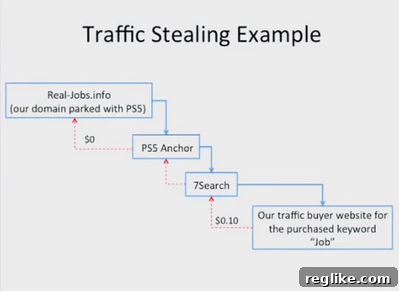
Above: A diagram illustrating the concept of Traffic Stealing, adapted from the researchers’ presentation. This visual helps to clarify how funds can be intercepted before reaching the domain owner.
Even if an intermediary entity along the complex advertising chain deemed a particular visit to be fraudulent and thus decided not to pass on revenue, the advertiser had still been charged. This means that funds were collected, but the ultimate recipient – the domain owner – was deprived. The researchers, in their analysis, attributed this specific type of revenue misappropriation directly to the parking company, not the ad network. This practice not only defrauds domain owners of their legitimate earnings but also erodes trust within the domain monetization ecosystem, making it difficult for honest domainers to reliably profit from their digital assets. It underscores a significant lack of transparency and accountability in revenue sharing agreements.
The Alarming Connection: Zero-Click Traffic and Malware Distribution
Beyond direct financial fraud, the report also brought to light a deeply concerning public safety issue related to zero-click traffic. This finding echoes previous warnings within the industry about parked domain traffic leading visitors to malicious websites. The study starkly claims that at least 3.7% of zero-click traffic buyers are implicated in the distribution of malware, or redirecting users to other “shady sites.” This statistic is particularly alarming because it transforms what might seem like a mere advertising efficiency problem into a potent cybersecurity threat.
When unwitting users are funneled from parked domains to sites hosting malware, they face risks ranging from drive-by downloads that install malicious software without their consent, to phishing attempts, or exposure to other forms of cyber exploitation. As the report, and previous observations, rightly point out, this insidious practice disproportionately harms the unsuspecting domain name owner. Their domain, which they intend to be a source of legitimate income, inadvertently becomes a conduit for cybercrime, potentially leading to brand damage, blacklisting by search engines, and a complete loss of trust from visitors. This adds a critical layer of risk management and ethical consideration for anyone involved in domain parking.
Unmasking the Perpetrators: Anonymity and Identification
For understandable legal reasons, the researchers anonymized the names of the specific parking companies identified as engaging in these illicit activities. They were referred to by generic labels such as PS1, PS2, PS5, and PS6. While this legal precaution protects the researchers, it leaves domain owners and advertisers in a challenging position when trying to identify and avoid unethical service providers. However, the study does offer clues, suggesting that with a bit of dedicated investigation, interested parties might be able to piece together the identities of these companies. The implications of operating under such a veil of anonymity highlight the lack of robust regulatory oversight in this particular corner of the internet.
To aid in this process, the report includes illustrative charts that visually represent the types of issues found at specific anonymized parking companies, along with the ad networks involved in these problematic activities. This graphical representation serves as a powerful tool for understanding the landscape of fraud within the industry.
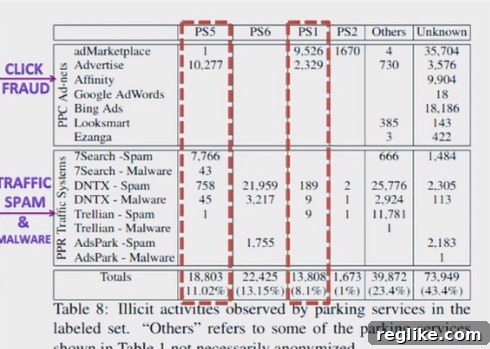
One notable exception to the anonymity was PS6, which the researchers explicitly disclosed as TeamInternet’s parking operation. TeamInternet also owns DNTX, implying that these entities were primarily responsible for sending poorly targeted zero-click traffic, contributing to the “traffic spam” issue. This specific revelation provides a concrete example of how industry players, even those with significant market presence, can be implicated in practices detrimental to the broader digital ecosystem.
Further assistance in potentially de-anonymizing other companies is provided through an additional chart, acting as a key to connect general observations to specific entities. This empowers industry participants to conduct their own due diligence.
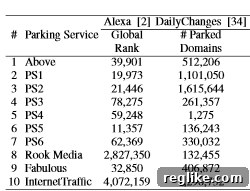
It’s important to clarify that certain companies—Above, Rook, Fabulous, and InternetTraffic—were not anonymized in the report because they were not specifically named in conjunction with the identified illicit activities elsewhere in the document. Their inclusion likely serves as a point of reference or comparison within the broader data analysis, rather than direct accusation.
Implications and Recommendations for a Safer Digital Landscape
The “Dark Side of Domain Parking” study serves as a critical wake-up call for everyone involved in the digital domain. For **domain owners**, the findings emphasize the absolute necessity of conducting thorough due diligence when selecting a parking provider. It’s no longer sufficient to merely look for the highest revenue share; scrutinizing the provider’s reputation, transparency in reporting, and traffic quality sources is paramount. Regularly monitoring traffic logs and cross-referencing earnings reports with independent analytics can help detect discrepancies and potential fraud. Understanding the terms of service and seeking explicit guarantees regarding traffic quality and payment transparency can mitigate risks.
For **advertisers**, the message is equally clear: vigilance is key. Blindly trusting ad networks and traffic sources can lead to significant financial losses due to click fraud and irrelevant traffic spam. Advertisers should leverage advanced analytics tools to monitor the quality and source of their traffic, question unexpected spikes in clicks, and demand granular reporting from their ad partners. Diversifying ad networks and prioritizing those with robust fraud detection mechanisms, as exemplified by the tier-one networks mentioned in the study, can safeguard budgets. Investing in brand protection tools that monitor for malicious redirects or malware associated with their campaigns is also a wise strategy.
For the **domain parking industry** as a whole, this research highlights an urgent need for greater transparency, stronger self-regulation, and potentially, increased external oversight. Fostering a more ethical environment will require proactive measures from reputable companies to set higher industry standards, share best practices for fraud detection, and openly report on their traffic acquisition methods. Establishing clear, universally accepted metrics for traffic quality and transparent revenue sharing models could help rebuild trust and drive out malicious actors. Ultimately, the long-term sustainability and credibility of domain parking as a legitimate monetization strategy hinge on the collective commitment to integrity and accountability. This study, therefore, is not merely an exposé but a crucial roadmap towards a more secure and trustworthy digital advertising ecosystem.