
Verisign’s Domain Forecast: A Shifting Landscape Amidst Evolving Digital Trends
Verisign, the exclusive registry operator for the prestigious .com and .net top-level domains, has recalibrated its annual forecast, signaling a more challenging outlook for domain name registrations. This adjustment follows a quarter marked by lower-than-expected domain registration figures, prompting the company to anticipate a significant contraction in its domain base for the current year. The latest projections suggest a potential drop of between 2.0 and 3.0 million domain names, a notable revision that underscores the dynamic shifts occurring within the global digital landscape and the domain name industry.
Declining Domain Base: A Closer Look at Q2 Performance
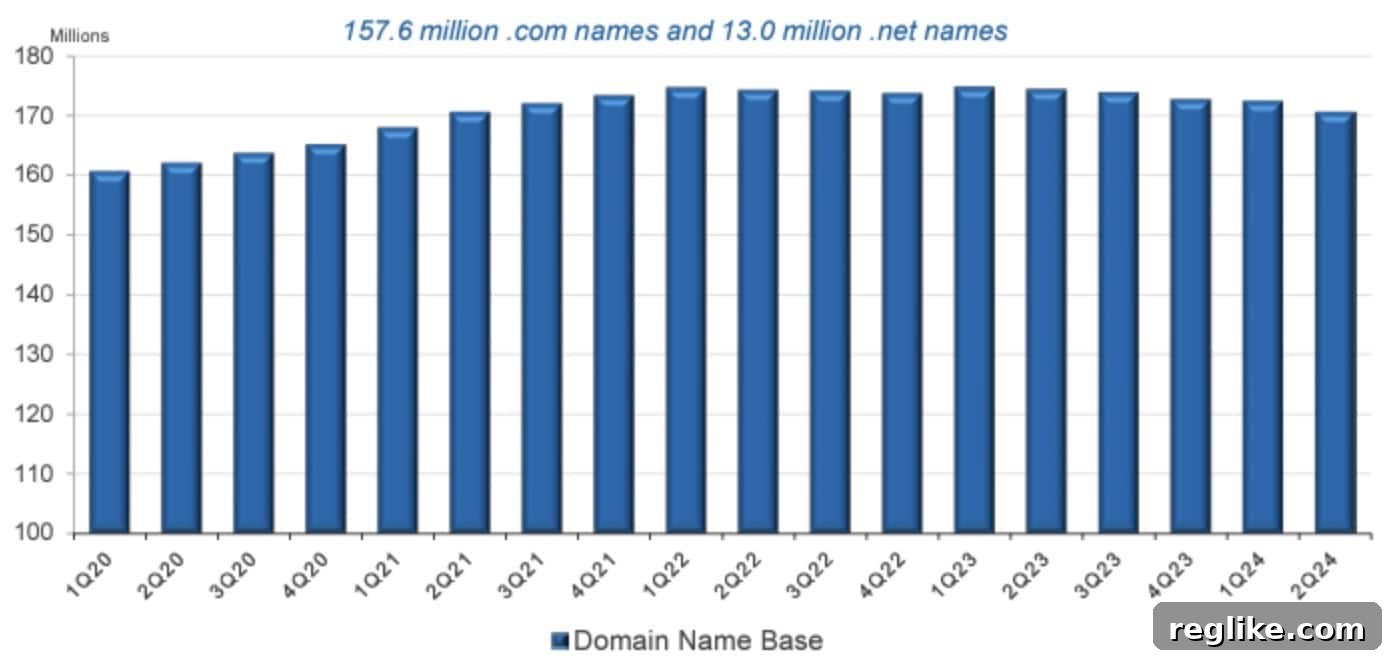
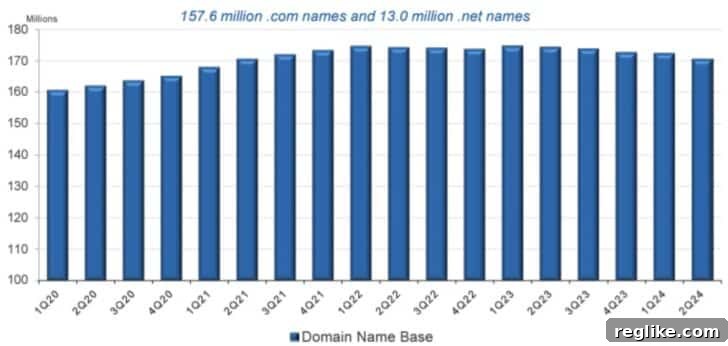
The second quarter of the year proved to be a challenging period for Verisign’s core business, as the total count of .com and .net domain name registrations concluded at 170.6 million. This figure represents a sequential decrease of 1.8 million registrations from the previous quarter, indicating a noticeable slowdown in the growth of new online identities. More broadly, when viewed on a year-over-year basis, the domain base experienced a 2.2% decline, reflecting a sustained trend of contraction rather than expansion.
A key indicator of market demand, new .com registrations, also presented a subdued picture. Verisign reported processing 9.2 million new .com registrations during the quarter. This is a considerable decrease when compared to the 10.2 million registrations recorded in the corresponding quarter of the previous year. This dip in new registrations suggests a potentially mature market, where the influx of entirely new websites or businesses requiring a primary online presence may be moderating. Factors such as global economic uncertainties, shifts in digital marketing strategies favoring social media platforms, and increasing competition from alternative top-level domains (TLDs) could be contributing to this trend. For many businesses and individuals, a .com domain remains the gold standard for credibility and recognition, but the market dynamics are clearly evolving.
Iterative Forecast Adjustments: Signs of Market Headwinds
Verisign’s revised annual forecast underscores a growing sense of caution and realism concerning the trajectory of the domain name market. The latest prediction of a 2.0 to 3.0 million reduction in the domain base for the year stands in stark contrast to earlier, more optimistic outlooks. Just last quarter, the company had projected a range from a drop of 1.75 million to a modest growth of 0.25 million, demonstrating a significant shift towards a more pessimistic view. Furthermore, at the commencement of the year, Verisign’s initial expectations ranged from a 1.0 million drop to a 1.0 million increase, highlighting a consistent downward revision as the year has progressed and market realities have unfolded.
These iterative adjustments in Verisign’s guidance are crucial for investors and market analysts. They not only reflect the company’s internal assessment of current registration trends but also signal potential broader headwinds affecting the entire domain industry. The persistent decline in the forecast indicates that the challenges Verisign faces are not merely transient but may represent deeper structural changes in how individuals and businesses establish and maintain their online presence. This ongoing re-evaluation suggests that the era of consistent, robust growth in .com and .net registrations, which characterized previous periods, may be giving way to a more complex and competitive environment, where the maintenance of the existing domain base and the attraction of new registrants require increasingly strategic efforts.
Financial Resilience: Revenue Growth Amidst Domain Contraction
Strategic Price Increases Drive Revenue
Despite the challenges in its core domain registration business, Verisign demonstrated remarkable financial resilience. The company managed to increase its revenue, reaching $387 million, a 4.1% rise compared to the same period last year. This growth is particularly noteworthy because it occurred even as the volume of domain registrations declined. The primary driver behind this revenue increase was Verisign’s strategic implementation of price adjustments. As the registry operator for .com and .net, Verisign holds a unique and powerful position, allowing it to periodically increase the wholesale price of these essential internet resources, subject to specific regulatory agreements.
These pre-approved price increases are a critical component of Verisign’s business model, providing a stable and predictable revenue stream that can offset fluctuations in registration volumes. While a declining domain base would typically lead to decreased revenue for most companies, Verisign’s ability to leverage its pricing power underscores its entrenched market position. This mechanism ensures that even during periods of reduced market expansion or even contraction, the company can maintain a robust financial performance, reflecting the inelastic demand for .com and .net domains, which are often considered fundamental for establishing a credible and widely recognized online presence.
Robust Profitability and Shareholder Returns
Beyond revenue growth, Verisign also reported generating more cash, a testament to its highly efficient operations and significant profit margins. The domain registry business, particularly for established TLDs like .com, is characterized by a relatively low variable cost structure once the initial infrastructure is in place. This inherent operational efficiency translates into substantial profitability, allowing Verisign to accumulate considerable cash reserves. Recognizing this strong cash flow generation, Verisign’s board of directors authorized an additional $1.11 billion for stock repurchases. This significant authorization signals confidence in the company’s financial health and its long-term stability.
Stock repurchases are a common strategy employed by companies with strong cash flow and mature business models. They serve to return capital to shareholders, reduce the number of outstanding shares, and can potentially boost earnings per share, thereby enhancing shareholder value. For Verisign, this substantial repurchase program indicates that management believes the company’s stock is a good investment and that its strong financial position allows for such capital allocation decisions without hindering future growth or operational needs. It reinforces the image of Verisign as a cash-generating powerhouse, capable of rewarding its investors even in a period of moderating market growth for its core products.
Regulatory Scrutiny: The .com Pricing Debate
Lawmakers Question .com Contract and Pricing
Verisign’s unique market position and pricing power have not gone unnoticed, drawing increasing scrutiny from governmental bodies. During a recent investor conference call, Verisign executives addressed questions concerning a letter dispatched by Republican lawmakers to the National Telecommunications and Information Administration (NTIA). This letter initiated an inquiry into the .com contract, specifically raising concerns about the pricing mechanisms and the broader implications of Verisign’s near-monopoly control over such a vital piece of internet infrastructure. The NTIA, an agency of the U.S. Department of Commerce, plays a pivotal role in shaping internet policy and oversees the U.S. government’s contractual relationship with Verisign for the stewardship of the .com domain.
The essence of the lawmakers’ concern typically revolves around ensuring fair pricing, promoting competition, and protecting consumers and businesses that rely heavily on .com domains for their online presence. Given that .com remains the most recognized and widely used top-level domain globally, any perceived unchecked power or excessive pricing by Verisign can attract significant attention from policymakers. This governmental oversight highlights the critical nature of .com domains not just as a commercial product but as a foundational element of the global digital economy. The ongoing dialogue between lawmakers, the NTIA, and Verisign underscores the complex interplay between market forces, regulatory frameworks, and public interest in managing essential internet resources.
Verisign’s Defense: Contractual Fortifications and Market Comparisons
In response to the mounting pressure regarding its .com pricing and contractual arrangements, Verisign articulated a clear and firm stance, emphasizing the robust nature of its agreements. The company stated that its contract for operating the .com domain automatically renews unless the NTIA explicitly cancels it. Furthermore, Verisign clarified that, even in the unlikely event of an NTIA cancellation, the company would continue its contractual relationship with ICANN (Internet Corporation for Assigned Names and Numbers), which coordinates the global internet’s domain name system. This intricate framework highlights the deep-seated and multi-layered nature of Verisign’s operational agreements, making any abrupt changes highly improbable. Crucially, Verisign also reiterated that the terms of the .com contract cannot be altered without mutual agreement between both the NTIA and Verisign, effectively solidifying its negotiating position.
Beyond contractual specifics, Verisign also provided its standard talking points to counteract pushback over its pricing strategy. The company consistently argues that the unregulated registrar market, where consumers purchase their domains, has been increasing its prices at rates significantly higher than Verisign’s wholesale price adjustments. Registrars, who add their own markups, operate in a competitive environment, yet their pricing often outpaces the registry operator’s increases. Moreover, Verisign points to the secondary aftermarket for domain names, where existing domains are bought and sold, often fetching prices many times higher than the original wholesale or retail registration fees. By highlighting these market dynamics, Verisign seeks to contextualize its own pricing as reasonable and regulated, especially when compared to other segments of the domain industry that operate with far less oversight. The underlying message is that Verisign’s consistent, modest price increases are essential for maintaining the stability, security, and reliability of the .com and .net infrastructure, which benefits the entire internet ecosystem.
Broader Industry Trends and Future Outlook for Domain Registrations
The current state of Verisign’s domain base and its revised forecasts are reflective of broader macroeconomic and technological trends impacting the digital landscape. Globally, economic slowdowns can lead to reduced entrepreneurial activity and a decreased demand for new web presence, impacting new domain registrations. Furthermore, while digital transformation continues apace, there’s also a maturation of the online space. Many businesses and individuals already have their primary web presence, and new entries may be less frequent or choose alternative platforms.
The rise of social media platforms as primary online identity hubs for many small businesses and individuals also presents a competitive dynamic for traditional domain registrations. While a dedicated website with a .com domain remains crucial for many established entities and professional brands, the barrier to entry for a basic online presence has lowered through social media. Moreover, the proliferation of new generic top-level domains (gTLDs) offers alternatives to .com and .net, potentially fragmenting the market, even if .com retains its dominant prestige. For Verisign and the wider domain industry, understanding these nuanced shifts will be critical for future growth strategies, requiring innovation in service offerings and continuous emphasis on the value proposition of a traditional domain name in a rapidly evolving digital world.
Conclusion: Navigating a Dynamic Digital Landscape
Verisign finds itself at a fascinating juncture, navigating the complexities of a maturing domain name market alongside increasing regulatory scrutiny. The downward revision of its domain base forecast highlights the real challenges of maintaining growth in an increasingly saturated and competitive digital environment. However, the company’s robust financial performance, driven by strategic price increases and high profit margins, underscores its inherent strength and unique market position. The substantial stock repurchase program further reinforces confidence in its financial stability.
The ongoing dialogue with Republican lawmakers and the NTIA concerning .com pricing exemplifies the delicate balance Verisign must maintain between commercial interests and its role as a steward of a critical global internet resource. As the digital economy continues to evolve, Verisign’s ability to adapt its strategies, articulate its value proposition, and deftly manage its regulatory relationships will be paramount. While the landscape for new domain registrations may present headwinds, the enduring importance of .com and .net as foundational elements of online identity ensures Verisign remains a central and influential player in the global digital infrastructure, albeit one that must continuously respond to dynamic market forces and public expectations.