
The Shifting Tides of .Com/.Net Growth: Unpacking Verisign’s Latest Insights and Search Engine Evolution
The digital landscape is a dynamic realm, constantly reshaped by technological advancements, economic forces, and strategic shifts by major internet players. Recent reports from Verisign, the authoritative registry for the internet’s most prominent top-level domains, .com and .net, have cast a spotlight on a significant trend: a discernible slowdown in their base growth. This moderation, a notable departure from previous periods of rapid expansion, prompts a closer examination of the underlying factors, particularly the profound influence of evolving search engine algorithms.
Following Verisign’s release of its latest earnings report, which clearly indicated this decelerating growth, industry experts and domain enthusiasts were quick to analyze the implications. One such observation came from fellow blogger Michael Berkens, who highlighted the trend, echoing earlier discussions about the changing dynamics of the domain market.

Michael’s tweet resonated with previous analyses, which, while acknowledging a historical steady decline in .com growth rates, recognized the emerging significance of the current figures. Indeed, while historical comparisons often require careful contextualization due to varying measurement methodologies (such as the difference between zone file numbers and reported earnings figures), the recent data from Verisign unmistakably points to a retreat in .com/.net growth rates. This trend, initially subtle, has now become a clearer signal of fundamental changes within the domain ecosystem.
Verisign’s Quarterly Performance: A Deeper Dive into the Numbers
Verisign’s recent quarterly performance fell short of expectations, missing the lower end of its forecast by a considerable margin of over 200,000 net domain additions. The .com/.net base expanded by a mere 1.37 million domains during the quarter. While any growth is positive, this figure represents a substantial decrease compared to expansion rates seen since 2009, signaling a significant deceleration in what has historically been a robust market segment.
To fully grasp the magnitude of this shift, a historical perspective is crucial. A review of Verisign’s quarterly reports, spanning back to Q4 2006, reveals a compelling narrative of growth and deceleration for combined .com/.net registrations. The following visual representation illustrates this journey:
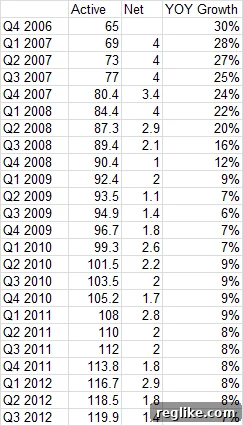
These figures, as reported by Verisign in their official financial releases, provide a direct window into the domain space. It’s important to note, however, that these numbers are calculated differently from the zone file statistics Verisign publishes on its website, meaning direct comparisons between the two sets of data may not always be accurate. Furthermore, it appears Verisign occasionally rounded its .com/.net base to the nearest million until Q4 2007, a practice that could subtly affect the perception of ‘net’ quarterly growth during that specific period.
Historical Trends: From Boom to Moderate Growth
Analyzing the historical data, it’s evident that yearly growth rates maintained considerable strength until Q1 2009. During this period, the .com/.net ecosystem was experiencing a significant boom, often adding upwards of 4 million domains to its base in most quarters through 2007. However, a noticeable slowdown began in Q2 2008, with quarterly additions decreasing to 2-3 million domains. The most pronounced shift occurred in Q4 2008 and extended into 2009, when quarterly net additions dropped further to 1-2 million, concurrently pushing annual growth rates into the single digits. This historical context underscores the significance of the current slowdown, drawing parallels to a period when the internet landscape underwent substantial shifts.
The inherent challenge of maintaining high percentage growth rates as the overall domain base expands is a statistical reality. However, the current trend is not merely a percentage phenomenon; it is also reflected in the absolute numbers of net additions quarter-to-quarter, visible in the third column of the data. This decline in absolute numbers signifies a more fundamental change rather than just a mathematical consequence of a larger base.
The Google Factor: Algorithms Reshaping the Domain Landscape
During a recent investor conference call, Verisign pointed directly to Google as a contributing factor to the current slowdown, a parallel drawn to the challenges observed in 2009. This attribution is deeply rooted in Google’s ongoing efforts to refine its search algorithms, specifically targeting low-quality content and manipulative SEO practices.
Google’s continuous algorithm tweaks, notably the well-documented Panda and Penguin updates, have had a profound impact on search engine rankings. These programs were designed to identify and penalize websites characterized by “content farms,” “keyword stuffing,” and other tactics aimed at artificially inflating search visibility. Crucially, they also began targeting “exact match domains” (EMDs) that often served as low-content, monetization-focused sites.
Many domain registrations for these types of sites, often referred to as “domainer” sites or “made for Adsense” pages, previously fueled a substantial portion of the growth in the .com/.net space. While parked pages have largely been out of Google’s index for an extended period, they were subsequently replaced by other forms of low-quality, often automatically generated content designed primarily for advertising revenue rather than genuine user value. Google’s algorithmic evolution effectively diminishes the viability of such strategies.
Verisign CEO D. James Bidzos elaborated on this intricate relationship during the earnings call, providing crucial insights into the search engine’s strategic direction and its ripple effects across the domain industry:
I think there is a more serious effort by the search engine algorithm players here to sort of clean up search results and improve the quality, as Pat said, to drive some of the monetization community down further. So we discussed in the last call, the Panda and Penguin programs, for example, that Google utilized where they were targeting content farms, they were targeting keyword stuffers and now, they’re also targeting exact name matches, which typically are monetization names often. So for example, if you search for purple blue widgets, and purplebluewidgets.com happens to be a registered domain, that in the past, would’ve been likely to score very high in the search results. However, if the search engine algorithm is tweaked to go out and consider other factors, the age of the domain, how many pages are on it, how fresh is some of the contents and give it a score, essentially, on how likely it is that it’s truly quality content that the searcher might be interested in versus something that had been set up for monetization purposes, I think the search engine algorithms are essentially targeting that kind of traffic to get it out.
Bidzos’s explanation highlights a fundamental shift in Google’s philosophy: moving away from simple keyword matching to a more holistic evaluation of content quality and user intent. Previously, an exact match domain (EMD) like ‘purplebluewidgets.com’ might have automatically ranked high for the query ‘purple blue widgets’ simply due to its keyword-rich URL. However, Google’s refined algorithms now prioritize a multitude of other factors, including the domain’s age and authority, the depth and freshness of its content, user engagement signals, and overall relevance. This comprehensive evaluation aims to reward websites that genuinely offer value to users, effectively de-prioritizing those solely created for advertising revenue without substantive, unique content. This strategic redirection by Google aims to elevate the overall quality of search results, ultimately benefiting users but presenting challenges for domainers reliant on less scrupulous tactics.
Collateral Effects: Renewal Rates and Economic Headwinds
The impact of these search engine changes extends beyond new registrations, influencing domain renewal rates as well. Verisign estimates a renewal rate of 72.3% for the last quarter, a notable decrease from 73.3% in the corresponding quarter of the previous year. This dip suggests that many domain holders, finding their monetization strategies less effective due to algorithmic shifts, are choosing not to renew their registrations. The return on investment for such domains has diminished, leading to a natural attrition within the base.
Beyond algorithmic shifts, Verisign also cites broader macroeconomic issues as a contributing factor to the slowdown, particularly in Europe. Economic uncertainty and financial constraints can directly impact businesses and individuals, leading to a decrease in new domain registrations as budgets tighten and investment in new online ventures slows. This confluence of search engine changes and economic headwinds creates a challenging environment for domain growth.
Patrick S. Kane, Senior Vice President and General Manager of Naming Services at Verisign, further noted an interesting behavioral shift: some monetizers are reportedly migrating to free domain options to maximize profit margins. He specifically highlighted the .tk domain as an example, where the cost barrier to entry is eliminated, allowing domainers to capture more advertising revenue without the overhead of registration fees. This migration, while potentially small in scale, indicates a strategic adaptation by some within the monetization community in response to tightening market conditions and reduced profitability in premium TLDs like .com and .net.
A Silver Lining: Towards a Healthier Domain Ecosystem?
Despite the current challenges, Verisign’s CEO, D. James Bidzos, sees a potential silver lining, envisioning a future where the .com and .net spaces are healthier and more robust:
But I think there might be some developments where other domains have sort of other TLDs have targeted in a sense, this monetization community and possibly, some of those names may have been drawn away over the years and moved to other areas, which is, in a sense, a good thing because it means that these changes, while they are making a difference and I know you see that every day, we do too, of course, and while it may take longer to recover depending on how intense and how sustained these campaigns are, the fact is that there may be fewer of these names to work on in .com because of the move to other TLDs.
Bidzos’s perspective suggests that the migration of purely monetization-driven domains to other, often free or less expensive, top-level domains could ultimately benefit the .com and .net ecosystem. By shedding these low-quality, transient registrations, the remaining .com and .net domains would increasingly represent legitimate businesses, high-quality content, and serious online ventures. This “cleaning up” process means that future search engine algorithm changes, which will inevitably continue, would have a proportionally smaller impact on the core .com/.net base, as fewer domains within these TLDs would be susceptible to penalties targeting spam or low-value content. In essence, a leaner, higher-quality domain base in .com and .net would be more resilient and stable.
This reasoning aligns with real-world experiences within the domain investment community. For instance, many domain portfolio holders have observed a similar trend. Personally, approximately 3%-4% of my own domain portfolio was allowed to lapse this year. Almost all of these were names previously monetized through “made for Adsense” sites. While these domains might have covered their registration fees a couple of years ago, the efficacy of such monetization strategies has significantly declined, rendering them unprofitable to renew under the current search engine landscape. This individual experience underscores the broader trend Verisign is observing.
The Road Ahead: Forecast and Implications
While one quarter does not definitively establish a long-term trend, the recent numbers from Verisign are a powerful indicator of significant shifts. Prior to this quarter, growth rates for .com and .net had been relatively steady, suggesting a stable, albeit moderated, trajectory. However, Verisign’s forecasts for the upcoming fourth quarter project net additions between 0.9 million and 1.3 million, figures not seen since the challenging period of 2009. This projection solidifies the notion that the slowdown is not an isolated event but rather a continuation of a challenging phase for domain growth.
The implications of these trends are far-reaching. For businesses, it emphasizes the critical importance of building genuine, high-quality online presences rather than relying on short-sighted SEO tactics. For domain investors, it necessitates a shift towards acquiring and developing domains with intrinsic value and long-term potential, moving away from speculative plays based purely on keyword matching or low-content monetization. And for the internet ecosystem as a whole, it signals a maturation, where quality, relevance, and user experience are increasingly prioritized, shaping a more robust and valuable digital landscape.
The continuous evolution of search engine algorithms, coupled with global economic dynamics, will undoubtedly continue to sculpt the future of domain name growth. Understanding these forces is paramount for anyone navigating the complex and ever-changing world of digital assets and online identity.