
The Curious Case of Verisign’s Market Cap: Resilience Amidst Policy Shifts
In the dynamic world of financial markets, where investor sentiment can swing wildly based on the latest news, some phenomena defy conventional wisdom. One such intriguing case is the recent performance of Verisign’s market capitalization. This internet infrastructure giant, responsible for the crucial .com and .net top-level domains, has demonstrated remarkable resilience, seeing its market cap return to October levels despite a significant change in its revenue-generating capabilities. This presents a fascinating puzzle for market observers: how can a company’s valuation remain seemingly unaffected by the loss of what was once considered a reliable source of hundreds of millions of dollars in annual pure profit?
Verisign: The Unseen Architect of the Internet’s Foundation
To understand Verisign’s unique position, one must first grasp its fundamental role in the global digital ecosystem. Verisign is not just another tech company; it is a foundational pillar of the internet. It operates the authoritative registry for the highly coveted .com and .net domain names, which means every time a new .com or .net website is registered or renewed, Verisign processes that request and maintains the corresponding entry in its massive database. This crucial function ensures that when you type a website address like “example.com,” your computer can reliably find the correct server.
This responsibility bestows upon Verisign a near-monopoly in a critical sector. The .com domain remains the most popular and recognized top-level domain globally, making Verisign’s services indispensable for businesses, individuals, and organizations worldwide seeking an online presence. This position translates into a highly stable and predictable revenue stream, as demand for .com domains, while subject to economic cycles, generally continues to grow alongside internet adoption. For years, this stability, combined with an established mechanism for price adjustments, made Verisign a favored stock for investors seeking a “cash printing machine” with robust fundamentals.
The End of an Era: Automatic .COM Price Hikes and Regulatory Scrutiny
For a significant period, a key component of Verisign’s financial outlook was its ability to automatically increase the wholesale price of .com domain registrations by up to 7% per year. This mechanism, enshrined in its contract with the U.S. Department of Commerce and ICANN (Internet Corporation for Assigned Names and Numbers), provided a predictable escalator for revenue growth. These annual price adjustments, though seemingly small on a per-domain basis, collectively added up to substantial figures, directly impacting Verisign’s top line and, more importantly, its net profit.
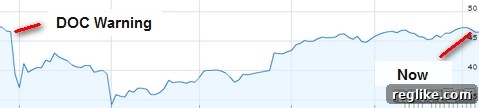
However, this era of automatic increases came under scrutiny. On October 25, Verisign announced that the Department of Commerce was reviewing its ability to implement these automatic price hikes. This news sent ripples through the domain industry, as the potential loss of this revenue lever was widely seen as a significant blow to Verisign’s future profitability projections. At the time of this announcement, Verisign’s market capitalization stood at approximately $7 billion. The expectation among many market analysts and investors would logically have been that such a material change to the company’s long-term earnings potential would lead to a downward re-evaluation of its stock.
Indeed, following this review, Verisign signed a new contract renewal that explicitly removed the provision for automatic 7% annual price increases for .com domains. This represented a fundamental shift in the company’s revenue strategy, requiring it to find growth avenues beyond simple price escalation. The implication was clear: the company would no longer be able to rely on a straightforward mechanism to boost its income, potentially impacting its overall profitability and, by extension, its valuation.
The $7 Billion Conundrum: Market Cap’s Unexpected Stability
Given the significant financial implications of losing the automatic price hike capability, one might logically expect Verisign’s market valuation to have experienced a noticeable decline. The direct impact of losing hundreds of millions of dollars a year in pure profit, projected over many years, should theoretically lead to a lower present value for the company. Yet, six months after the initial announcement and the subsequent contract renewal without the hikes, Verisign’s market cap has remarkably returned to, or remained at, its October level of approximately $7 billion. This intriguing stability begs the question: why did the market not punish Verisign more severely, or why has it recovered so quickly?
This situation challenges conventional financial analysis, which typically dictates that future cash flows are the primary driver of a company’s valuation. When a predictable and substantial revenue stream is curtailed, the expectation is a corresponding adjustment in the company’s market worth. The fact that Verisign has seemingly weathered this storm with its valuation intact suggests that other factors are at play, or that the initial market assessment of the impact was either miscalculated or swiftly re-evaluated based on a deeper understanding of Verisign’s intrinsic value and strategic position.
Why Did the Market Not Punish Verisign? Potential Explanations
Several plausible explanations can shed light on Verisign’s surprising market stability:
1. Inelastic Demand and Essential Service Status:
The .com domain is not a luxury; it’s a necessity for most businesses and individuals serious about their online presence. Demand for .com names is highly inelastic, meaning that even if prices were to rise (or, in this case, simply not rise as expected), the fundamental need for these domains would remain robust. Verisign’s revenue is driven by volume more than by individual price points. Continued growth in internet usage and new business formation translates to consistent demand for .com registrations and renewals. The market might be betting that volume growth will largely offset the stagnation in price increases for the foreseeable future, maintaining a strong, albeit flatter, revenue trajectory.
2. Strong Cash Flow and Operational Efficiency:
Even without automatic price hikes, Verisign remains an incredibly profitable company with strong cash flow. Its operational costs are relatively low compared to the vast revenue generated from millions of domain registrations. The infrastructure is largely in place, and the business model is highly scalable. This means that Verisign will continue to generate significant free cash flow, which can be returned to shareholders through dividends and share buybacks, or invested in other growth initiatives. Investors often value companies with strong cash-generating capabilities, especially in times of market uncertainty.
3. Investor Confidence and Predictability:
While losing the automatic price hikes might seem like a negative, the resolution of regulatory uncertainty can sometimes be a positive. The period of review and negotiation likely introduced an element of risk and unpredictability. With a new contract in place, even if less favorable on pricing, there is now a clear path forward. This renewed clarity and long-term stability might be more appealing to certain investors than the previous scenario of uncertainty surrounding future pricing policies. Knowing the rules of the game, even if they’ve changed, allows for better long-term planning and investment decisions.
4. Diversification and Future Opportunities:
While .com and .net are Verisign’s primary revenue drivers, the company is also involved in other areas, such as providing critical DNS (Domain Name System) services and enhancing internet security through DNSSEC (Domain Name System Security Extensions). While these may not currently rival .com revenue, they represent strategic investments in the future of internet infrastructure. The market might be factoring in Verisign’s overall strategic importance and its potential to leverage its expertise in other adjacent areas, ensuring its long-term relevance beyond just domain registration fees.
5. Market Overreaction or Prior Undervaluation:
It’s possible that the market had already, to some extent, priced in the possibility of losing the automatic price hikes. Regulatory scrutiny over such essential infrastructure services is not uncommon, and savvy investors might have anticipated such a development. Alternatively, Verisign could have been undervalued even with the potential for price hikes. In this scenario, the market’s current valuation simply reflects a more accurate assessment of its inherent worth, regardless of the price adjustment mechanism.
6. Share Buyback Programs:
Verisign has a history of robust share buyback programs, which can effectively reduce the number of outstanding shares and thus support or even increase the earnings per share (EPS) and stock price, even if net income growth slows. Such capital allocation strategies are a common tool for mature, highly profitable companies to return value to shareholders and maintain stock stability.
The Broader Implications for the Domain Industry and Digital Economy
Verisign’s situation has broader implications beyond its own balance sheet. For registrars (companies that sell domain names to the public), the stability of wholesale .com prices provides more predictability for their business models. For domain investors and businesses relying on .com names, the absence of automatic price increases means more predictable costs, which can be a positive for long-term planning and budgeting.
This case also highlights the ongoing role of regulatory oversight in critical internet infrastructure. Governments, recognizing the foundational importance of services like those provided by Verisign, maintain an interest in ensuring fair practices and preventing potential abuses of market power. The resolution of Verisign’s contract underscores the balance between allowing companies to operate profitably and safeguarding the public interest in an open and accessible internet.
A Look Ahead: Verisign’s Path Forward
Moving forward, Verisign will need to adapt its growth strategy. While its status as a “cash printing machine” will likely endure due to the essential nature of its services, the emphasis will shift from price-driven growth to volume-driven growth, operational efficiency, and potentially the development of new, value-added services. The company’s ability to innovate within the domain management and internet security space, and to continue demonstrating its indispensable role, will be key to sustaining investor confidence and achieving future valuation increases.
For investors, Verisign continues to offer a unique proposition: exposure to the underlying growth of the internet through a highly stable, essential service provider. While the days of guaranteed annual price hikes may be over, the company’s deep moat, robust cash flow, and critical infrastructure role suggest that its enduring value proposition remains strong, even if its growth trajectory is now more nuanced.
Unpacking the Enigma of Verisign’s Enduring Value
In conclusion, the curious case of Verisign’s market cap resilience, despite the removal of automatic .com price increases, is a testament to the complex interplay of fundamental value, market sentiment, and strategic positioning. While initially perplexing, the stability can be attributed to Verisign’s irreplaceable role in the internet’s foundation, its robust cash flow generation capabilities, the resolution of regulatory uncertainty, and potentially the market’s long-term view of its essential services. Verisign remains a critical player in the digital economy, and its journey continues to offer valuable insights into how essential infrastructure assets are valued in an ever-evolving digital landscape.