
Unveiling Consumer Sentiment: A Deep Dive into Domain Name Preferences and New TLDs
While often overlooked by the general public, the concept of expanded choices resonates deeply with consumers. This notion holds especially true within the domain name landscape, where the introduction of new top-level domains (TLDs) has sparked both curiosity and debate.
The Domain Name Association (DNA), a prominent advocacy group for the adoption of new TLDs, recently released the findings of a comprehensive survey. This survey aimed to gauge consumer sentiment towards domain names, with a particular focus on understanding perceptions and preferences surrounding these newly introduced TLDs. Despite its inherent bias as an advocate, the DNA’s survey methodology appeared balanced and acknowledged the challenges associated with gathering accurate data on relatively unfamiliar new TLDs.
The survey employed a series of hypothetical scenarios, presenting respondents with identical second-level domains paired with varying TLDs. For instance, participants were asked, “Where would you go to pay bills online?”
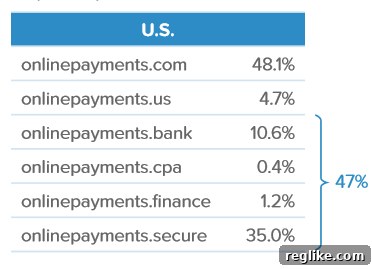
Each question of this nature included the ubiquitous “.com,” the relevant country code TLD (ccTLD), and a selection of four new TLD options, many of which were not yet readily available at the time of the survey. This approach raises an interesting question: Would the results have differed if the survey had presented only a single new TLD to each participant? Given that new TLDs constituted 67% of the choices, it is plausible that this skewed the responses in their favor.
Nevertheless, the responses to the bill payment question revealed intriguing insights. There was a clear preference for “.secure” compared to other TLDs, especially “.bank,” when it came to a task requiring a high level of trust and security. Exploring this preference further through a dedicated study comparing only new TLD choices would be invaluable. Such a study could provide a deeper understanding of how consumers perceive the relative trustworthiness and suitability of different new TLDs for sensitive online activities.
Another hypothetical scenario asked Australian respondents, “Where would you buy shoes if you lived in Melbourne?” The results indicated a significant preference for geographically relevant domains:
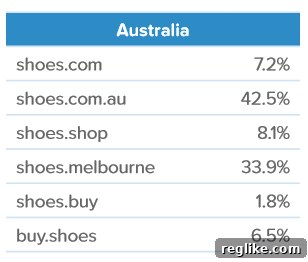
While these results might appear promising for geo-domains, the validity of this question is questionable. The approach mirrors the practice of using the exact search term in an Adwords landing page, where users are more likely to convert due to the perceived relevance and familiarity. It is likely that a similar effect influenced the responses to this question, leading to an inflated preference for geo-domains.
The DNA report also highlighted the relatively low awareness of new TLDs among the general population. This observation aligns with the general consensus within the domain name industry. In fact, the DNA survey’s estimate of 25% awareness might be an overestimation, potentially skewed by the specific demographics of the survey participants. The report itself acknowledges this possibility, noting anomalies in the data, such as the significantly higher awareness reported in Mexico (70%) compared to the United States (15%), a disparity that lacks a clear explanation.
Furthermore, the placement of the awareness question within the survey is a critical consideration. Asking this question at the beginning of the survey would likely yield different results compared to asking it after participants had already answered multiple questions about new TLDs. Exposure to the topic throughout the survey could artificially inflate awareness levels.
The survey also revealed that respondents expressed a desire for greater choice when it comes to domain names. However, this finding should be interpreted with caution, as consumers generally express a preference for more options in most contexts. The desire for more choice is a common human trait and doesn’t necessarily translate into a strong preference for new TLDs specifically.
One particularly encouraging result for the domain name industry was the finding that a significant portion of users still type domain names directly into their browsers. While search engines remain the dominant method of online navigation, 35% of respondents indicated that they frequently navigate by directly typing domain names. Moreover, 85% reported typing domain names at least some of the time, highlighting the enduring importance of memorable and easily typed domain names.
The complete dataset from the DNA survey is available to its members. A summarized report is also publicly accessible on the DNA’s website (PDF format).
The Importance of Understanding Domain Name Preferences
Understanding consumer preferences regarding domain names is crucial for businesses, marketers, and anyone involved in the online landscape. Domain names serve as the digital addresses of websites and play a significant role in shaping brand identity, online visibility, and user experience. As the internet continues to evolve and new TLDs proliferate, staying informed about consumer perceptions and preferences becomes even more critical.
The introduction of new TLDs offers businesses and individuals a wider range of options for creating memorable and relevant domain names. However, the success of these new TLDs hinges on consumer adoption and trust. By understanding how consumers perceive these new extensions and what factors influence their choices, businesses can make informed decisions about their domain name strategy.
Factors influencing domain name preferences include:
- Trust and Security: Consumers are more likely to trust and engage with websites that they perceive as secure and reliable. TLDs like “.secure” or industry-specific extensions can help convey a sense of security and build trust with potential customers.
- Relevance and Memorability: A domain name that is relevant to a business’s products or services and easy to remember is more likely to attract visitors and generate leads. New TLDs offer opportunities to create more specific and memorable domain names that stand out from the crowd.
- Geographic Targeting: Geo-domains, such as “.melbourne” or “.london,” can be effective for businesses targeting specific geographic regions. These domains can help improve local search rankings and attract customers in the targeted area.
- Brand Identity: A domain name should reflect a business’s brand identity and values. New TLDs offer opportunities to create domain names that are more aligned with a business’s branding and marketing efforts.
The Future of Domain Names: Embracing Choice and Innovation
The domain name landscape is constantly evolving, with new TLDs being introduced regularly and consumer preferences shifting over time. Businesses need to stay informed about these changes and adapt their domain name strategies accordingly. By embracing choice and innovation, businesses can leverage the power of domain names to enhance their online presence, build brand awareness, and drive growth.
As the internet becomes increasingly crowded, standing out from the competition is more important than ever. A well-chosen domain name can help businesses differentiate themselves and attract attention in a crowded online marketplace. New TLDs offer opportunities to create unique and memorable domain names that capture the essence of a brand and resonate with its target audience.
Ultimately, the success of new TLDs will depend on their ability to provide value to both businesses and consumers. By offering greater choice, relevance, and innovation, new TLDs have the potential to transform the domain name landscape and create new opportunities for online growth and success.