
Unveiling the True Usage of New Top-Level Domains: An In-Depth Analysis
In the ever-evolving landscape of the internet, new top-level domains (TLDs) have emerged, promising fresh opportunities for branding and online presence. However, separating genuine usage from mere registration numbers has become a significant challenge. A critical look at the data reveals that simply counting domain registrations provides a misleading picture of actual TLD adoption and utility.
Traditional leaderboards that rank TLDs based on the total number of registered domains in their zones are often skewed. These rankings can be easily manipulated by offering domains at extremely low prices, artificially inflating registration figures without necessarily reflecting real-world usage. This practice creates a distorted view of TLD popularity, making it difficult to discern which domains are genuinely active and contributing to the online ecosystem.
While some organizations have attempted to gauge actual usage, these efforts often rely on subjective metrics with varying definitions. For instance, analyzing the presence of websites associated with domains can be a starting point, but it fails to distinguish between functional websites and mere placeholders. Even excluding placeholders, the data may not accurately represent “real” websites – those actively used by individuals or businesses to establish a meaningful online presence.
A recent analysis conducted by Dataprovider.com offers a more rigorous and insightful approach to understanding TLD usage. This study delves deeper than surface-level metrics, employing a multi-faceted methodology to uncover the true extent to which different TLDs are being actively used and engaged with by internet users.
The Dataprovider.com analysis begins by comparing the size of the zone file of each TLD to its corresponding usage. This initial step helps to identify TLDs with a significant number of registered domains, but also highlights those where a large proportion of domains may be inactive or underutilized. The analysis then focuses on domains with associated websites, filtering out placeholders to obtain a more accurate representation of active online presence.
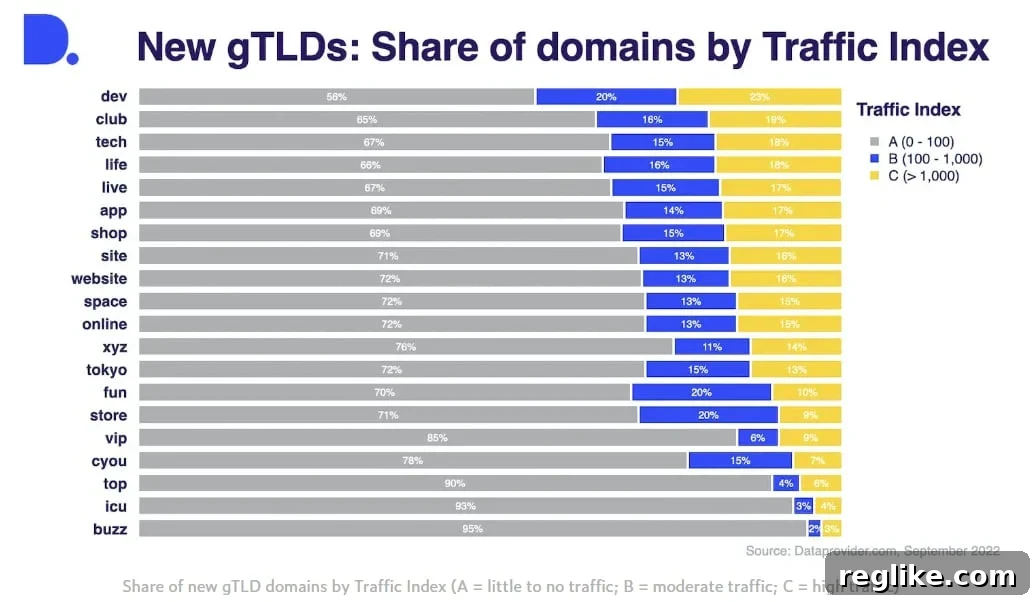
However, the most innovative aspect of the Dataprovider.com analysis lies in its examination of traffic patterns. By measuring the traffic directed to domains within the top 20 largest zone files, the study identifies TLDs that are attracting genuine user engagement. This traffic analysis provides a valuable indication of which TLDs are hosting websites that are actively being visited and used by internet users.
It’s important to acknowledge that “traffic” is a broad term and can encompass various types of activity. For example, domains set up for spam campaigns may generate significant traffic, even though their purpose is malicious rather than beneficial. Conversely, many legitimate websites may receive relatively low traffic, particularly if they are niche or newly established. However, by focusing on domains with moderate to high traffic volume, the Dataprovider.com analysis provides a reasonable approximation of actual usage percentages for each TLD.
The results of the Dataprovider.com analysis reveal interesting insights into the relative popularity of different TLDs. Domains such as “.dev” and “.app,” which are often associated with Google and require SSL certificates for operation, tend to rank higher in terms of traffic. This suggests that users are more likely to trust and engage with websites hosted on these domains.
Conversely, TLDs that have been heavily promoted with low-cost domain registrations often appear near the bottom of the traffic rankings. This observation reinforces the notion that simply accumulating domain registrations does not necessarily translate into meaningful usage or online presence.
It is crucial to interpret the results of this analysis in the context of the total number of domains registered within each TLD. For example, while “.dev” may have a high percentage of trafficked sites, its overall domain count (e.g., 319,000) may be lower than that of “.club” (e.g., 688,000). Therefore, the analysis suggests that there may be a greater number of trafficked sites on “.club” than on “.dev,” even though the percentage of trafficked sites is higher for “.dev.”
To gain a truly accurate understanding of TLD usage, it would be necessary to conduct in-depth investigations into specific examples of websites hosted on different TLDs. This would involve analyzing the content, functionality, and user engagement of these websites to determine their overall contribution to the online ecosystem. However, the Dataprovider.com analysis represents a significant step forward in providing a more objective and data-driven assessment of TLD usage.
In conclusion, the Dataprovider.com analysis provides valuable insights into the true usage of new TLDs, moving beyond the limitations of simple registration counts. By focusing on traffic patterns and filtering out inactive domains, the study offers a more accurate representation of which TLDs are actively contributing to the online landscape. While further research is needed to fully understand the nuances of TLD usage, this analysis serves as a crucial tool for assessing the real-world impact of new domain extensions.
The internet domain name system continues to evolve. Understanding these trends helps businesses and individuals make informed decisions about their online presence and branding strategies. Selecting the right TLD can impact visibility, credibility, and overall online success.
As the digital world expands, the significance of a well-chosen domain name becomes even more critical. A domain is more than just an address; it’s a representation of a brand’s identity, values, and mission. In a competitive online environment, a memorable and relevant domain can be a powerful asset.
The future of TLDs will likely see further diversification and specialization. New TLDs catering to specific industries, interests, and geographic regions are expected to emerge. This will provide businesses and individuals with even greater opportunities to tailor their online presence to their target audiences.
Ultimately, the success of any TLD depends on its ability to foster a vibrant and engaging online community. TLDs that attract high-quality content, active user participation, and innovative applications are likely to thrive in the long run. This requires a commitment to quality, security, and user experience.
Therefore, while new TLDs continue to emerge, understanding the data behind their use is critical. This Dataprovider.com analysis offers an insightful look, helping users and businesses navigate the complex domain landscape. By focusing on real usage instead of inflated registration numbers, stakeholders can make better decisions regarding their online strategy and domain selection. The key takeaway: dig deep into the data to unearth the true value of new TLDs and unlock their potential for success in the digital age.