
Decoding Domain Registrar Performance: A Deep Dive into August’s .Com Transfer Data
The domain name industry is a dynamic ecosystem where customer choices and operational efficiency directly impact a registrar’s market share. Understanding these shifts requires meticulous analysis of official data, and ICANN’s regular publications of Verisign’s .com statistics provide invaluable insights into this competitive landscape. The recently released August performance data offers a critical snapshot of how various domain name registrars, including Moniker, fared in terms of successful domain transfers and overall portfolio health.
For domain investors, businesses, and individual registrants, the fluidity of domain transfers signifies a constant evaluation of services, pricing, and user experience. Registrars, on the other hand, closely monitor these metrics as indicators of customer satisfaction and potential areas for improvement or concern. This article delves into the August figures, with a particular focus on Moniker’s performance following significant account interface changes, and sheds light on broader trends affecting the industry.
Moniker’s Post-Transition Performance: A Detailed Examination
For several months, industry observers have been keenly watching Moniker, a prominent domain registrar, following its substantial overhaul of the customer account interface. Speculation was rife regarding the potential for a massive exodus of domains as users grappled with the new system. While the immediate aftermath didn’t reveal the catastrophic “hemorrhaging” some anticipated, the latest .com data from August confirms a persistent, albeit slower, “bleed” of domain assets, particularly concerning for the registrar’s long-term stability.
The successful transfer data is a strong indicator of customer sentiment. When a domain is transferred out, it often signals dissatisfaction with the current registrar or a move to consolidate services elsewhere. Conversely, transfers in represent new business and growth. The following chart visually summarizes the August transfer activity for the top ten registrars experiencing the most outbound transfers:
.Com August Successful Transfers
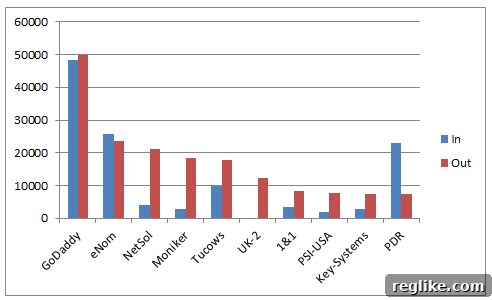
The visual representation above illustrates a critical balance: the blue column on the left signifies domains successfully transferred into a registrar, while the red column on the right denotes domains successfully transferred out. A registrar’s health in this context is generally reflected when the blue column is substantially taller than the red, indicating a net gain of domains through transfers. Conversely, a significantly taller red column points to net losses, suggesting customers are moving their assets elsewhere.
While the visual data provides an immediate overview, it’s crucial to exercise caution. A single month’s data, especially in the context of high-volume transfers, might be influenced by a handful of large portfolio movements rather than a broad trend. However, when aggregated over several months, such data begins to paint a clearer picture of a registrar’s trajectory. In Moniker’s case, the August figures, when viewed in conjunction with previous months, contribute to a concerning pattern.
Moniker’s Transfer Out Trend: A Slow but Steady Decline
In August, Moniker recorded a loss of 18,254 .com domains due to outbound transfers. While not an unprecedented figure in isolation, it represents a high mark for the company within the current year. To contextualize this, consider the preceding months: June, the month of the interface transition, saw Moniker lose 17,506 .coms, followed by 18,057 losses in July. Prior to these changes, the registrar typically experienced monthly losses ranging from 6,000 to 14,000 domains. This indicates a measurable increase in domain departures coinciding with and persisting after the interface update, suggesting a direct correlation between the operational change and customer migration.
The interface redesign, intended to enhance user experience or streamline operations, appears to have had the unintended consequence of prompting a segment of Moniker’s customer base to seek alternative registrars. This highlights the delicate balance registrars must maintain between innovation and user familiarity. Disruptive changes, even if technically superior, can alienate long-standing customers who prioritize ease of use and consistency in managing their valuable domain portfolios.
Beyond Transfers: The Critical Metric of New Registrations vs. Deletions
While transfer data offers a window into customer movement between registrars, an equally, if not more, telling indicator of a registrar’s health is the ratio of new domain registrations to expired domains that are not renewed or transferred. This metric reflects a registrar’s ability to attract new business and retain its existing customer base over the long term, independent of competitive transfers.
For Moniker in August, this ratio presents a particularly challenging outlook. The registrar saw approximately 25,700 .com domains deleted from its books – domains that either expired without renewal or were not transferred to another registrar. In stark contrast, only 10,587 new .com domains were registered with Moniker during the same period. This substantial deficit, with deletions more than doubling new registrations, signifies a significant shrinkage in their overall .com domain portfolio. A healthy registrar typically aims for a positive net growth, where new registrations and transfers in comfortably outweigh deletions and transfers out.
At the close of August, Moniker’s .com registrations stood just above the 1 million mark. If the current trend of high deletions relative to new registrations, coupled with consistent outbound transfers, continues unabated, it is highly probable that the registrar slipped below this significant threshold in September. Crossing below a million active registrations, particularly for .com, is not merely a symbolic event; it can have tangible implications for a registrar’s perceived market position, negotiation power with registries, and overall business valuation. It suggests a challenge in both attracting new users and retaining existing ones, pointing to potential issues with pricing, customer service, or the overall value proposition.
The Broader Registrar Landscape: Trends and Challenges
Moniker is not an isolated case in facing significant domain movements. The August data also highlights challenges for other established registrars. Network Solutions, for instance, experienced substantial losses, with 21,302 .com domains transferred out against only 3,951 transferred in. While Register.com didn’t appear on the top ten list for outbound transfers, it’s known to exhibit similar imbalanced ratios in monthly reports. This trend among legacy registrars like Network Solutions is often attributed to the nature of their clientele and business models.
Many domains registered with Network Solutions, particularly older ones, may have been acquired through auction platforms like NameJet. When these domains come up for renewal, registrants, often domain investors, frequently choose to transfer them to more cost-effective registrars with robust portfolio management tools, or to consolidate them with other holdings. This cyclical pattern of acquisition, holding, and transfer for renewal is a common dynamic in the domain investment community and can significantly skew transfer statistics for registrars that serve this market segment.
The broader implications of these transfer trends paint a picture of an increasingly competitive domain registration market. Registrants are more discerning, actively seeking better value, enhanced user interfaces, superior customer support, or specific features like integrated website builders and email services. This constant flux forces registrars to continuously innovate and adapt to evolving customer expectations or risk losing market share to more agile competitors.
Interpreting the Data and Future Outlook for Registrars
While the August data offers valuable insights, it’s essential to reiterate that monthly statistics are merely snapshots. True trends emerge over quarters and years, allowing for a more accurate assessment of a registrar’s long-term health and strategic effectiveness. Factors influencing domain transfers and registrations are multifaceted, ranging from pricing strategies and promotional campaigns to the quality of customer support, the reliability of services, and the ease of use of management interfaces. A sudden surge in transfers out could be a direct response to a policy change, a price hike, or a decline in service quality, while consistent losses over time indicate deeper systemic issues.
For registrars struggling with net losses, the path forward often involves a dual approach:
- Customer Retention: Investing in robust customer support, proactive communication about changes, and loyalty programs to prevent existing customers from migrating.
- Customer Acquisition: Differentiating through competitive pricing, value-added services (e.g., advanced security, privacy features, hosting bundles), and an intuitive, modern user experience that appeals to new registrants.
The domain industry continues to evolve, with new gTLDs, enhanced security protocols, and evolving privacy regulations constantly reshaping the landscape. Registrars that demonstrate agility, customer-centricity, and a commitment to technological excellence are best positioned to thrive. The August .com transfer data serves as a compelling reminder that in the world of domain names, customer choice is paramount, and performance is relentlessly scrutinized. Monitoring these figures is not just an academic exercise; it’s a vital component of strategic planning for any entity operating within the vast and critical internet infrastructure.