
Navigating the New TLD Landscape: The Critical Challenge of Universal Acceptance and User Recognition
In the rapidly evolving digital realm, the introduction of new Top-Level Domains (TLDs) promised to revolutionize the internet’s naming structure, offering businesses and individuals more descriptive, memorable, and unique web addresses beyond the traditional .com, .org, or .net. However, this expansion has brought with it a significant hurdle: the challenge of universal acceptance and user recognition. While technically valid, many new TLDs struggle to achieve widespread adoption and intuitive understanding among the general public. This article delves into the complexities of this issue, using a prominent example to illustrate the real-world implications for branding, marketing, and user experience.
The conversation around new TLDs often revolves around technical compatibility and software updates. Yet, an equally vital aspect is human behavior – how users interact with and perceive these novel internet identifiers. A recent incident involving a bus advertisement for the .sexy top-level domain name perfectly encapsulates this dilemma, bringing into sharp focus the gap between technical enablement and practical usability.
The .sexy TLD Bus Ad: A Case Study in User Confusion
The esteemed domain industry figure, Frank Schilling, owner of the .sexy TLD, recently drew attention with a public bus advertisement for his domain. The ad itself was a bold statement, aiming to capture public interest and promote the new TLD. However, it inadvertently sparked a critical discussion about how new domain extensions are presented to and understood by the broader internet user base.

Adrian Kinderis, CEO of ARI Registry, a prominent figure in the domain name system (DNS) industry, promptly observed and questioned a specific element of the advertisement: the inclusion of “https://” before the domain name. This seemingly minor detail ignited a crucial debate, prompting Frank Schilling to elaborate on his rationale, which touched upon a fundamental challenge facing new TLDs.
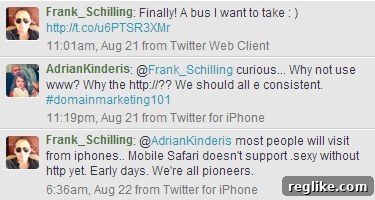
Schilling explained that a significant number of cell phone users, when manually typing a new TLD into their mobile browser’s address bar, often need to prefix it with “http://” or “https://”. Without this prefix, their devices might not recognize the string as a valid web address, leading to failed navigation, search engine queries, or even misinterpretation of the input. This practical necessity, born out of current mobile browser behaviors and underlying system configurations, serves as a stark illustration of the ongoing “universal acceptance” problem for new TLDs.
Understanding Universal Acceptance (UA): More Than Just Technical Compatibility
Universal Acceptance (UA) is a foundational principle for the internet’s future. It mandates that all domain names and email addresses, regardless of their newness or script, must work correctly with all internet-enabled applications, devices, and systems. While significant progress has been made on the technical front – with most modern browsers and email clients now capable of resolving new TLDs – the issue, as demonstrated by the .sexy ad, often lies in user behavior and ingrained habits.
For decades, users have been conditioned to automatically recognize “.com” as a web address. The prefixes “http://” or “https://” have largely become invisible, with browsers automatically adding them. The concept of typing a naked domain like “example.sexy” and expecting it to resolve instantly is still foreign to many, especially on mobile devices where direct URL entry can be less forgiving. This gap between technical capability and user intuition creates a barrier to entry for new TLDs, impacting their commercial viability and public adoption.
The HTTP/HTTPS Prefix Dilemma: Guiding Users or Creating Friction?
Frank Schilling’s decision to include “https://” was a direct response to a real-world user experience issue. He correctly identified that without such guidance, many potential visitors might not reach the website. However, this approach also highlights a paradox: while it aims to facilitate access, it goes against the modern trend of simplifying URLs and expecting browsers to intelligently resolve domain names without prefixes.
Consider the average internet user: When was the last time they manually typed “http://” or “https://” into their browser for a familiar .com site? For the vast majority, this action is a relic of the early internet. Modern browsers are designed to be smart, auto-completing URLs and often resolving domain names even if the protocol prefix is omitted. This user expectation clashes with the current reality for some new TLDs, particularly when users are on less sophisticated mobile interfaces or older software versions.
Furthermore, the shift towards HTTPS as the standard for secure web communication adds another layer of complexity. While essential for security and increasingly favored by search engines for SEO purposes, explicitly including “https://” in an advertisement might visually clutter the message and potentially confuse users who are accustomed to cleaner, shorter domain presentations. Advertisers are caught between providing enough information for successful navigation and maintaining a concise, memorable brand message.
The “www.” Prefix Debate: Familiarity vs. Modernity
Kinderis’s initial query regarding the “https://” prefix subtly extended to another common point of contention: the necessity of the “www.” prefix. He pondered whether advertisers might feel compelled to include “www.” to ensure people recognize a string of characters as a domain name, thereby separating it from other instances of dots in advertising copy that aren’t web addresses.
Historically, “www.” (World Wide Web) was an almost universal indicator of a website. It clearly differentiated a web address from other network addresses or simply a company name with a period. However, like “http://”, “www.” has become largely optional in modern browsing. Many websites now operate perfectly well on their “naked” domain (e.g., example.com instead of www.example.com), and the trend is towards shorter, more streamlined URLs.
Yet, for new TLDs, where the domain extension itself might not immediately scream “website!” to an unfamiliar user, the “www.” prefix could serve as a valuable visual cue. This is especially relevant in contexts where text might contain other dots, leading to potential misinterpretation. Consider the following example:

In an advertisement for “Plumping Line . Fresh Glow,” a user might see “Line.Fresh” and not immediately associate it with a domain if there isn’t a clear “www.” or “http://” indicator. Without these familiar signposts, a new TLD like “Fresh.Glow” could easily be mistaken for a product tagline or an email address, rather than a clickable web portal. This ambiguity creates friction for users and diminishes the effectiveness of the advertisement.
The Advertiser’s Conundrum and Broader Implications
The core problem highlighted by Frank Schilling’s ad is that even when advertisers make an effort to guide users – by including prefixes like “https://” – they still face an uphill battle against deeply ingrained user habits. Most people will instinctively try to type “sexy” directly into their browser, expecting it to work. When it doesn’t, or when it defaults to a search query, it leads to frustration and a lost opportunity for the brand.
This challenge extends beyond direct typing. It impacts how new TLDs are perceived in email addresses, software applications, and even voice commands. If a system or a user doesn’t universally accept and correctly process a new TLD, it hinders email deliverability, software functionality, and the overall reach of the brand utilizing that domain.
For the success and widespread adoption of new TLDs, a multi-faceted approach is required. Registries and registrars must continue to advocate for and ensure technical universal acceptance across all platforms. Browser developers need to enhance their intelligence in recognizing and resolving new TLDs without requiring explicit prefixes. Most importantly, educational initiatives are crucial to inform the public about the expanded domain name system and encourage new browsing habits. The goal is to reach a point where typing “yourbrand.shop” is as intuitive and reliable as typing “yourbrand.com.”
Conclusion: Bridging the Gap Between Innovation and User Experience
The case of the .sexy TLD bus ad serves as a powerful reminder that the journey for new Top-Level Domains is far from over. While the technical infrastructure largely supports these innovative extensions, the human element – universal acceptance, user recognition, and ingrained browsing habits – remains a critical barrier to their full potential. Advertisers, in their quest for clarity and reach, are often forced to choose between modern, concise branding and providing explicit, sometimes redundant, navigational cues.
As the internet continues to grow and evolve, bridging the gap between cutting-edge domain innovation and seamless user experience will be paramount. This requires continuous collaboration among all stakeholders – from domain registries and registrars to browser developers and content creators – alongside ongoing user education. Only then can new TLDs truly unlock their promise of a more diverse, descriptive, and accessible online world, where every web address is intuitively recognized and effortlessly reached, without the need for historical prefixes or complex workarounds.