
Navigating the Chinese Domain Market: Why .ORG Domains Are a Poor Investment Strategy
Are you a domain investor eyeing the dynamic Chinese market, perhaps considering Pinyin domains under the .org extension? While the allure of high-growth economies often draws keen interest from global investors, a closer examination of China’s unique regulatory environment and specific market dynamics reveals significant challenges for .org domains. For those currently holding or contemplating the acquisition of .org domains with the strategic intent of targeting Chinese buyers, especially for aftermarket sales, it is crucial to understand the substantial restrictions and prevailing trends that make such investments increasingly unviable and risky.
The digital landscape in China operates under a distinct set of rules, heavily influenced by robust government oversight and specific local market preferences. This detailed analysis delves into the primary reasons why the .org domain, a globally recognized extension synonymous with non-profit organizations and open communities, faces considerable hurdles for adoption and successful monetization within the People’s Republic. From critical licensing requirements to shifts in registry strategies, multiple factors converge to diminish the value, utility, and overall potential of .org domains in this vital economic region.
A Striking Decline: The Shrinking Presence of .ORG Domains in China
The statistical evidence paints a clear and concerning picture regarding the trajectory of .org domains in China. Data from the China Internet Network Information Center (CNNIC), the authoritative body responsible for administering internet resources in mainland China, indicates a consistent and significant decline in the total number of .org domains registered within the country over the last fifteen years. This downward trend reached a notable low point of approximately 146,000 registered domains in 2020.
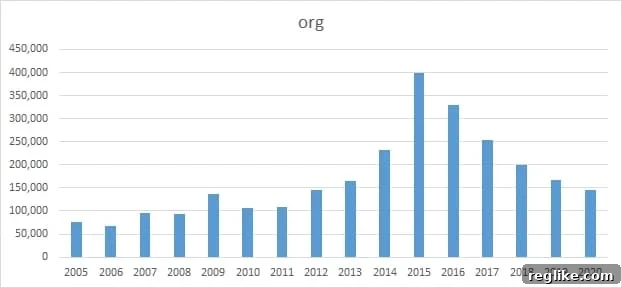
To truly grasp the scale of this decline, it’s essential to put this figure into perspective. In the very same year, China recorded an astounding 19 million .cn domains. The stark disparity between 146,000 .org domains and 19 million .cn domains highlights a fundamental and pervasive lack of market penetration and user adoption for the .org extension. This precipitous drop is not merely a statistical anomaly; it reflects underlying systemic issues that directly impact the usability, legality, and overall viability of operating a website on a .org domain within China.
Domain investors hoping to capitalize on the appeal of Pinyin domains or other regionally targeted names under this extension must confront the reality that the market for these assets is not only shrinking but is also fundamentally hampered by operational barriers. Understanding these barriers is paramount for anyone considering a domain portfolio strategy focused on the Chinese market.
The Indispensable Barrier: China’s ICP Licensing Requirement
Perhaps the most critical and, for .org domains, insurmountable hurdle in China is the mandatory ICP (Internet Content Provider) licensing requirement. In China, any website operating within the country, whether hosted locally or specifically targeting local users, must obtain an ICP license from the Ministry of Industry and Information Technology (MIIT). This license serves as an essential government approval for a website to legally publish content online, ensuring strict compliance with China’s comprehensive internet regulations. Without a valid ICP license, a website cannot be legally hosted within mainland China. Furthermore, even if hosted internationally, any site without ICP approval faces severe risks of being blocked by the Great Firewall, effectively rendering it inaccessible to the vast majority of Chinese internet users.
The core problem for .org domains is unequivocally clear: the Chinese government currently does not issue ICP licenses for them. This policy effectively prevents any entity – be it a commercial business, a non-profit organization, or an individual – from legally operating a fully compliant website on a .org domain from within China. The implications of this policy are profound and far-reaching, fundamentally limiting the utility and market value of .org domains.
Direct Evidence from Leading Chinese Registrars
To further emphasize this critical point, one needs only to consult the website of Aliyun (Alibaba Cloud), a prominent subsidiary of the Alibaba Group and by far the largest domain registrar in China. On their dedicated .org domain registration page, a highly visible notice in Chinese explicitly states:
.org域名暂无法进行网站备案,请先注册进行保护
This message translates directly to: “Currently, .org domains cannot undergo website ICP filing (备案 – ‘bei’an’), please register first for protection.” While Aliyun, along with other registrars, will allow you to proceed with the registration of a .org domain name, the crucial caveat is that acquiring the domain does not grant the ability to obtain the necessary ICP license. This means you cannot build and operate a fully compliant and reliably accessible website on that domain within mainland China. This distinction is vital for investors: owning the domain is one aspect; being able to *use* it legally and effectively for its intended purpose in the Chinese market is an entirely different and currently impossible challenge for .org domains.
Broader Impact on Market Dynamics and Investment Decisions
The inability to secure an ICP license for .org domains triggers a cascading effect across the entire Chinese domain market. Firstly, local registrars like Aliyun have virtually no incentive to heavily promote or push .org domains, as their practical utility for local businesses, organizations, and individuals is severely curtailed. Consequently, marketing and sales efforts are overwhelmingly concentrated on domain extensions like .cn and .com, which are fully compliant with China’s rigorous ICP regulations and are therefore widely adopted.
Secondly, Chinese businesses, government agencies, non-profit organizations, and individual entrepreneurs are acutely aware of these stringent restrictions. They naturally steer clear of .org domains, understanding that any significant investment in developing and maintaining a website on such a domain would be largely fruitless, as it could never legally operate or achieve widespread accessibility within the country. This dramatically diminishes the pool of potential buyers for .org domains in the aftermarket, making sales exceptionally unlikely and inevitably driving down any perceived intrinsic value. For domain investors, this translates directly into a high-risk, low-reward scenario where the fundamental utility and liquidity of the asset are severely compromised, rendering it an unwise speculative choice for the Chinese market.
The Intricacy of Non-Profit Status in China
Beyond the formidable ICP licensing conundrum, another significant factor contributing to the limited appeal and adoption of .org domains in China is the inherent difficulty in establishing and operating officially recognized non-profit organizations (NPOs) within the country. Globally, the .org extension is widely acknowledged and often serves as the default choice for charitable organizations, foundations, educational institutions, community groups, and various other non-commercial entities. It carries an implicit sense of trust and a strong association with public service and civic engagement.
However, the process of becoming an officially recognized and operational non-profit organization in China is considerably more arduous and administratively complex than in many Western nations. The Chinese government maintains stringent oversight over civil society organizations, requiring extensive approvals, affiliations with government-backed supervisory units, and strict adherence to a labyrinthine set of regulations. As highlighted in previous analyses of the Chinese domain landscape, the government has, in recent years, become increasingly rigorous in its scrutiny and confirmation processes for non-profit statuses, reflecting a broader policy of tighter control over social organizations.
While the .org registry technically permits any type of registrant worldwide, its brand identity and global perception are deeply intertwined with the non-profit sector. Given the considerable hurdles, intense scrutiny, and bureaucratic complexities faced by NPOs in China, the primary target audience for .org domains – genuine non-profit entities seeking an online presence – is significantly smaller and far more constrained than in other regions. This scarcity of a natural user base further limits the organic demand for .org domains, even if the pervasive ICP issue were somehow to be resolved. Without a robust, easily navigable, and expansive non-profit sector, the inherent value proposition and natural adoption curve of the .org extension for its core user base in China are severely undermined.
Public Interest Registry’s Strategic Shift: Quality Over Quantity
Adding yet another layer to the myriad challenges faced by .org domains in the Chinese market is a significant strategic shift implemented by the Public Interest Registry (PIR), the registry operator for the .org extension. Several years ago, PIR transitioned its focus away from aggressive promotional tactics aimed at increasing registration volume, instead adopting an approach that prioritizes “quality over quantity” of registrations. Historically, many domain investors have capitalized on low-cost promotional offers and bulk registration discounts, enabling them to acquire large portfolios of speculative domains. This traditional investment strategy typically relies on the premise that a small percentage of these acquired domains will eventually be sold at a significant profit, thereby offsetting the acquisition and holding costs of the larger portfolio.
PIR’s new strategic direction, however, has largely eliminated these “cheap promo” opportunities that were once a staple for domain investors. By consciously prioritizing stable, long-term registrations from legitimate organizations and focusing on maintaining the integrity and purpose of the .org namespace, PIR has inadvertently removed one of the key avenues through which speculative investors might have accumulated .org domains for niche markets such as China. This shift, when combined with the severe market and regulatory challenges already discussed, makes the financial model for investing in .org domains specifically for aftermarket sales in China even less attractive and more precarious. The increased cost of acquisition, coupled with the absence of prospects for high volume sales or quick turnover, becomes a much more significant and prohibitive barrier to entry for potential investors.
Pinyin Domains and the .ORG Conundrum: A Call for Prudent Investment
For domain investors specifically targeting the vast and lucrative Chinese market, Pinyin domains – domain names that utilize the phonetic transcription of Chinese characters into the Latin alphabet – have long represented a category of significant interest. These domains theoretically offer a crucial bridge between the Chinese language and the global internet infrastructure, making them potentially valuable for businesses and individuals wishing to appeal directly to a Chinese-speaking audience. However, the strategy of pairing a Pinyin domain with the .org extension for the Chinese market is inherently fraught with peril and should be approached with extreme caution.
The inherent obstacles, most notably the virtually insurmountable ICP licensing issue, fundamentally undermine the practical utility and legal viability of any Pinyin .org domain for local Chinese use. A Pinyin domain’s core value proposition largely stems from its ability to effectively connect with a Chinese-speaking audience, facilitating brand recognition, online presence, and direct communication. If a website built on such a domain cannot legally operate or be reliably accessed within mainland China due to regulatory blocks, its primary value proposition is entirely negated. Investors who pursue this strategy might ultimately find themselves holding assets that are effectively digital white elephants – names that may sound promising and culturally relevant but are functionally useless for their intended market, leading to significant financial losses and unrealized potential.
In conclusion, the powerful confluence of stringent regulatory requirements, particularly the non-issuance of ICP licenses for .org domains, the complex and restrictive landscape for establishing and operating non-profit organizations in China, and the Public Interest Registry’s strategic shift away from investor-centric promotions, collectively renders .org domains a highly unwise and speculative investment for the Chinese market. For those considering or currently holding .org domains with the specific intention of targeting Chinese buyers, a thorough and critical reassessment of your portfolio strategy is strongly advised. Prudent investors should instead focus on domain extensions that are fully compliant, widely adopted, and actively promoted within the Chinese digital ecosystem, such as .cn or .com, to ensure their investments have a genuine chance of success, liquidity, and long-term viability in this unique and complex market.