
Navigating the Changing Landscape of WHOIS: Contact Information Removal and GDPR Compliance
The domain name system (DNS) is a critical infrastructure of the internet, and WHOIS is a publicly accessible database that contains information about registered domain names, including contact details of the domain name owners. However, recent changes driven by privacy concerns, particularly the European Union’s General Data Protection Regulation (GDPR), have significantly impacted the accessibility of this information.
Many domain name registrars are now removing or obscuring the contact information of domain owners in WHOIS records. This can create challenges for those who need to contact domain owners for legitimate reasons, such as addressing technical issues, reporting abuse, or pursuing legal matters.
I recently received an anonymous voicemail message from an Enom customer who was deeply frustrated by the changes made to the WHOIS records for his domain names. According to the customer, Enom had replaced the actual contact information with “fake” details without obtaining prior consent. He stated that this was presumably done to comply with European regulations, but the implementation was poorly executed. The customer emphasized that the provided address was non-functional, making it impossible to contact anyone regarding technical problems or other concerns. This change affected hundreds of domain names owned by the individual.
To illustrate this situation, here’s an example of a WHOIS record for one of my domains registered with Enom:
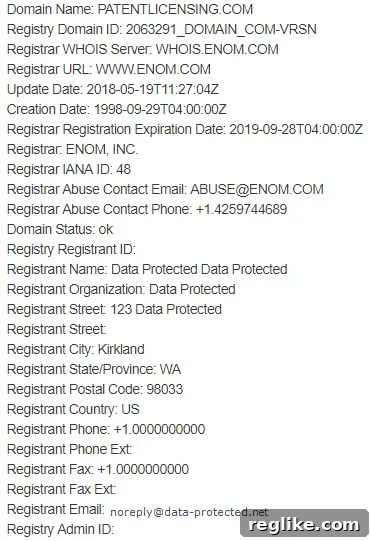
As you can see, the only way to contact someone regarding this domain through the WHOIS record is to send an email to Enom’s abuse address. This indirect approach can be cumbersome and may not be suitable for all types of inquiries.
The Impact of GDPR on WHOIS
The current state of flux in WHOIS is primarily due to ICANN’s response to the GDPR. ICANN, the Internet Corporation for Assigned Names and Numbers, is responsible for coordinating the DNS and managing the WHOIS database.
GDPR is a European Union regulation that aims to protect the personal data of individuals. It imposes strict requirements on organizations that collect, process, and store personal data, including domain name registrars.
In light of GDPR, ICANN has implemented a temporary specification for handling WHOIS data. This specification requires registrars to provide a means for people to contact the domain name owner via email or a web form, even if the owner’s direct contact information is not publicly displayed. This mechanism is designed to balance privacy concerns with the need for legitimate communication.
However, the implementation of this contact mechanism is still evolving. It may take some time for registrars to fully implement it effectively. The functionality resembles anonymized email addresses used in WHOIS privacy and proxy services, ensuring that direct personal information remains protected while enabling communication.
The Option to Publish Contact Information
The temporary specification also requires registrars to provide customers with the option to publish their contact information in the WHOIS database. However, the deadline for implementing this option is “as soon as commercially reasonable,” which provides registrars with some flexibility.
According to section 7.2.1 of the temporary specification:
As soon as commercially reasonable, Registrar MUST provide the opportunity for the Registered Name Holder to provide its Consent to publish the additional contact information outlined in Section 2.3 of Appendix A for the Registered Name Holder.
Section 2.3 of Appendix A lists the following contact information that registered name holders can choose to publish:
- Registry Registrant ID
- Registrant Name
- Registrant Street
- Registrant City
- Registrant Postal Code
- Registrant Phone
- Registrant Phone Ext
- Registrant Fax
- Registrant Fax Ext
In addition to the registrant contact information, registrars may also offer customers the option to publish administrative, technical, and other contact details. However, this is not a mandatory requirement.
Challenges and Uncertainties
The current situation is complex and fraught with uncertainty. ICANN is currently involved in a legal dispute with an affiliate of Enom over the company’s interpretation of GDPR as it relates to WHOIS data. This legal battle highlights the challenges in interpreting and implementing GDPR requirements in the context of the domain name system.
Some registrars, such as GoDaddy, have chosen to continue publishing WHOIS data, while others have opted to remove or obscure it. This inconsistency can make it difficult to find accurate and up-to-date contact information for domain owners.
The transition period is expected to last for several months, and it may take even longer for all the issues to be resolved. In the meantime, it is important to be aware of the changes in WHOIS and to adapt accordingly.
Strategies for Contacting Domain Owners
Despite the challenges, there are still ways to contact domain owners. Here are a few strategies you can try:
- Check the WHOIS record: Even if the contact information is not directly displayed, the WHOIS record may provide an email address or web form for contacting the domain owner.
- Contact the registrar: You can contact the registrar and request assistance in contacting the domain owner. The registrar may be able to forward your message or provide you with alternative contact information.
- Use online tools: Several online tools can help you find contact information for domain owners. These tools may use various techniques, such as searching social media profiles or business directories.
- Engage a domain name broker: If you need to contact a domain owner for a specific purpose, such as purchasing the domain name, you may consider engaging a domain name broker. Brokers can act as intermediaries and help you negotiate with the domain owner.
Conclusion
The changes in WHOIS are a significant development in the domain name industry. While these changes are driven by legitimate privacy concerns, they can also create challenges for those who need to contact domain owners for legitimate reasons.
It is important to stay informed about the changes in WHOIS and to adapt your strategies accordingly. By using the available tools and resources, you can still find ways to contact domain owners and achieve your objectives. The landscape is evolving, and adaptability is key to navigating the future of domain name contact information.