
The Final Chapter: Supreme Court Rejects Appeal in Long-Running France.com Domain Dispute
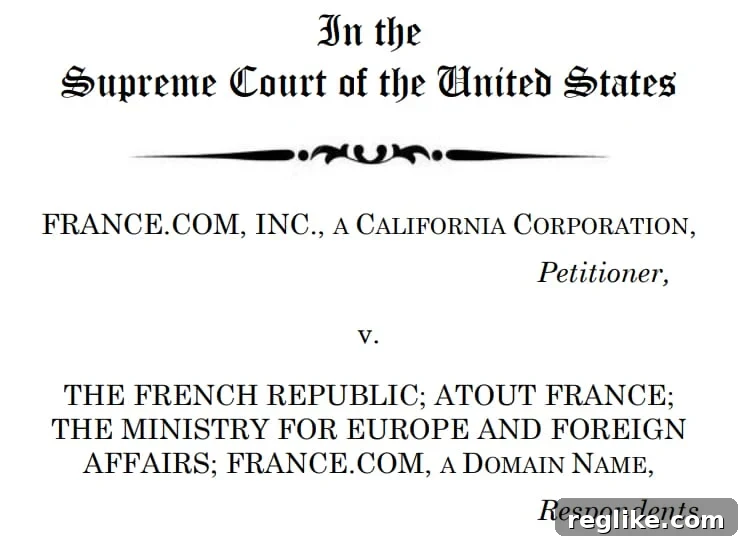
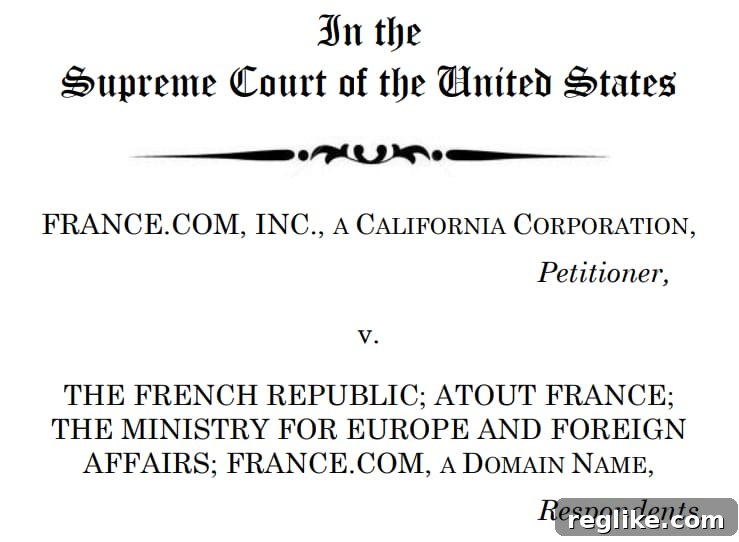
In a move that marks the definitive end of a protracted and high-stakes legal battle, the Supreme Court of the United States has formally declined to issue a writ of certiorari in the contentious dispute surrounding the France.com domain name. This decision represents a significant setback for Jean-Noël Frydman, the domain’s long-time former owner, who had petitioned the nation’s highest court as a last resort, having exhausted all other available judicial avenues within the U.S. legal system. The Supreme Court’s refusal to hear the case effectively upholds the prior rulings that sided with the French government, solidifying its ownership of the valuable digital asset and closing a chapter on one of the most remarkable international domain disputes of our time.
A Digital Frontier: The Genesis of France.com and Frydman’s Vision
The story of France.com begins in the early days of the commercial internet, a nascent era when visionaries like Jean-Noël Frydman recognized the immense potential of clear, descriptive domain names. In 1994, Frydman, demonstrating foresight that predated widespread internet adoption, successfully registered the domain name France.com. For many years, under Frydman’s stewardship, this domain served as a prominent online portal dedicated to promoting travel, culture, and business related to France. It grew into a recognized brand, a go-to resource for millions seeking information about the country, and a testament to the power of a well-chosen, generic top-level domain. Frydman’s enterprise meticulously built a platform that not only offered travel services but also fostered a comprehensive digital ecosystem, establishing a significant online presence that directly connected users worldwide with the allure of France. This early registration and subsequent development underscored the significant investment and effort made by Frydman in building the France.com brand, an investment that would later become the core of his legal contention.
The Unforeseen Conflict: A Trademark Dispute Escalates into a Sovereign Claim
The seeds of the current international incident were sown in 2014 when Frydman’s company, France.com, Inc., initiated legal proceedings in Paris. The lawsuit was initially filed against a Dutch company, alleging trademark infringement related to the France.com brand. However, what began as a seemingly straightforward intellectual property dispute quickly escalated into a full-blown international incident. The French Republic, represented by its Ministry for Europe and Foreign Affairs, and its official tourism agency, Atout France, strategically intervened in the ongoing matter. This intervention transformed the nature of the dispute entirely, shifting it from a commercial trademark disagreement between private entities to a fundamental question of national sovereignty and the exclusive right of a state to its own name. The French government’s involvement immediately raised the stakes, introducing complex layers of international law and sovereign rights into what had previously been a commercial battle over a domain name.
The Heart of the Matter: France’s Asserted Claim to National Sovereignty
Central to the French government’s compelling argument was the assertion that the French state, and not a private entity, held the exclusive and inalienable right to control and utilize its own name, “France,” particularly in a commercial context. Through successive court appearances in France, the government successfully convinced the judiciary that the nation’s very sovereignty was at stake. Their core contention was that under existing French law, the name “France” is an inherent part of the public domain and the national identity, rendering it impossible for any private enterprise, especially one based outside of France, to appropriate or exploit it commercially. To allow a private corporation to exclusively own and operate France.com, they argued, would constitute a direct violation of the French Republic’s exclusive right to its national name and an infringement upon its sovereignty. This bold legal strategy essentially positioned the domain name as a national symbol, akin to a flag or anthem, which must remain under state control to preserve national integrity and public interest.
The Domain Seizure: Practical Implications of a Foreign Court Order
The French courts’ decisions culminated in a pivotal moment in 2018. Following the Paris Court of Appeals’ definitive ruling in favor of the French government, a certified copy of this judgment was presented to Web.com, the U.S.-based domain registrar then managing France.com. Faced with a valid and legally binding order from a foreign sovereign court, Web.com was compelled to act. Despite the protests and legal challenges from Frydman, the registrar proceeded with the transfer, effectively reassigning the France.com domain name from Frydman’s company to the French government. This transfer was a profound moment, marking the physical manifestation of the French legal victory and immediately stripping Frydman of the digital asset he had nurtured for nearly a quarter-century. It underscored the complex challenges registrars face when caught between international legal systems and highlights the potential for foreign judicial decrees to impact digital property owned by U.S. entities.
Battling in American Courts: The Doctrine of Sovereign Immunity
Undeterred by the loss of his domain, Jean-Noël Frydman initiated a new legal offensive in U.S. federal courts in 2018, seeking to reclaim France.com. However, his efforts were met with a formidable legal doctrine: sovereign immunity. The French government successfully argued before the Court of Appeals for the Fourth Circuit that it was protected from Frydman’s lawsuit under the Foreign Sovereign Immunities Act (FSIA). The FSIA is a complex U.S. federal statute that generally shields foreign states from jurisdiction in U.S. courts, with only specific, narrowly defined exceptions. The Fourth Circuit agreed with the French government’s interpretation, ruling that its actions related to France.com fell under the umbrella of sovereign acts, thereby granting it immunity from Frydman’s claims. This ruling was a critical blow to Frydman’s case in the U.S., as it effectively prevented him from litigating the core ownership dispute in American courts. Following this decision, Frydman petitioned the appeals court for an en banc rehearing – a rare procedure where all judges of the court hear the case – but this request was also denied, signaling the diminishing avenues for his legal redress within the U.S. appellate system.
The Supreme Court’s Decisive Non-Action: A Writ of Certiorari Denied
With all other domestic legal options exhausted, Frydman turned to the highest judicial authority in the United States, filing a petition for a writ of certiorari with the Supreme Court. A writ of certiorari is a request for the Supreme Court to review a case decided by a lower court. The Court grants certiorari sparingly, typically only for cases that present significant legal questions, resolve conflicting rulings among lower courts, or involve matters of national importance. In its order list released today, the Supreme Court unequivocally rejected Frydman’s petition. This denial is not a judgment on the merits of the case itself but rather a decision not to hear it, effectively upholding the Fourth Circuit’s ruling that the French government enjoys sovereign immunity under the FSIA. The “rule of four,” which requires at least four of the nine justices to agree to hear a case, was evidently not met. For Frydman, this marks the absolute legal terminus of his fight for France.com within the American judicial system, sealing the fate of the domain in the hands of the French Republic. The Court’s decision underscores the broad scope of sovereign immunity and its powerful implications for private citizens seeking redress against foreign governments in U.S. courts, particularly in complex international digital property disputes.
Broader Implications and Lasting Legacy of the France.com Case
The protracted legal saga of France.com stands as a landmark case with far-reaching implications for international domain ownership, intellectual property rights, and the delicate balance of national sovereignty in the digital age. This dispute highlights the potential for fundamental clashes between national laws and international norms, particularly concerning valuable generic domain names that are inherently linked to a nation’s identity. For domain registrants and owners globally, the France.com case serves as a stark reminder that ownership of a seemingly “generic” country-name domain is not absolute, especially when a sovereign nation asserts a claim based on national identity and public interest. It compels a re-evaluation of the risks associated with investing in such domains and the potential for a foreign government to reclaim what it perceives as its sovereign digital territory. The ruling emphasizes the powerful shield of sovereign immunity, demonstrating how effectively it can be wielded by foreign states to protect their interests from litigation in U.S. courts. This case is likely to be cited in future international domain disputes, shaping how digital assets intertwined with national identities are viewed and contested on the global stage, urging greater clarity in international digital property law and potentially prompting new considerations for domain registrars and policymakers worldwide.