
Understanding Cybersquatting Trends: Insights from WIPO’s Latest Data
In the dynamic landscape of the internet, safeguarding intellectual property is a continuous challenge for businesses and individuals alike. One of the persistent threats is cybersquatting – the malicious registration of domain names that are identical or confusingly similar to existing trademarks. This practice not only dilutes brand equity but can also lead to consumer confusion, phishing attempts, and significant financial losses. Addressing this global issue, the World Intellectual Property Organization (WIPO) plays a pivotal role through its Uniform Domain-Name Dispute-Resolution Policy (UDRP).
Recent data from WIPO indicates a slight but notable increase in cybersquatting cases filed in the first three quarters of 2019, reflecting the ongoing vigilance required in online brand protection. While these numbers represent a small fraction of the vast ocean of registered domain names, they underscore the enduring importance of robust dispute resolution mechanisms and proactive strategies for intellectual property holders.
WIPO’s Integral Role in Resolving Domain Name Disputes
WIPO stands as the leading institution for resolving domain name disputes under the UDRP, a policy implemented by ICANN (Internet Corporation for Assigned Names and Numbers) to provide a streamlined, administrative procedure for resolving conflicts arising from abusive domain name registrations. Unlike traditional litigation, UDRP offers a more efficient and cost-effective pathway for trademark owners to reclaim domain names that have been registered in bad faith.
The UDRP applies to generic top-level domains (gTLDs) such as .com, .net, .org, and many of the new gTLDs introduced in recent years, as well as a growing number of country code top-level domains (ccTLDs). WIPO’s expertise and global reach make it the preferred forum for brand owners worldwide, handling the majority of UDRP complaints. Its decisions are non-binding in a legal sense but are generally enforced by domain name registrars, making it a powerful tool for brand protection.
Analyzing the Latest Cybersquatting Caseload: A Closer Look at 2019 Trends
The latest statistics released by WIPO reveal an upward trajectory in cybersquatting disputes during the initial nine months of 2019. A total of 2,723 cases were filed with WIPO through the third quarter of 2019, marking an increase from the 2,592 cases recorded during the same period in the preceding year. This incremental rise, though modest, signals a continued or even heightened level of activity in the domain name dispute arena.
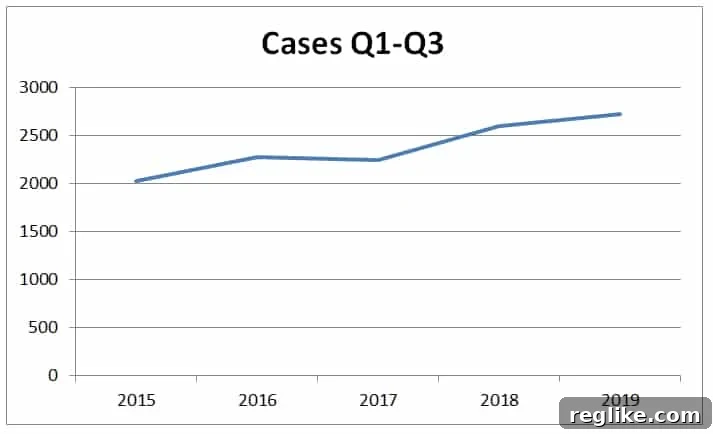
The Upward Trend in 2019
The increase of 131 cases year-over-year for the first three quarters suggests that trademark holders are actively monitoring and enforcing their rights in the digital space. This could be attributed to several factors: enhanced brand protection strategies, increased awareness among businesses about UDRP mechanisms, or perhaps a rise in sophisticated cybersquatting tactics necessitating formal dispute resolution. Regardless of the underlying cause, the data underscores the persistent threat posed by domain name abuse.
Historical Context and Fluctuations
A review of WIPO’s caseload over the past five years (Q1-Q3 data) offers valuable historical context. As illustrated in the chart above, the number of filed cases has generally been on an upward trend, with one notable exception. Between 2016 and 2017, there was a slight dip in the number of cases. Such fluctuations can be influenced by various factors, including global economic conditions, the introduction of new gTLDs creating new avenues for both legitimate registration and abuse, changes in legal precedents, or even shifts in how proactively brands engage in online enforcement.
However, the overall trajectory points towards a sustained, if not growing, volume of domain name disputes. This long-term trend highlights the enduring need for efficient and accessible mechanisms like the UDRP to protect intellectual property in an ever-expanding digital ecosystem.
The Broader Landscape: A Small Subset of Registered Domains, Yet Critical
It is crucial to put these numbers into perspective. While thousands of cases are filed annually, the total number of domains at issue remains a very small subset when compared to the hundreds of millions of domains registered globally. For instance, as of the latest update available for 2019, approximately 3,430 .com domains had been the subject of a UDRP complaint during the year. Considering that there are over 144 million registered .com domains, this means that roughly only one in every 42,000 .com domains faced a UDRP dispute in that period.
Why the Numbers Matter (Despite Being Small)
While the fractional percentage might suggest a minimal problem, this perspective can be misleading. Each cybersquatting incident represents a direct attack on a brand’s identity, reputation, and potentially its revenue. For the brand owner targeted, a single abusive domain name can cause significant damage. The “small subset” figure masks the concentrated impact on the businesses and individuals directly affected.
Furthermore, these statistics only account for cases that reach the formal dispute resolution stage. Many more instances of cybersquatting might go undetected, are resolved through direct negotiation, or are deemed not worth pursuing by the trademark holder. Therefore, the WIPO caseload, while significant, likely represents merely the tip of the iceberg concerning the full scope of online brand abuse.
Impact on Brands and Consumers
The ramifications of cybersquatting extend beyond just the legal costs of dispute resolution. Brands face risks such as:
- Reputational Damage: Abusive domain names can host malicious content, phishing scams, or competitive attacks that tarnish a brand’s image.
- Loss of Revenue: Consumers misled by lookalike domains might be diverted to competitor sites or fall victim to scams, leading to direct financial losses.
- Consumer Confusion: Similar domain names confuse customers, eroding trust and loyalty.
- Security Risks: Cybersquatters often use these domains for phishing attacks, installing malware, or disseminating misinformation, posing significant security threats to users.
- SEO and Traffic Diversion: Legitimate website traffic can be siphoned away, impacting search engine rankings and online visibility.
The Mechanics of UDRP: How Disputes Are Resolved
Understanding the UDRP process is key to appreciating its effectiveness. When a trademark owner believes a domain name has been registered in bad faith, they file a complaint with an approved dispute resolution provider like WIPO. The complainant must satisfy three core elements:
- The domain name is identical or confusingly similar to a trademark in which the complainant has rights.
- The registrant of the domain name has no rights or legitimate interests in respect of the domain name.
- The domain name has been registered and is being used in bad faith.
Once a complaint is filed, the domain name registrant (respondent) is given an opportunity to respond. A neutral panel of one or three independent experts is then appointed to review the submissions from both parties. The panel’s decision is usually issued within 14 days of its appointment. If the complaint is successful, the domain name is typically transferred to the complainant or cancelled. This administrative process offers a swift and specialized resolution, avoiding the complexities and costs often associated with court litigation.
Strategies for Proactive Brand Protection
Given the persistent nature of cybersquatting, businesses cannot afford to be reactive; proactive measures are essential. Effective brand protection strategies include:
- Comprehensive Trademark Registration: Securing trademark rights globally is the foundational step.
- Defensive Domain Name Registrations: Registering key variations of a brand name, common misspellings (typosquatting), and across different top-level domains (gTLDs and relevant ccTLDs) can prevent abuse.
- Continuous Monitoring: Utilizing domain name monitoring services to identify new registrations that are identical or similar to existing trademarks. This early detection is crucial for timely intervention.
- Engagement with Legal Experts: Consulting with intellectual property lawyers specializing in domain name disputes for strategic advice and UDRP filings.
- Educating Internal Teams: Ensuring marketing, legal, and IT departments are aware of cybersquatting risks and reporting protocols.
- Leveraging New Domain Management Tools: Exploring brand protection tools offered by registries and registrars, especially with the proliferation of new gTLDs.
Future Outlook and Continued Vigilance
The digital landscape is constantly evolving, presenting new challenges and opportunities for both legitimate brand owners and malicious actors. The continued growth of the internet, the emergence of new technologies like artificial intelligence (AI) that can be leveraged for both protection and abuse, and the expansion of the domain name system with new TLDs mean that cybersquatting will remain a dynamic threat.
WIPO’s data for 2019, showing a slight increase in cases, serves as a reminder that vigilance cannot waver. The role of organizations like WIPO, providing accessible and effective dispute resolution mechanisms, will only grow in importance. For brand owners, integrating robust online brand protection into their overall business strategy is not just an option but a necessity to thrive in the digital age.
Conclusion
The slight uptick in cybersquatting cases reported by WIPO for the first three quarters of 2019, totaling 2,723 disputes, reinforces the ongoing battle against online trademark infringement. While the number of disputed domains remains a small percentage of overall registrations, the individual impact on affected brands is substantial. WIPO’s UDRP system continues to be an indispensable tool for intellectual property owners to defend their digital assets effectively.
As the internet continues its rapid expansion, the need for proactive monitoring, defensive registrations, and timely dispute resolution will only intensify. Businesses and individuals must remain vigilant, leveraging the resources and mechanisms available to protect their brands and consumers from the persistent threat of cybersquatting, ensuring a safer and more trustworthy online environment.