
Ron Paul vs. RonPaul.com: Unpacking a High-Stakes Domain Dispute
The digital landscape often serves as the primary battleground for political narratives and personal brands. Few cases illustrate this better than the recent contention surrounding the domain RonPaul.com. This high-profile dispute, which saw former presidential candidate Ron Paul file a Uniform Domain-Name Dispute-Resolution Policy (UDRP) complaint against the site’s operators, quickly captured the attention of both the tech media and political observers alike. What initially appeared to be a straightforward attempt by a public figure to reclaim his online namesake soon revealed layers of complexity, raising profound questions about motives, ethics, and the evolving nature of online activism.
At its core, the conflict presented a clash between a well-known political figure seeking control over his digital identity and a group of long-standing supporters—or so they seemed—who had cultivated a significant online presence under his name. The prevailing narrative was, for a time, largely shaped by the perception of RonPaul.com as a selfless fan endeavor, operated by dedicated adherents to Paul’s libertarian principles for over four years. However, a deeper look into the details unearthed by the UDRP process suggests that both parties involved in this high-stakes disagreement have significant questions to answer and explanations to provide, challenging the simplistic portrayal initially embraced by many.
The Anatomy of a Domain Dispute: Understanding the UDRP Process
To fully grasp the intricacies of the Ron Paul vs. RonPaul.com saga, it’s essential to understand the legal mechanism at play: the Uniform Domain-Name Dispute-Resolution Policy, or UDRP. This policy was established by the Internet Corporation for Assigned Names and Numbers (ICANN) to provide an administrative alternative to traditional litigation for resolving disputes over domain names. It’s specifically designed to protect trademark holders from instances of “cybersquatting,” where individuals register domain names that are identical or confusingly similar to existing trademarks, often with the explicit intent to profit from them, either by selling them to the trademark owner or by diverting traffic.
For a complainant like Ron Paul to succeed in a UDRP action and have a domain name transferred, they typically must prove three distinct elements, each crucial for a favorable ruling:
- Identical or Confusingly Similar: The domain name in question must be identical or confusingly similar to a trademark or service mark in which the complainant has rights. In this case, Ron Paul’s personal name, especially given his public profile, would likely qualify as having trademark significance.
- Lack of Rights or Legitimate Interests: The registrant (the current domain owner) must be shown to have no rights or legitimate interests in respect of the domain name. This means they registered the domain primarily to exploit the complainant’s reputation without a genuine right to do so.
- Registration and Use in Bad Faith: The domain name must have been registered and must be being used in “bad faith.” This is often the most contentious and challenging element to prove, as it involves demonstrating the registrant’s intent. Examples of bad faith include registering a domain primarily for the purpose of selling it to the trademark owner for an amount exceeding documented out-of-pocket costs, disrupting a competitor’s business, or creating a likelihood of confusion among internet users to attract traffic for commercial gain.
The UDRP process is intended to be a relatively swift and cost-effective remedy compared to traditional court proceedings. However, as the RonPaul.com case demonstrates, it can often expose deeply entrenched commercial interests, hidden motivations, and create significant public relations challenges for all parties involved, often revealing more than initially meets the eye about domain ownership and online operations.
Ron Paul’s Stance: A Controversial Complaint with Ironic Undertones
When the news first broke that Ron Paul had initiated a UDRP against RonPaul.com, the immediate reaction from much of the tech media and segments of his own supporter base was one of surprise, and in some cases, outright criticism. The prevailing sentiment was that Paul was unfairly targeting his own devoted followers—individuals who had seemingly invested years of effort and resources into promoting his cause online. Indeed, the general press narrative tended to side with the operators of the website, highlighting what they perceived as the less favorable aspects of Paul’s complaint, suggesting a heavy-handed approach against what many believed to be a genuine grassroots effort.
One particular point of contention, widely reported and adding a layer of potent irony to the proceedings, stemmed from Ron Paul’s well-known and long-standing skepticism towards international bodies. Paul, a staunch advocate for national sovereignty and a vocal critic of organizations like the United Nations, found himself utilizing a dispute resolution process that is frequently administered by entities such as the World Intellectual Property Organization (WIPO), which operates under the aegis of the UN. This perceived hypocrisy became a significant talking point, with critics quick to highlight the apparent contradiction in his actions, questioning whether principles could be set aside when personal branding and digital control were at stake. For a politician who built a career on unwavering adherence to principle, this move was seen by some as a pragmatic, if not paradoxical, concession.
Beyond the irony, questions arose about Paul’s timing and underlying motives. Why pursue a UDRP after more than four years of the site’s consistent operation? Was it genuinely about preventing consumer confusion and protecting his brand, or did it stem from a belated desire to gain control over a valuable online asset and a substantial mailing list that had been independently cultivated over the years? While the specific legal arguments detailed in Paul’s official complaint were not entirely public in the initial reports, the media’s focus on the perceived “stink” of his filing suggested broader concerns about the fairness and optics of his claim against a site that, on the surface, appeared to be a genuine fan endeavor. The situation underscored the delicate balance public figures must strike between diligently protecting their intellectual property and potentially alienating their most ardent and long-term supporters.
The RonPaul.com Operators: Benevolent Fanatics or Calculated Entrepreneurs?
For years, the operators of RonPaul.com had cultivated and enjoyed a reputation as selfless champions of the liberty movement, diligently running a popular website dedicated to Ron Paul’s ideals and fostering a community around them. However, the initiation of the UDRP process, with its inherent requirement for transparency and disclosure, began to peel back this seemingly altruistic façade, revealing potential commercial motivations that significantly complicated the initial narrative.
The Explicit Sales Pitch: Money, Influence, or Both?
One of the most damning pieces of evidence to emerge, undermining the operators’ purely altruistic claims, was a letter they themselves published on RonPaul.com. This letter explicitly detailed an offer to sell the domain to Ron Paul. Strikingly titled, “This may be one of the most important messages you read this year,” the communication bore all the hallmarks of a sophisticated direct sales pitch. It began by offering the RonPaul.ORG domain for free—a gesture that, while seemingly generous, would inevitably boost traffic and legitimacy to the more valuable .com domain, which was clearly the primary target for sale.
The true “kicker” came with the explicit offer: RonPaul.com, along with its extensive and highly engaged mailing list, for a quarter of a million dollars ($250,000). The operators didn’t mince words, boldly suggesting that with the power of their mailing list, Paul could “easily make back the purchase price in a matter of days” by soliciting donations from the dedicated base they had built. While they later attempted to justify this offer by arguing it wasn’t about selling “his name” but rather a valuable mailing list—which they were actively getting appraised—their own published letter unequivocally stated the inclusion of the prestigious .com domain in the proposed transaction. This attempt at semantic gymnastics did little to dispel the growing perception of a calculated commercial transaction rather than a benevolent hand-over of a community asset.
Further complicating their defense were allegations from Ron Paul’s legal team, who presented evidence of an even earlier, more substantial offer from someone associated with the site, proposing a sale for upwards of $800,000. Moreover, a quick check of the public WHOIS record for RonPaul.com explicitly indicated that the domain was, in fact, “for sale.” These cumulative pieces of evidence painted a picture far removed from that of a purely selfless fan site, strongly suggesting that the domain was viewed, at least in part, as a highly valuable, tradable asset with significant financial potential.
Even if the operators were genuinely committed Ron Paul fanatics, the operation of the site also involved selling a significant amount of merchandise, from books to apparel. While this could be rationalized as a means to cover operational costs or to fund the liberty movement, the scale and pricing of the domain and mailing list offers suggested a more substantial commercial enterprise. The central question then became: were they true believers who also happened to run a profitable side business, or was the political advocacy a convenient and effective front for a lucrative domain operation?
The Panama Puzzle: Who’s Really Behind RonPaul.com?
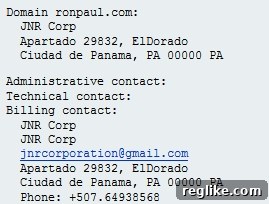
Perhaps one of the most intriguing and concerning revelations to emerge from the UDRP filing process was the unveiling of the true WHOIS information for RonPaul.com. Many domain owners, especially those running politically sensitive or high-profile websites, utilize WHOIS privacy services to shield their personal information from public view. However, a UDRP complaint can often compel these services to reveal the underlying registrant details to the arbitration panel. In this instance, the disclosure was particularly illuminating.
While one might logically expect Ron Paul’s most ardent supporters to reside in locations synonymous with American libertarianism – perhaps the heartland or the conservative South – the WHOIS record pointed to a rather unexpected locale: Panama. This revelation immediately raised red flags for many observers. The use of offshore entities, particularly in jurisdictions known for their financial privacy and sometimes less stringent regulatory oversight, often suggests a desire for anonymity, potential tax advantages, or a means to obscure ownership for various strategic reasons. For a website purportedly run by American political activists deeply engaged in domestic political discourse, the Panama connection felt incongruous and fueled significant suspicion about the true identities, ultimate beneficiaries, and long-term intentions of the operators.
While it’s theoretically possible that the domain was legitimately leased to individuals running the site, or that the Panama entity was simply a legitimate business structure for managing various online assets, the inherent lack of transparency inevitably invited scrutiny. Such arrangements, while not inherently illegal, raise ethical questions, especially in the context of political advocacy where transparency is often championed as a core value. The offshore location certainly cast a different, more complex light on the simple “selfless supporter” narrative.
The Sudden Silence: Evasive Maneuvers or Prudent Legal Advice?
In an attempt to clarify these mounting and increasingly pressing questions, journalists reached out directly to the RonPaul.com operators. Initially, there was a cooperative response, with promises of prompt and direct answers to all inquiries. However, this willingness to engage quickly evaporated when specific, “hard” questions were posed—particularly concerning the complex leasing arrangements, the mysterious Panama connection, and the specific details surrounding the $800,000 sale offer. The operators promptly invoked legal counsel, stating that their lawyer advised them to remain silent and that an amicable settlement of the UDRP case might be near.
This abrupt and dramatic shift from open communication to legal stonewalling served to deepen suspicions significantly. In a public dispute of this nature, transparency often works in favor of those with nothing to hide, fostering trust and clarifying misunderstandings. The sudden silence, particularly after initial openness, strongly suggested that these lines of questioning touched upon sensitive areas the operators were either unwilling or unable to address publicly. It inadvertently reinforced the impression that the “fan site” façade was perhaps a carefully constructed narrative designed to mask more complex, and potentially less savory, commercial underpinnings that would not withstand public scrutiny.
Broader Implications: Online Identity, Activism, and Commerce in the Digital Age
The Ron Paul vs. RonPaul.com dispute serves as a compelling and multi-layered case study with far-reaching implications. For public figures, it underscores the critical importance of proactive domain management and robust brand protection strategies in the digital age. Waiting years to address potential conflicts can lead to entrenched interests, complicated legal battles, and the challenging task of distinguishing genuine, altruistic fan support from commercially motivated ventures that expertly leverage a public figure’s name and likeness for profit. Early registration and clear policies can mitigate such headaches.
For domain owners and online activists, the case vividly illustrates the fine and often blurry line between passionate advocacy and perceived cybersquatting. While well-intentioned fan sites can undeniably contribute immensely to a political movement or a public figure’s reach, attempts to overtly monetize a public figure’s name, especially through high-value domain sales, inevitably invite legal scrutiny and raise significant ethical questions. The exposure of the Panama connection further emphasizes the critical need for transparency, particularly for entities involved in political discourse, where trust, authenticity, and accountability are paramount to maintaining public credibility.
Ultimately, the RonPaul.com saga is a powerful testament to the complex interplay of intellectual property rights, internet governance policies, and the often-murky intersection of political activism and commercial enterprise in the online realm. While Ron Paul’s UDRP complaint had its own set of criticisms and ironic undertones, the subsequent revelations about the RonPaul.com operators undoubtedly cast a considerable shadow over their intentions, transforming a seemingly black-and-white narrative into a nuanced, and somewhat unsettling, examination of motives on both sides. The dispute serves as a cautionary tale, reminding us that in the digital world, behind every seemingly simple domain name, there can be a fascinating, intricate, and often financially driven story waiting to be told.