
In the rapidly evolving digital landscape, safeguarding personal and business information associated with website ownership has become paramount. Domain name registrars have long offered services to mask registrant details, but a critical distinction exists between different approaches. A significant development in this space emerged with domain name registrar Network Solutions filing a patent application for “Private Domain Name Registration” with the U.S. Patent and Trademark Office.
This move by Network Solutions aims to patent various aspects of a domain privacy service, highlighting an ongoing industry effort to define and protect intellectual property in how domain ownership information is handled publicly. This application is technically a continuation of a prior filing from 2004, which was later abandoned, underscoring a long-standing interest by the company in formalizing its unique approach. The new application, filed on May 25, 2012, and subsequently published (pdf), positions Network Solutions as a key player seeking to innovate and differentiate in the competitive domain registration market.
Understanding Domain Name Registration and WHOIS
To fully grasp the significance of Network Solutions’ patent application, it’s essential to understand the fundamentals of domain name registration and the WHOIS database. A domain name registrar is an organization accredited by ICANN (Internet Corporation for Assigned Names and Numbers) or a national ccTLD (country code Top-Level Domain) authority to manage the reservation of Internet domain names. When a user registers a domain name, they typically provide a set of contact details.
This contact information is then stored in the WHOIS database, a publicly accessible directory that lists the registrants of domain names. The WHOIS record typically includes the registrant’s name, postal address, email address, and phone number, as well as administrative and technical contact details, the registrar’s name, and the domain’s registration and expiration dates. The primary purpose of the WHOIS database is to maintain transparency and accountability, allowing anyone to identify the owner of a domain name for administrative or technical purposes, such as resolving technical issues, handling legal disputes, or addressing security concerns.
However, the public nature of the WHOIS database also presents significant downsides. Domain owners often find their personal information exposed to spammers, telemarketers, and even potential harassers. This unsolicited contact can range from annoying marketing calls to more serious privacy invasions, making domain privacy services an increasingly vital offering for individuals and businesses alike who wish to protect their digital identity and personal safety. The demand for solutions that shield personal data from public view without compromising legal ownership has driven innovation in the domain registration industry, setting the stage for developments like Network Solutions’ patent.
Network Solutions’ Patent Application: “Private Domain Name Registration”
The patent application filed by Network Solutions, titled “Private Domain Name Registration,” is not merely a defensive measure but an assertive step to claim intellectual property over a specific method of providing domain privacy. By seeking to patent “various aspects” of its service, Network Solutions aims to legally protect the unique mechanisms and processes involved in its privacy offering. The application draws a direct comparison to existing services, notably those offered by Go Daddy, and articulates how its approach distinguishes itself within the industry.
This strategic move underscores Network Solutions’ commitment to solidifying its position and potentially shaping future industry standards for domain privacy. The details within the patent application delve into the technical and operational differences, emphasizing specific functionalities that set its “privacy” model apart from more common “proxy” services. For instance, the application outlines how its system ensures the registrant maintains their legal ownership while their contact information is shielded, a nuance that carries significant implications for domain owners.
The Crucial Distinction: WHOIS Privacy vs. WHOIS Proxy
At the heart of Network Solutions’ patent application lies a fundamental distinction that domain owners must understand: the difference between a WHOIS proxy service and a WHOIS privacy service. While both aim to mask a registrant’s personal details from public WHOIS queries, their underlying legal and operational mechanisms are distinct, leading to significant differences in ownership rights and flexibility.
WHOIS Proxy Services (e.g., Go Daddy’s Domains By Proxy)
The vast majority of WHOIS masking services provided by domain registrars today operate as proxy services. A prime example is Go Daddy’s Domains By Proxy. In a proxy arrangement, the service provider (the proxy) actually becomes the legal registrant of the domain name. The original domain owner effectively assigns their registration rights to the proxy service, which then lists its own contact information in the public WHOIS database. While this method effectively hides the original owner’s details, it comes with a critical caveat: the original owner technically relinquishes direct legal ownership of the domain to the proxy service.
This transfer of legal ownership can introduce complexities, especially in scenarios involving legal disputes, domain transfers, or asset management. For instance, if a domain owner wishes to transfer their domain to another registrar, they typically must first remove the proxy service, effectively revealing their personal information in the WHOIS database before the transfer can proceed. This requirement can be inconvenient, time-consuming, and temporarily expose the owner’s data, defeating one of the primary purposes of domain privacy during a critical phase of domain management.
WHOIS Privacy Services (e.g., Network Solutions)
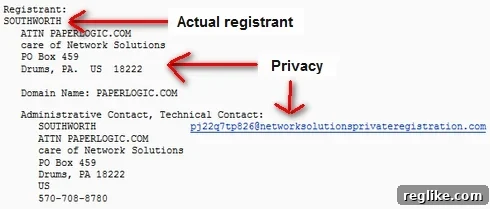
Network Solutions, through its patent application, champions a different model: WHOIS privacy. With a WHOIS privacy service, the original registrant remains the legal and named owner of the domain name. The service acts merely as a contact intermediary. The contact information listed in the public WHOIS database is that of the privacy service, while the domain owner retains full legal control and rights to their digital asset. This distinction is crucial because it ensures that the registrant’s identity is protected without transferring legal ownership or control of the domain.
Here’s an illustrative example of what a Network Solutions private registration might look like in the WHOIS database:
The key benefit of a privacy service over a proxy, as extensively explained in Network Solutions’ patent application, is the ability to transfer your domain to another registrar while seamlessly maintaining your privacy. This means domain owners can switch registrars without the hassle of first disabling their privacy service and exposing their details. This significantly streamlines domain management and enhances security during critical operational changes.
Implications and Benefits of Network Solutions’ Approach
Network Solutions’ emphasis on the “privacy” model over the “proxy” model presents several distinct advantages for domain owners, which are implicitly or explicitly covered in its patent claims. These benefits contribute to enhanced control, security, and flexibility in managing digital assets.
Enhanced Registrant Control and Legal Ownership
One of the most significant advantages is the preservation of full legal ownership and control by the registrant. In a privacy model, the domain owner’s name remains on the official registration records, even if a service’s contact details are publicly listed. This ensures that in legal disputes, intellectual property claims, or challenges to domain ownership, the registrant’s rights are unequivocally clear. This level of control simplifies compliance, legal processes, and overall asset management, providing peace of mind to individuals and businesses.
Streamlined Domain Transfers
The ability to transfer a domain to another registrar while maintaining privacy is a key differentiator and a major convenience for domain owners. Under the proxy model, temporary exposure of personal details during a transfer is often unavoidable. With the privacy model, this step is eliminated, making the transfer process quicker, more secure, and less prone to temporary privacy breaches. This feature is particularly valuable for users who frequently manage multiple domains or wish to consolidate their registrations with a preferred provider without privacy interruptions.
Robust Security and Reduced Unsolicited Contact
Both privacy and proxy services aim to reduce unsolicited contact, such as spam emails, telemarketing calls, and physical junk mail, by masking personal information. However, the privacy model, by allowing the registrant to retain direct legal ownership while using an intermediary for public contact, arguably offers a more robust and consistent shield. The patent application further details how Network Solutions’ service manages and forwards communications, adding another layer of practical utility to its privacy offering.
Ancillary Services and Future Innovations
Beyond simply masking contact details, other claims within Network Solutions’ patent application relate to sophisticated ancillary services. These include setting specific rules for scanning and forwarding postal mail and for forwarding email. This means the privacy service isn’t just a placeholder; it’s an active manager of communications directed at the masked WHOIS entry. Such features enhance the overall value proposition, ensuring that important physical or digital correspondence reaches the legitimate domain owner efficiently and securely, while still filtering out unwanted intrusions.
The Patent Landscape and Industry Context
The filing by Network Solutions takes place within a broader patent landscape where intellectual property rights around domain privacy are already established. Go Daddy, for instance, has secured patents related to WHOIS proxy services. Network Solutions’ application, by drawing a direct comparison and explaining how its service differs, indicates a strategic move to carve out its own protected space within this competitive environment.
The fact that the vast majority of WHOIS masking services currently provided by domain registrars are proxy services, rather than true privacy services, highlights the potential impact of Network Solutions’ patent. If granted, this patent could significantly influence how domain privacy services are developed and offered across the industry. It might compel other registrars to either adapt their offerings to avoid infringement, seek licensing agreements from Network Solutions, or innovate further to develop entirely new privacy solutions.
This legal and technical differentiation is vital for both registrars, who seek to protect their innovations and market share, and for domain owners, who stand to benefit from clearer distinctions and potentially superior privacy options. The ongoing evolution of domain privacy services, spurred by patent filings like this, signifies a maturing industry where the nuances of digital asset protection are becoming increasingly refined and legally defined.
Conclusion
Network Solutions’ patent application for “Private Domain Name Registration” marks a significant development in the domain privacy sector. By explicitly seeking to patent a service that allows the domain owner to retain legal registrant status while shielding their contact information, Network Solutions is drawing a clear line between its “privacy” model and the more prevalent “proxy” services offered by competitors like Go Daddy. This distinction, particularly the ability to transfer domains while maintaining privacy, offers a compelling advantage for domain owners seeking greater control and flexibility over their digital assets.
As the digital world continues to prioritize data protection and online security, the nuances of domain privacy services will become even more critical. Network Solutions’ pursuit of this patent underscores an industry-wide drive towards innovation in safeguarding registrant information and defining the future of digital asset ownership. Domain owners are encouraged to understand these differences to make informed decisions about protecting their personal and business information in the public WHOIS database, ensuring they choose a solution that best aligns with their needs for control, security, and seamless management.