
Enhancing Online Ads with Social Overlays: Google’s Vision and the Evolution of Social Advertising
The landscape of online advertising is in constant flux, driven by innovation and the ever-evolving dynamics of user interaction. A pivotal moment in this evolution was marked by Google’s strategic move to integrate social elements directly into online advertisements. This article delves into Google’s significant patent applications concerning “Social Overlays On Ads,” exploring their implications, the underlying technology, and how these concepts have shaped the broader domain of digital marketing.
In a clear demonstration of its intent to weave social interaction deeper into its advertising ecosystem, Google filed two critical patent applications. These applications, identified as 20120116871 and 20120116867, were submitted in November and subsequently published. Both patents share the evocative title, “Social Overlays On Ads,” signaling a profound shift towards more interactive and community-driven ad experiences. These filings were not just about incremental improvements; they represented a conceptual leap towards making advertisements less intrusive and more engaging by leveraging the power of social connections.
Understanding the Concept of Social Overlays on Ads
At its core, the “Social Overlays On Ads” concept describes a system where dynamic social information is superimposed directly onto an advertisement. Imagine an ad that doesn’t just display a product or service, but also shows you how many people within your immediate social network—perhaps your Google+ circles at the time—have expressed a positive sentiment towards that ad or the advertised content. This seemingly simple addition transforms a static advertisement into a living, breathing social entity, capable of influencing consumer behavior through trusted recommendations.
The patents outlined various mechanisms for this social integration. For instance, an ad could dynamically display a count of users from your specific Google+ circles who have ‘liked’ or expressed interest in the ad. This feature was designed to capitalize on the psychological principle of social proof, where individuals are more likely to engage with something if they see their peers or a significant number of others have already done so. Furthermore, the system envisioned seamless integration with Google’s erstwhile +1 system. If a user were to click the +1 button on an ad, this endorsement would then become visible to members of their Google+ circles, effectively turning a passive ad viewer into an active brand advocate.
Beyond simple endorsements, the patents also explored functionalities that would empower viewers to “republish” or share an ad directly to their social network, mirroring the ease with which users could share photos or posts on platforms like Facebook. This capability would turn every ad into a potential piece of viral content, amplifying its reach and impact far beyond its initial placement. The goal was to transform advertising from a one-way broadcast into a multi-directional conversation, fostering organic discovery and peer-to-peer recommendations.
Consider the illustrative example that accompanied the patent description:
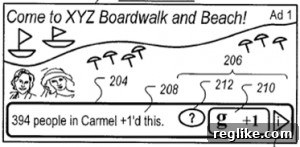
This image depicted an advertisement augmented with a social overlay, indicating how many people within the user’s geographical location had given the ad a +1. Such localized social proof could be particularly potent for businesses targeting specific demographics or regions, creating a sense of community and shared interest around a product or service.
The Benefits of Socially Enhanced Advertisements
The introduction of social overlays promised a multitude of benefits for both consumers and advertisers, aiming to bridge the gap between traditional advertising and the burgeoning social web.
For Consumers: Enhanced Relevance and Trust
- Increased Relevance: Social overlays promised to make ads more relevant by showing endorsements from known connections or a broader community. This relevance helps users filter out noise and discover products or services that genuinely align with their interests and trusted circles.
- Building Trust: Recommendations from friends, family, or even a large number of local peers inherently carry more weight than generic ad copy. Social proof builds trust and reduces the skepticism often associated with advertisements.
- Improved Discovery: Users could discover new products or services not just through algorithms, but through the genuine interests and actions of their social network, fostering a more organic discovery process.
- Personalized Experience: By leveraging individual social graph data, ads could be tailored to feel more personal and less like mass-market bombardment.
For Advertisers: Amplified Reach and Engagement
- Higher Engagement Rates: Ads with social overlays are inherently more interactive and engaging. The presence of social proof encourages users to pause, consider, and act, potentially leading to higher click-through rates (CTR) and conversion rates.
- Expanded Reach through Advocacy: When users +1 or share an ad, they become unpaid brand advocates. This word-of-mouth marketing is invaluable, extending the ad’s reach beyond its paid impressions and into trusted social networks.
- Improved Brand Perception: A brand associated with positive social interactions and endorsements gains credibility and a more favorable public image.
- Deeper Consumer Insights: Tracking social interactions with ads could provide advertisers with richer data on consumer preferences, social influence, and network dynamics, informing future marketing strategies.
- Optimized Return on Investment (ROI): By generating more qualified leads and leveraging organic amplification, social ads could deliver a significantly higher ROI compared to traditional, less interactive ad formats.
The Google+ Context: A Vision for Social Integration
At the time of these patent filings, Google+ was a central pillar of Google’s social strategy. The integration of “Social Overlays On Ads” with the Google+ +1 system and its concept of “circles” was therefore highly strategic. Circles allowed users to segment their social connections into distinct groups (e.g., family, friends, colleagues), and the patents envisioned that social overlays could respect these divisions, showing endorsements from specific circles. This granular control over social visibility aimed to provide users with a more private and personalized social ad experience, fostering trust in an era increasingly concerned with data privacy.
While Google+ itself did not achieve the widespread adoption hoped for and was eventually sunset, the underlying philosophy behind these patents—to infuse advertising with genuine social signals and peer recommendations—has remained incredibly influential. It showcased Google’s ambition to create a more integrated, socially-aware web experience, where advertising felt less like interruption and more like a helpful recommendation from a friend.
A Familiar Tune: Echoes of Facebook’s Social Advertising
Upon reviewing Google’s patent applications, many in the industry, including this author, likely experienced a sense of déjà vu. The concept of leveraging social connections to enhance advertisements was already a cornerstone of another social media giant’s success:

Facebook had, for years, pioneered and perfected the art of social advertising. Its platform seamlessly integrated actions like “Likes,” “Shares,” and comments into its ad delivery system. When a user liked a brand page or interacted with an ad, their friends could see that activity, essentially turning every user interaction into a mini-endorsement. This fundamental difference—where Facebook built its ad system around an already thriving social graph—gave it a significant advantage. Google’s patents, while innovative in their technical approach, appeared to be playing catch-up in a space Facebook had already largely defined.
The “familiarity” stemmed from Facebook’s highly effective use of social proof. Advertisements on Facebook frequently showed which of your friends had liked a particular page or product, making the ad instantly more trustworthy and relevant. This early adoption of social signals cemented Facebook’s position as a dominant force in social advertising, influencing how brands approached digital marketing for years to come. Google’s patents, therefore, can be seen as an acknowledgment of the power of this model and an attempt to integrate similar functionalities within its vast advertising network.
The Enduring Legacy and Evolution of Social Advertising
While the specific technologies and platforms mentioned in Google’s 2012 patents might have evolved, the core principles they championed have become foundational to modern digital marketing. Social advertising has continued its trajectory of growth and innovation:
- User-Generated Content (UGC): The rise of platforms like Instagram and TikTok has further amplified the power of UGC, where everyday users create content that implicitly or explicitly promotes products, often organically integrating into ad campaigns.
- Influencer Marketing: This entire industry is built on the concept of leveraging social trust and recommendations, mirroring the vision of social overlays but on a grander, celebrity-driven scale.
- Social Commerce: The lines between social media and e-commerce have blurred, with in-app shopping, live stream selling, and personalized product recommendations based on social activity becoming commonplace.
- Community Building: Brands increasingly focus on building strong online communities, knowing that engaged members are their most powerful advocates, echoing the idea of social circles influencing ad perception.
The patents from Google, “Social Overlays On Ads,” serve as a testament to the foresight of integrating social dynamics into advertising. They highlighted the critical shift from merely displaying ads to fostering genuine engagement and leveraging the profound influence of social connections. This vision has undeniably shaped the strategies of countless businesses and continues to drive innovation in the ever-expanding realm of online advertising.
The journey from a static banner ad to a dynamically personalized, socially endorsed advertisement underscores a fundamental truth: people trust people. As technology advances, the emphasis on authenticity, community, and peer influence in advertising will only grow stronger, ensuring that the spirit of these early social ad patents continues to guide the future of digital marketing.
You can review the original Google Ads patent application here.