
The End of an Era: Google AdSense for Domains and the Search for New Monetization Strategies
The landscape of domain monetization is undergoing a seismic shift, marking the close of a significant chapter for many online businesses. For well over a decade, Google AdSense for Domains stood as a foundational pillar for generating passive revenue from parked domains. However, recent, decisive actions by Google have effectively decommissioned this service, sending profound ripple effects across the entire domain industry. This pivotal change is compelling domain owners, registrars, hosting companies, and internet service providers (ISPs) to urgently explore and adopt alternative revenue streams, signifying the definitive end of AdSense for Domains’ dominance in online monetization.
AdSense for Domains: From Ubiquitous Presence to Ultimate Demise
The effective shutdown of Google AdSense for Domains wasn’t a singular, abrupt event, but rather a calculated series of maneuvers by Google to systematically remove advertisers from displaying their ads on parked domains. Initially, many industry observers noted a gradual decline in performance, but in recent weeks, the impact has accelerated dramatically. According to invaluable insights from major domain parking companies, the revenue performance derived from parked pages has plummeted rapidly, experiencing a far more intense deterioration than in any previous period. It appears Google has been systematically removing even the most lucrative advertisers from displaying ads on these pages in the final, most impactful phases of this transition.
While Google technically maintains an option for advertisers to opt back into showing ads on parked domains, the practical reality renders this choice virtually non-existent. The process for re-enabling these ads is obscure, complex, and fraught with difficulties, effectively acting as an insurmountable deterrent for the vast majority of advertisers. During recent attempts to configure a Google Ads campaign that would ostensibly include parked pages, the indication that parking is opted out by default is remarkably subtle. It is typically buried deep within advanced settings, nested under an option that the overwhelming majority of advertisers would likely never even encounter, let alone actively seek out.
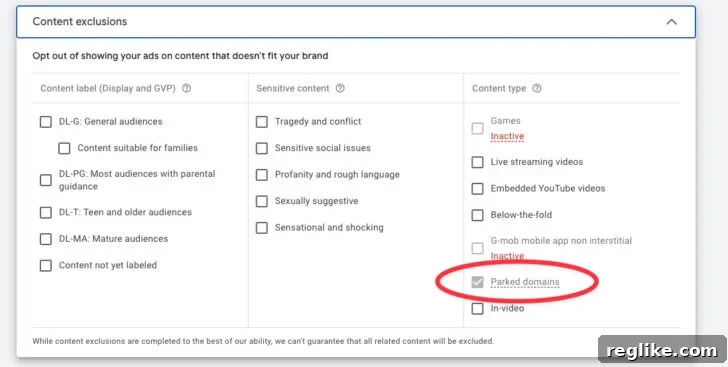
The user experience for any advertiser attempting to opt back in is particularly frustrating and serves as a strong indicator of Google’s intent. It is not as straightforward as simply unchecking a box during the routine campaign setup. A tooltip, made visible only when a user precisely hovers their mouse over the “Parked domains” option, reveals that opting into parked domains must be executed at the account level. Critically, this tooltip also provides a link, ostensibly designed to guide users through this complex account-level change. However, clicking this link currently leads to a dreaded 404 error page, rendering the suggested path to re-engagement entirely inaccessible. This technical dead-end strongly underscores the message: Google is not facilitating the inclusion of parked domains in its ad campaigns. Consequently, it is highly improbable that many advertisers will ever bother, or even succeed, in navigating this labyrinthine process to opt back in. For all practical purposes, the once-mighty AdSense for Domains is unequivocally dead, leaving a significant void in the domain monetization ecosystem.
The Multifaceted Impact on Diverse Domain Monetization Models
The cessation of AdSense for Domains reverberates across various segments of the domain monetization ecosystem, affecting different types of monetizers in distinct and often challenging ways. The once-reliable, passive income stream has effectively dried up, forcing a profound strategic re-evaluation for all players involved, from individual domain investors to large corporations.
Arbitrageurs Seek Refuge in Related Search for Content (RSOC)
One group particularly hard hit by this monumental change comprises arbitrageurs – those sophisticated operators who acquire traffic at a low cost, often through advertising, and aim to monetize it at a higher rate, historically through parked domains displaying AdSense ads. With AdSense for Domains now out of the picture, many arbitrageurs are aggressively migrating towards Related Search for Content (RSOC). RSOC offers a mechanism to display search results or related content instead of direct ads, still providing monetization opportunities based on user clicks on those search results. However, this transition is fraught with significant hurdles. Some prominent companies have openly struggled with the abrupt shift, facing considerable revenue adjustments and operational complexities as they realign their strategies. Conversely, others appear to be adapting more successfully, managing to maintain a relatively stable performance through optimization and quick pivots. Yet, the road ahead for RSOC may also be bumpy. There are strong indications that Google continues to refine and adjust its rules and algorithms for RSOC, with recent changes potentially introducing more complexities and financial pain for arbitrage-based strategies. This continuous evolution means that even the perceived “safe haven” of RSOC could still present future uncertainties for those relying on it heavily, demanding constant vigilance and adaptation.
The Growing Relevance of Zero-Click Monetization
Beyond the realm of RSOC, another burgeoning strategy gaining significant traction in the post-AdSense for Domains era is zero-click monetization. This innovative approach focuses on generating revenue without explicitly requiring a user to click on an ad or a link. Instead, value is extracted directly from the user’s implicit intent, their direct navigation, or through advanced data analytics. For instance, a user typing a domain name directly into their browser that leads to an advertiser’s site, without any intermediate ad interaction, can be considered zero-click monetization. While RSOC still involves a user interaction (clicking on a related search result), zero-click monetization bypasses this step entirely, offering a potentially more efficient, albeit technically sophisticated, revenue model for certain types of high-intent traffic. This method can be particularly appealing for domain owners looking to simplify the monetization funnel, capture value directly from user engagement, or leverage the inherent brand or keyword authority of their domains, making it a viable and increasingly popular alternative for specialized monetizers.
Registrars, Hosting Companies, and ISPs: Navigating Uncharted Waters
While RSOC and zero-click monetization might offer partial solutions for some individual domain owners and arbitrageurs, a profoundly significant segment of the industry finds itself in an acutely precarious position: domain registrars, hosting companies, and Internet Service Providers (ISPs). These colossal entities have historically monetized their vast, aggregated portfolios of parked pages, default landing pages for newly registered domains, and incidental error traffic (such as 404 pages) with ads predominantly served through platforms like AdSense for Domains. Their established business models often relied heavily on the aggregated, passive revenue generated from millions of such pages, effectively transforming what would otherwise be inert digital real estate into a substantial and predictable profit center.
The core challenge for these large-scale providers is that neither RSOC nor zero-click monetization readily integrates into their existing infrastructure or business models for managing default parked pages and error traffic at scale. Attempting to implement complex RSOC setups on every newly registered domain or generic error page is logistically impractical, if not entirely impossible, given the sheer volume. Similarly, implementing sophisticated zero-click strategies across millions of diverse, low-engagement parked domains presents immense technical, operational, and financial hurdles. These companies cannot simply “pivot” their default domain displays or error pages to these more nuanced and resource-intensive monetization methods with ease, particularly without substantial re-engineering and investment.
It’s crucial to acknowledge that the practice of monetizing parked domains and error traffic has historically been a contentious one, frequently drawing complaints from end-users and even legal threats concerning perceived misdirection, unwanted advertising, or privacy concerns. Despite this ongoing friction and the associated reputational risks, these large entities consistently persisted because the financial returns were undeniably substantial. The “good money” generated from these passive, high-volume revenue streams was significant enough to justify enduring the occasional user backlash, navigating regulatory scrutiny, and managing legal challenges. This historical context vividly illustrates just how vital AdSense for Domains was to their operational budgets, profitability, and indeed, their very business model. Now, without this core, highly scalable revenue source, these giants of the internet infrastructure face a critical and immediate gap in their financial models, compelling them to seek entirely new, equally scalable, and fully compliant solutions.
Exploring New Horizons: Alternatives Beyond Google’s Ecosystem
The abrupt and permanent departure of Google AdSense for Domains necessitates a proactive and urgent search for robust, reliable, and diversified monetization alternatives. For many companies, especially registrars, hosting providers, and ISPs, this strategic pivot will mean looking beyond Google’s ecosystem entirely and exploring independent Pay-Per-Click (PPC) providers and other innovative monetization platforms that cater specifically to domain traffic.
The Resurgence of Non-Google PPC Providers
Those who are relatively new to the intricate dynamics of the domain industry might not be fully aware of its rich history, but before Google established its near-monopoly on parked domain monetization, a vibrant duopoly once existed. Yahoo was a formidable and highly influential player in this space, offering a significant alternative for monetizing parked traffic. While Yahoo’s direct involvement in this specific niche has diminished significantly over time, the underlying concept of independent PPC networks designed specifically for domain parking remains incredibly relevant. Companies like Skenzo are prime examples of enduring players that still leverage alternative ad feeds, including those originating from Yahoo or other major advertising networks, offering a lifeline in this new landscape. These non-Google PPC providers are now expected to experience a substantial resurgence in interest as domain monetizers desperately seek viable replacements for their lost AdSense revenue. These specialized platforms often possess expertise in handling direct navigation traffic and offer specific ad formats tailored precisely for parked pages, providing a crucial lifeline for those entities abruptly cut off from Google’s revenue streams. The intensified competition among these alternative providers may also lead to more favorable terms, improved revenue shares, and the development of even more innovative solutions for domain owners.
Beyond Parking: Adding Tangible Value to Idle Domains
While finding direct PPC replacements is an immediate and primary concern for many, the long-term, sustainable strategy for numerous domain owners and infrastructure providers should also involve moving beyond passive parking altogether. This strategic shift encourages the proactive addition of tangible value to previously idle domains. Instead of merely displaying generic ads on a static page, domains can be thoughtfully transformed into dynamic and engaging assets:
- Simple, Informative Landing Pages: These can offer basic information relevant to the domain name, incorporate contact forms, or serve as effective lead generation capture points.
- Niche Mini-Sites: Developing small, focused content hubs or directories that attract organic traffic and can be monetized through well-integrated affiliate links, direct advertising sales, or specialized lead generation.
- Strategic Redirects: Effectively forwarding domain traffic to relevant existing projects, services, or e-commerce sites, thereby intelligently utilizing the domain’s inherent branding or keyword value.
- Dedicated Lead Generation Platforms: Specialized setups meticulously designed to capture user interest and valuable data, which can then be qualified and sold to relevant businesses in various sectors.
- Advanced Data Monetization: For high-traffic parked domains, sophisticated analysis of user behavior can generate unique insights that can be sold as market intelligence or utilized for highly targeted advertising campaigns (distinct from traditional ad serving).
This forward-thinking approach transforms domains from passive, static assets into active, contributing components of a broader digital strategy, thereby unlocking significantly higher revenue potential and fundamentally reducing reliance on any single advertising provider.
The Far-Reaching Ripple Effect: Broader Industry Implications
It would be a grave mistake for domain owners who do not actively park domains to dismiss this development as irrelevant or isolated. The dramatic decline in profitability for a significant segment of the domain industry has a profound and far-reaching ripple effect that impacts the entire ecosystem. When major players like registrars, hosting companies, and large-scale investors experience a substantial hit to their core revenue streams, it inevitably impacts the entire interconnected domain economy. This could manifest in several critical ways:
- Potential Increase in Domain Prices: To offset lost monetization revenue, registrars might be compelled to increase registration and renewal fees for all domain names.
- Reduced Innovation and Investment: Less available capital within the industry could lead to reduced investment in new services, security enhancements, and critical infrastructure upgrades.
- Impact on Domain Investors and the Secondary Market: A lower overall industry profitability could translate into a decrease in domain valuations and a slower, less liquid secondary market for premium domain names.
- Accelerated Shift in Business Models: Companies may be forced to aggressively diversify their offerings, potentially leading to the emergence of innovative new services but also unforeseen market disruptions.
- Market Consolidation: Smaller players or those unable to adapt quickly enough might be acquired by larger, more resilient entities, leading to reduced market diversity and competition.
Ultimately, a less profitable and less dynamic domain ecosystem affects everyone involved, from the largest corporations managing millions of domain names to the individual investor holding a handful of premium names. The stability, growth, and vibrancy of the domain space are intrinsically interconnected, and a significant disruption to one major revenue model invariably creates widespread waves across the entire sector.
Conclusion: Adapting to the New Reality of Domain Monetization
The permanent sunset of Google AdSense for Domains marks a definitive watershed moment for the entire domain industry. While it undeniably presents significant challenges and necessitates a rapid re-evaluation of established practices, it also simultaneously fosters an environment ripe for innovation, strategic diversification, and the emergence of new market leaders. Domain owners, registrars, and hosting companies must now proactively embrace and implement new monetization strategies, ranging from diligently exploring alternative non-Google PPC providers to intelligently transforming previously idle domains into truly valuable and dynamic digital assets. The ability to adapt quickly, strategically, and with foresight will be the ultimate determinant of success in this redefined landscape, ensuring that the vast potential of domain real estate continues to be unlocked in creative, sustainable, and forward-thinking ways.