GoDaddy’s Groundbreaking Patents: Revolutionizing Domain Suggestions and Targeted Advertising
In a significant stride towards enhancing the digital landscape, Go Daddy Group, Inc., the esteemed parent company of the world’s largest domain name registrar, GoDaddy, has unveiled three pioneering patents. These filings, initially submitted in 2008 and subsequently published by the U.S. Patent and Trademark Office on October 1st, introduce a revolutionary method for generating highly relevant domain name suggestions. Far beyond mere domain registration, these innovative applications also promise to redefine targeted advertising, refine search results, and optimize website content, marking a new era of intelligent web presence management.
GoDaddy’s initiative addresses a longstanding challenge in the domain registration industry: the limitations of conventional suggestion systems. For years, users and businesses alike have struggled with tools that, while functional, often fall short of providing truly insightful and contextually relevant recommendations. These new patents are set to transform this experience, offering a sophisticated, concept-based approach that promises to unlock greater potential for online ventures.
The Evolution of Domain Suggestions: From Keywords to Ontology
The quest for the perfect domain name is often the first, critical step in establishing an online identity. Yet, the process has historically been fraught with limitations. Current domain suggestion systems predominantly rely on a relatively simplistic methodology: generating suggestions based on synonyms of imputed keywords. While this approach has served its purpose, it often results in a narrow range of options, frequently missing broader conceptual connections that could lead to more impactful and memorable domain names.
GoDaddy, through its detailed patent applications, critically assesses these existing shortcomings. The company acknowledges that relying solely on synonym-based algorithms inherently constrains the results, presenting a limited view of potential domain names. This traditional method can hinder creativity, prevent businesses from finding unique brand identities, and ultimately, limit the growth potential of online projects.
Currently-used algorithms to display concept-based results may be based on synonyms of keywords received. This approach may limit the results to only synonyms of keywords.
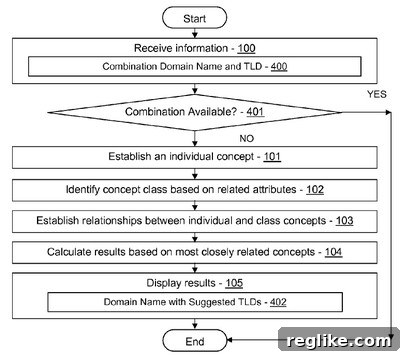
The current invention may use, but is not limited to, ontological based algorithms to calculate and display results (Step 105). These algorithms may be in addition to, but are independent of any synonym-based algorithms. This allows results to be displayed which may include concepts related to the information received and not just synonyms alone (Step 700).
This excerpt from the patent application underscores the core innovation: the implementation of a “sophisticated ontology.” Unlike simple synonym matching, an ontological approach involves creating a structured representation of knowledge within a specific domain. It defines concepts, attributes, and the relationships between them in a comprehensive and hierarchical manner. This allows GoDaddy’s system to understand not just the words themselves, but the underlying meaning and contextual relationships, leading to significantly more intelligent and diverse suggestions.
By leveraging ontological algorithms, GoDaddy’s system can move beyond superficial word associations. It can identify domains that are conceptually related, even if they don’t share direct synonyms. For instance, if a user searches for “eco-friendly car,” a synonym-based system might suggest “green vehicle.” An ontology-based system, however, could also propose domains related to “sustainable transportation,” “electric vehicles,” “carbon footprint reduction,” or “renewable energy mobility,” offering a much richer and more relevant array of choices.
Broadening the Horizon: Diverse Applications of GoDaddy’s Ontology System
The ingenuity of GoDaddy’s patented method extends far beyond merely suggesting better domain names. Its robust ontological framework opens up a multitude of possibilities across various facets of digital marketing and web presence management. The applications detailed in the patents highlight GoDaddy’s vision for a more integrated, intelligent, and user-centric online ecosystem.
-
Optimizing Top-Level Domain (TLD) Recommendations
One of the most compelling extensions of this system is its ability to suggest corresponding top-level domain names (TLDs) with unprecedented accuracy and relevance. Instead of simply offering common TLDs like .com or .net, the system analyzes the concept inherent in the suggested domain name and aligns it with a suitable gTLD (generic Top-Level Domain).
For example, if the core concept of a domain revolves around providing information, the system could intelligently recommend a .info TLD. Similarly, if the domain’s concept is centered on e-commerce or product acquisition, a .shop or .store TLD might be suggested. This intelligent pairing helps businesses choose TLDs that reinforce their brand identity and communicate their purpose more effectively to their target audience.
Furthermore, the system demonstrates an impressive linguistic sophistication. It can identify and suggest appropriate country code domain names (ccTLDs) based on linguistic cues. If the spelling of a word in the domain uses a British English variant (e.g., “colour” instead of “color”), the system could automatically recommend a .co.uk domain, demonstrating a deep understanding of regional linguistic preferences and target markets. This level of detail ensures that businesses can establish a localized presence with ease and precision.
-
Enhancing Keyword Suggestions for Online Advertising Campaigns
The ontological engine also holds immense potential for revolutionizing online advertising campaigns. Even with minimal initial information, such as the primary domain name being advertised, the system can generate a comprehensive list of highly relevant keywords. Traditional keyword tools often rely on direct word associations, which can lead to missed opportunities for reaching niche audiences or capturing intent that isn’t explicitly stated.
By understanding the underlying concepts related to a given domain, GoDaddy’s system can suggest keywords that resonate with potential customers’ broader interests and search behaviors. This leads to more targeted ad placements, improved click-through rates, and ultimately, a better return on investment (ROI) for advertisers. This capability is invaluable for businesses looking to maximize their advertising spend and connect with genuinely interested users across various platforms.
-
Intelligent Content and Advertising on Web Pages
Perhaps one of the most transformative applications lies in its ability to generate relevant content and highly targeted advertising on web pages, including parked domains. Historically, advertising on parked pages has been generic and often irrelevant, relying on basic keyword matching that fails to capture the true intent or context of the domain. GoDaddy’s ontological system aims to change this dramatically.
- Targeted Advertising on Parked Pages: By applying its sophisticated ontology, the system can better interpret the conceptual meaning behind a parked domain name. This allows it to display advertisements that are far more relevant to the domain’s potential purpose or industry, moving beyond simple keyword and synonym analysis. For example, a parked domain like “greenenergyfuture.com” could display ads for solar panels, wind turbines, or sustainable living solutions, rather than just generic energy-related ads. This enhanced relevance benefits both advertisers (higher engagement) and users (more useful information).
- Dynamic Website Content and Navigation: Beyond advertising, the system can dynamically generate content and streamline navigation on active websites. This intelligence can be driven by multiple factors, including the core concepts embedded in the domain name itself, the anchor text of a link that led a user to the site, or other contextual signals related to the page’s concept. Imagine a website where content adapts based on how a user arrived, offering a personalized experience. A user clicking an “organic produce” link to a general grocery site might see their homepage dynamically reconfigure to highlight organic sections, recipes, and related products. This capability promises to significantly enhance user experience, improve engagement metrics, and drive conversions by delivering highly relevant information and pathways within a site.
The Future of Digital Presence and Marketing
GoDaddy’s commitment to innovation, as evidenced by these patents, underscores its leadership in the domain industry and its vision for the future of online presence. By moving beyond rudimentary keyword matching to a sophisticated ontological understanding, GoDaddy is paving the way for a more intuitive, intelligent, and effective digital experience.
These patents represent a significant leap forward, promising not only to simplify the arduous task of finding the perfect domain name but also to create a more relevant and engaging internet for everyone. For businesses, this means more powerful branding, more effective advertising, and a deeper connection with their target audience. For individual users, it signifies a more tailored and less frustrating online journey. GoDaddy’s foresight in leveraging advanced semantic technologies sets a new benchmark for how domain registrars can evolve into comprehensive digital solution providers.
As the digital world continues to expand, the need for intelligent systems that can cut through the noise and deliver precision will only grow. GoDaddy’s patented ontological approach positions the company, and its users, at the forefront of this exciting evolution, promising a smarter, more connected future for all online endeavors.
For those interested in the technical details, the patent documents can be accessed via the links below:
Suggesting Concept-Based Domain Names Patent
Suggesting Concept-Based Top Level Domain Names Patent
Displaying Concept-Based Targeted Advertising Patent